‘NAZA’ director accuses Israeli media of ignoring Gaza civilian deaths for entire war
Amid domestic uproar, Yuval Abraham insists anonymous allegations of intentional harm to innocents were verified; Israel sends diplomats talking points to respond to film; ex-hostage Liri Albag: 'You sold out your own people for people who wish for your death'
The Israeli co-director of a documentary alleging that mass civilian deaths were routinely built into the IDF’s targeting decisions during the Gaza war defended the film’s claims and its framing in his first Hebrew media interview since winning a top award at the Venice Film Festival over the weekend.
In the Monday Channel 13 interview, which frequently turned tense, journalist Raviv Drucker repeatedly cast doubt on how Yuval Abraham and co-director Rachel Szor could have verified the film’s allegations, made by 24 anonymous IDF Intelligence Corps soldiers.
Drucker is one of the few Israelis to have seen the film in its entirety, as it has not yet been made publicly available.
The Channel 13 journalist expressed particular skepticism regarding allegations that the IDF approved strikes it knew would kill hundreds of civilians or that the IDF approved strikes that would have killed hundreds of civilians who did not heed evacuation warnings — even in the absence of a Hamas target. The IDF has denied the allegation.
Drucker said that on multiple occasions, when he would report on soldiers’ testimonies, he found himself unable to verify them or discovered they were inaccurate.
Abraham responded that the allegations in the film were verified, noting that he produced the documentary in partnership with the British publication, “The Guardian,” and that the film’s creators had to take steps to protect the identities of the soldiers.
“This is a Guardian film, made in cooperation with a leading publication, with a staff of editors who had access to the raw materials,” Abraham said. “The identities of the people were verified, the cases they discussed were verified.”
NAZA, Hebrew military shorthand for "collateral damage," is a documentary about AI-assisted targeting and the civilian-casualty thresholds calculated before Israeli strikes in Gaza.
Yuval Abraham, co-director of NAZA, did an interview on Israeli TV with veteran investigative… pic.twitter.com/C2GZM5pw3D
— Max ???? (@MaxNordau) September 14, 2026
The Guardian issued its own statement on Monday slamming the Israel government’s response to the film as “authoritarian,” praising the NAZA directors and pledging to defend the film from “any attacks or attempts at censorship.”
Asked during the Channel 13 interview why the film did not spend more time on the Hamas-led October 7, 2023, attack that launched the war, or the mistreatment of the Israeli hostages held in Gaza, Abraham responded that it did include those topics, and repeatedly challenged Drucker to do more investigative journalism about the war’s civilian toll in the Strip.
“Why didn’t you broadcast?” Abraham asked Drucker. “Three years in the [Israeli TV news] investigative programs, there wasn’t even one item, if I’m not mistaken, that dealt with the rules of engagement in Gaza, that dealt with the collateral damage policy, that researched in-depth the damage to innocent Palestinians’ lives in the Strip.”
“You say [our film] wasn’t complex enough. Okay. So why didn’t you broadcast something complex yourself?” Abraham asked, without getting an answer from Drucker.
Over 73,000 Palestinians have been killed during Israel’s military campaign in Gaza, which was sparked by Hamas’s invasion and massacre of some 1,200 people and the hostage-taking of another 251. The Palestinian death toll is according to the Hamas-run Gaza health ministry, which doesn’t differentiate between civilians and combatants.
The Israeli military believes that Hamas’s overall toll is largely accurate, with IDF officials estimating that two to three civilians were killed for every dead terror operative. The IDF says it has killed over 24,000 combatants in Gaza and another 1,200 terrorists inside Israel during the October 7 onslaught.
El discurso de Yuval Abraham tras ganar el Premio Especial del Jurado en #Venezia83 con #Naza: "La negación de un delito es lo que ayuda a que persista. Y por eso es muy importante para nosotros que los israelíes vean esta película. Es nuestro país el que comete estos crímenes" pic.twitter.com/g56MZs2Vaf
— ???? Jorge Daniel Díaz ???? (@jorgedanieldiaz) September 12, 2026
Asked whether he hopes to screen the movie in Israel, Abraham said, “That’s the goal. We really want to. We’ll do everything possible so that it’s broadcast as widely as possible in Israel.”
Abraham and Szor now face threats of legal action in Israel, including a threat to have their citizenship revoked, and condemnation across the political spectrum. But Abraham said he still considers Israel his home.
“Israel is my home, it’s the place where I want to live, the place that’s so important to me,” he said. “So of course I’m scared that I won’t be able to return. What will I do here, abroad?”
Among the film’s allegations is one, featured in a promotional video of the documentary, that the military planned a strike during the war against Hamas in the Gaza Strip in which 500 civilian deaths had been anticipated. The IDF has denied that claim as “completely false.”
“The IDF has never planned, approved, or carried out a strike in Gaza in which 500 civilians or anything near that number were anticipated to be killed. Nor was any credible claim raised throughout the war suggesting that an IDF strike had caused anything near that number of fatalities,” the military said.
The IDF said that Abraham and Szor “couldn’t possibly verify this claim, there is no real supporting evidence, and yet they published it anyway.”
Yuval Abraham and Rachel Szor look drawn and solemn amid strong applause for Golden Lion Contender ‘NAZA’ exposing Israeli targeting of civilians in Gaza #VeniceFilmFestival pic.twitter.com/hqyzoZhwHM
— Deadline (@DEADLINE) September 10, 2026
Testimony in the film alleges “mass killing on an industrial scale” in Gaza, one of the officers said in a series of anonymous interviews, describing an AI-assisted system that identified targets using data gathered from thousands of hacked mobile phones.
The IDF said decisions on the selection and approval of strikes were made “by human personnel only… and not by artificial intelligence.”
Earlier on Monday, IDF Chief of Staff Lt. Gen. Eyal Zamir instructed the military’s top legal official to examine legal action against the film and those involved in it, saying it defamed the military, and separately ordered an investigation into the leaking of classified material used in its production.
The IDF has not allowed journalists to independently enter Gaza since the start of the war.
Netanyahu, former hostages hit out at Israeli directors
Prime Minister Benjamin Netanyahu joined the chorus of condemnations of NAZA later on Monday.
“We’re fighting worldwide antisemitic incitement, but when it comes from within us, it’s intolerable,” Netanyahu said, before trying to draw a correlation between the film and his political rivals Yair Golan and Gadi Eisenkot, ahead of next month’s Knesset election.
Separately, former hostage Eliya Cohen posted a video lashing out at the two Israeli co-directors.
“NAZA”, a documentary about Israel’s AI-powered mass killing in Gaza, received a 25-minute ovation at the Venice Film Festival.
It features Israeli intelligence personnel and whistleblowers discussing how Palestinians were targeted.
Al Jazeera’s Dmitry Medvedenko reports. pic.twitter.com/6aGRX8w4Ab
— Al Jazeera English (@AJEnglish) September 11, 2026
Cohen said he recognized that Israel is a democratic country and that the law doesn’t allow for them to be arrested for their documentary.
However, he urged the public to hang up signs with the directors’ faces on them so they’ll be forced to walk the streets of Israel “in shame.”
Cohen said the pair smeared IDF soldiers who fought to bring him home from captivity. “People need to spit on them in the streets.”
He argued that the allegations made in the film endanger IDF soldiers as well as Jews in the Diaspora.
Another former hostage, Rom Braslavski, called Abraham and Szor “traitors” who “should be sent to prison.”
Former hostage Liri Albag called for NAZA’s creators to be booted from the country.
“On October 7, if you’d been in the Gaza envelope, none of the terrorists would have stopped to say, ‘Hey, leave him alone, that one’s okay — don’t hurt him,'” Albag wrote in an Instagram post, alongside a photo of Abraham.
“Or perhaps you would have simply joined the ‘struggle for the liberation of Palestine’ and harmed your own people?” Albag wrote. “I initially planned to write “harmed your own blood,” but then I remembered we really don’t share the same blood, and thank goodness for that!!!!!!!!!!”
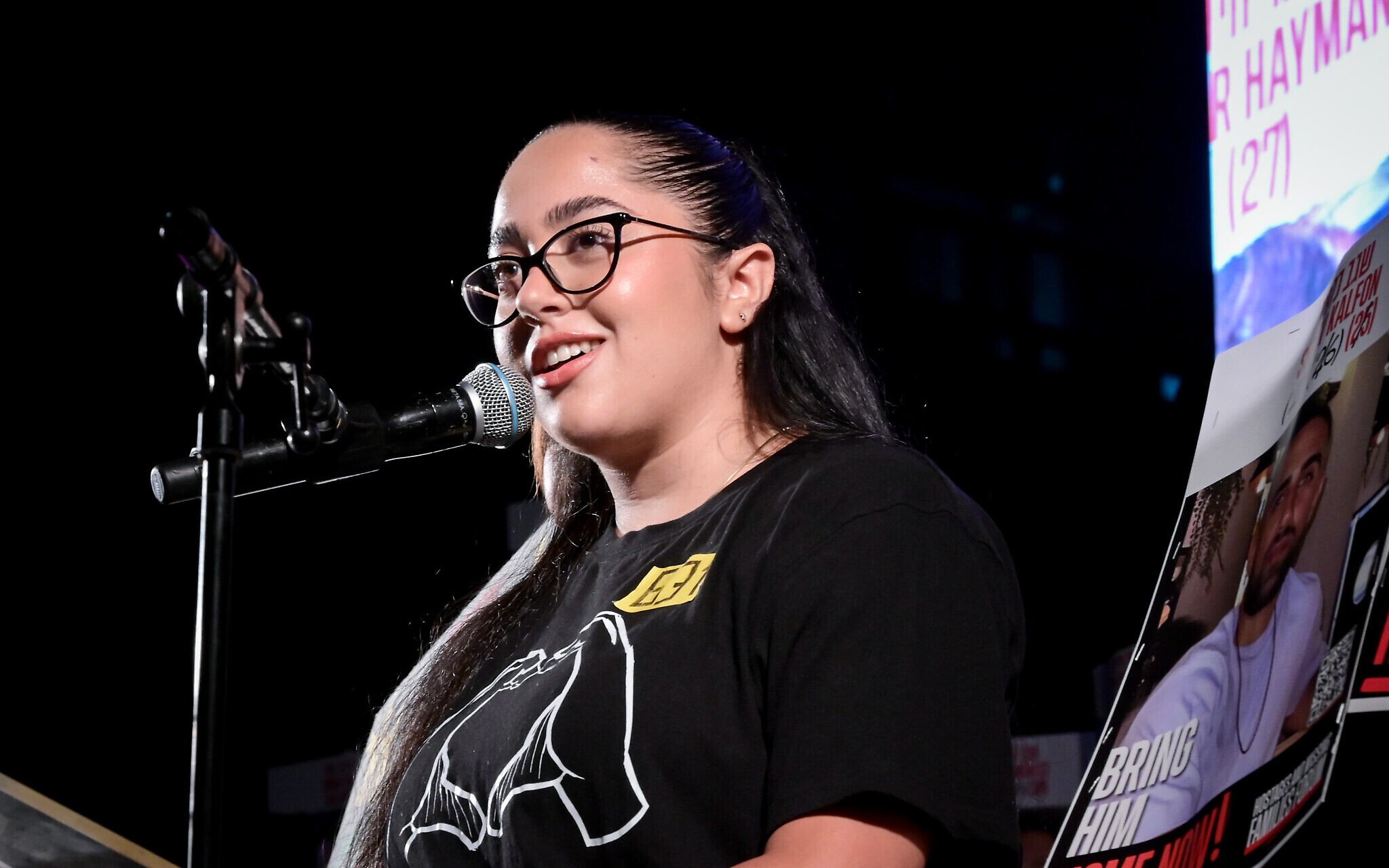
“Disgusting. You sold out your own people for people who wish for your death. And for that, there is no forgiveness,” she went on. “How the hell do people like this have citizenship here?!?!?! Kick them right out of our country.”
700 in film industry come to Naza directors’ defense
As domestic criticism of the film mounted, a large group of professionals in the Israeli film industry sought to demonstrate the existence of an alternative view.
Over 700 of them signed onto a petition that expressed support for Abraham and Szor and called out government efforts to silence or outlaw them.
“We, filmmakers, call upon everyone still fighting for freedom of speech and artistic expression to join in expressing support and solidarity with Rachel Shor and Yuval Abraham, the creators of the film “No Other Land,” the petition read, referencing the pair’s earlier, Oscar-winning film about settler violence and home demolitions targeting Palestinians in the West Bank.
“In recent days, we have witnessed an unprecedented campaign of incitement and vitriol against the filmmakers — a campaign that is dangerously close to effectively sanctioning violence against them and threatening their lives,” the petition said.
Among the signatories were “Waltz with Bashir” director Ari Folman, “In Treatment” (BeTipul) director Hagai Levi, “Our Boys” actor Shlomi Elkabetz, “In Treatment” actress Shira Geffen, and award-winning director Nir Bergman.
The signatories also criticized those who have spoken out against NAZA without having even watched it.
“We hope the film is distributed in Israel soon so that everyone can watch it, form their own opinions, and engage in a genuine, long-overdue discussion about the war in Gaza and its consequences — a discussion that, to date, has barely taken place in Israeli media or society,” the petition stated.
Israeli government sends diplomats talking points to respond to ‘NAZA’ — report
Meanwhile, Channel 12 reported on Monday that Israeli government agencies, including the Foreign Ministry, have been holding intensive meetings to formulate a response to the film. It is unclear if those meetings began in advance of the film’s screening at Venice.
Israel recognizes how damaging the movie is to its standing in the West, according to the network.
Israeli diplomats abroad were sent talking points to guide their response to the film’s allegations.
According to Channel 12, the main messages are: in vibrant democracies, there are always those who publish lies; there is no genocide in Gaza, and anyone who claims there is does not know what the term means; the IDF invests significant resources to minimize harm to civilians; the movie is full of inconsistencies; and the IDF called off hundreds of operations in Gaza out of fear of collateral damage to Palestinian civilians.
Agencies contributed to this report.