NY’s Adam Yauch Park vandalized with swastikas, pro-Trump message
Police investigating incident at Brooklyn memorial to late Jewish Beastie Boy; graffiti removed short time later
A New York park dedicated to the memory of late Beastie Boy member Adam Yauch was defaced with swastikas and a message in support of President-elect Donald Trump.
The two Nazi symbols and the words “Go Trump” spray-painted on a piece of playground equipment were discovered Friday.
New York journalist Jeremy Larson said on Twitter that police were investigating the incident and that the park would be closed until the graffiti was removed.
The park was renamed in 2013 for the late rapper, who died of cancer the year before at the age of 47, just a couple of blocks from where he grew up. Like fellow Beastie Boy members Adam Horovitz and Michael Diamond, Yuach was Jewish. The playground includes basketball courts, a community garden, a greenhouse, a small fitness area, an open play space, drinking fountains and a dog run.
New York City Councilman Brad Lander also said police were investigating and the Parks Department planned to remove the messages. The graffiti was apparently painted over a short time later, according to posts on Twitter.
During this past year, anti-Semitic imagery proliferated on social media, Jewish journalists were targeted and longstanding anti-Jewish conspiracy theories got a fresh airing. Much of the bias originated with the alt-right, or alternative right, a loose group espousing a provocative and reactionary strain of conservatism. It’s often associated with far right efforts to preserve “white identity,” oppose multiculturalism and defend “Western values.”
In addition to the online intimidation, reports of anti-Semitic vandalism and other attacks have risen. Last week, the day after the election, a Philadelphia storefront was sprayed with a swastika and the words “Sieg Heil 2106,” which means “Hail Victory,” a common Nazi chant, and the word “Trump,” with a swastika replacing the “T.”
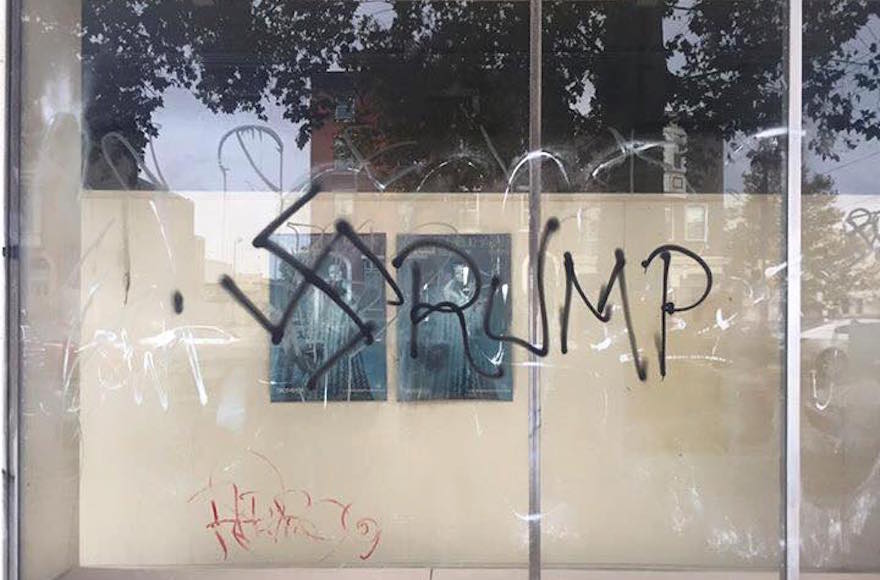
These developments stunned US Jewish leaders, who in recent years had been more focused on anti-Semitism in Europe and on addressing complaints of anti-Jewish bias on college campuses amid the debate over the boycott, divestment and sanctions movement against Israel.
But as the presidential race intensified, Jews started seeing their names bracketed with a series of parentheses in harassing tweets, signaling that the person had been identified as a Jew. The image became known as the Jewish cowbell and its source was traced to neo-Nazis and white nationalists.
Donald Trump’s campaign came under scrutiny since much of the harassment came from accounts claiming to support him.

Trump drew direct criticism last July when he tweeted an image of Hillary Clinton’s face with a six-pointed star, a pile of hundred dollar bills and the words “most corrupt candidate ever.” The star was in the shape of the Jewish Star of David and was widely condemned as anti-Semitic. Trump’s campaign said it was a sheriff’s badge.
Last month, the president-elect gave a speech in West Palm Beach, Florida, in which he accused Clinton of holding secret meetings with bankers in a conspiracy to undermine US sovereignty. The Anti-Defamation League said that whether intentional or not, Trump had reflected a classic anti-Semitic theme of Jewish control of banks.
The president-elect’s daughter Ivanka, and her husband, Jared Kushner, who is now one of his top advisers, are both Orthodox Jews. Kushner has defended Trump against allegations of bias.
The issue erupted anew when Trump announced far-right publishing executive Stephen Bannon as his top White House Strategist. Bannon led the Breitbart website, considered by many to be the alt-right’s platform that has been widely condemned as racist, sexist and anti-Semitic. Trump campaign manager Kellyanne Conway called the accusations against Bannon “very unfair.”
Seventy-one percent of Jewish voters voted for Hillary Clinton in the 2016 race, according to exit polls. ADL’s Greenblatt worked in the Obama administration.