Of rockets, ribbons and the wrath that follows
The army's intense shelling of Gaza Sunday is enough to make the papers take notice, and show that Israel is better at dropping bombs than waving satin
Like a cucumber dropped into a food processor running at high speed, Israel’s summer vacation came to a violent end Sunday with a rocket striking the city of Sderot and a furious response from the IDF, the likes of which has not been seen for years, giving the press something to cover after a news hiatus during which people grappling with each other in robes and spandex and throwing balls and hoops around half a world away were seemingly the only thing going on.
The cross-border flare-up makes front page news in all three major Israel dailies, overshadowing Israel’s rhythmic gymnasts’ disappointing end to the Olympic Games, which surely would have made top story had there not been actual news literally falling from the sky. At least that’s the case among the two tabloids, Israel Hayom and Yedioth Ahronoth, which make it pretty clear there’s not much else in terms of news.
Haaretz, which has apparently not taken the summer off, also manages to break new ground with an exclusive on Israel planning to break new ground for Jewish housing in Hebron, the first in about a decade.
While Israel’s rocket woes usually take precedence over any counterattack at Gaza, the fact that the wave of bombings that scarred the Strip late Sunday night leads the coverage in most cases bears out just how ferocious and unexpected the airstrikes were.
“Wave of attacks across Gaza,” reads Israel Hayom’s headline, writing that things are “heating up” in the south.
But despite the hyperbole and Palestinian reports of dozens of attacks, the paper makes sure to note that the army claims the incident was as unremarkable as Israeli athletes failing to win medals.
“The attacks continued for several long minutes, but at the end military sources said aircraft struck ‘a few’ targets, and this was not an extraordinary attack in terms of scale,” the paper reports.
That may have been the army’s initial message, but it later changed its story to admit the strikes were out of the ordinary, which indeed Yedioth Ahronoth telegraphs with the jingoistic headline “The fire and the punishment.”
For the punishment, the paper reports matter-of-factly that it was out of the ordinary, given that “the IDF usually makes do with “just a strike right after [a rocket attack from Gaza] or at 1 in the morning,” and not both as it did this time. “The attack was the harshest by the IDF in some time,” the tabloid reports as vaguely as possible.
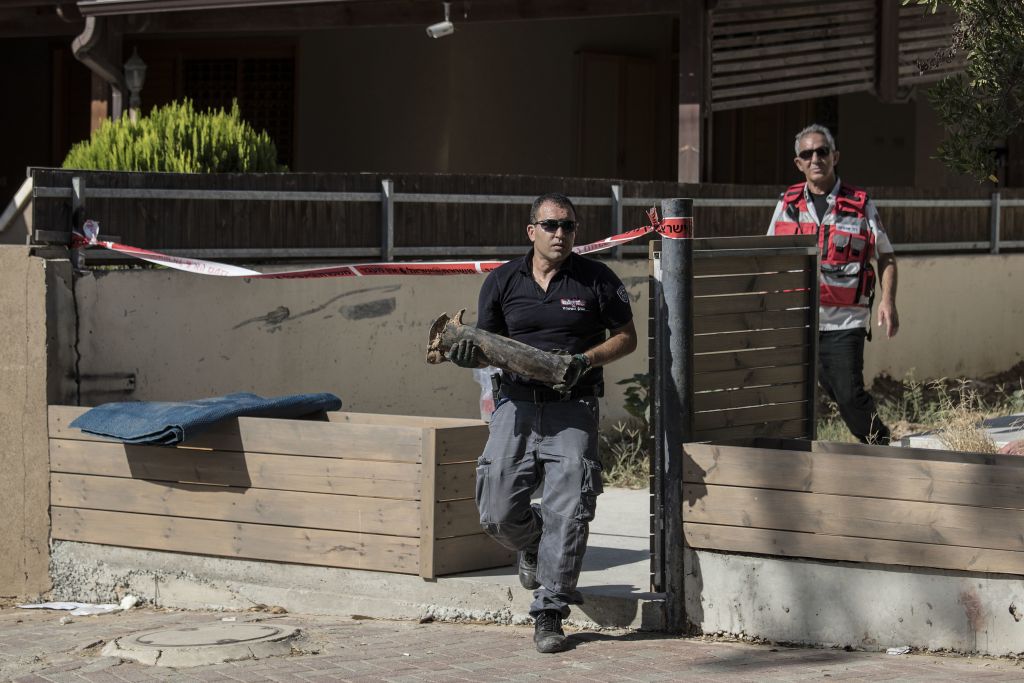
While it has few questions or qualms about the response, the paper has several questions about the rocket fire, such as why didn’t the Iron Dome anti-missile battery shoot it out and does this herald a new war, or at least more rockets.
For residents of Sderot quoted by the paper the answer is clear: Yes. “This is very worrying. It feels like it’s going to get close again,” one is quoted saying.
In Haaretz, Amos Harel explains how the army can shoot more than normal and still claim nothing has changed, noting that the strikes are still in line with Israel’s policy of making sure Hamas knows it is responsible for every rocket out of Gaza, regardless of which group shot it, and that it will pay a strategic price.
Yet Harel also pins the harsher response on Defense Minister Avigdor Liberman, who is known for bombastic rhetoric against Hamas.
“Since being made defense minister, Liberman has toned down his public statements, but he’s gone back to his base position that the Hamas regime needs to fall, and if things descend into a wider military confrontation, Israel will need to act decisively to achieve that goal,” he writes.
Even if Liberman doesn’t achieve his goal, he can always blame someone else. At least that’s the message Israeli readers may take away after reading about Israel’s highly touted ribbon-twirling stars who failed to secure a medal of any kind at the Olympics Sunday despite high expectations and some cool moves, a loss that disgruntled coach Ira Vigdorchik quickly turned into a political squabble.

“The girls competed like they needed to,” she’s quoted saying in Yedioth. “We did everything we could after coming into an arena that was slicked down with ribbons and not fit for practice. You need to remember that we competed without an Israeli judge, like we had in the European and world championships. We kept sixth place and we’ll have to do more to excel in the future.”
Yet Israel Hayom is sure to assure Vigdorchik, the girls (“some of whom could not stop crying,” according to Yedioth) and Israeli readers that sixth place is nothing to be ashamed of.
“On the one hand, you can’t discount the achievement we managed coming in sixth in the world, something just a handful of Israelis in the delegation did. On the other hand, after the medals and achievements of the team in big tournaments in years past, there were grounded hopes for a medal,” correspondent Miki Sagi writes, before signing off with a corny “see you in Tokyo 2020.”

Haaretz leaves the rhythmic gymnasts off its front page, replacing their grace and aplomb with a heavy-handed tale of Israeli plans to expand the Jewish enclave in the divided West Bank city of Hebron, for the first time in something like a decade.
The paper isn’t sure how long exactly it’s been going on, and also isn’t sure on all the details for the plans, which it reports is just now being hashed out and was given the go-ahead by both Liberman and his predecessor Moshe Ya’alon. But given what little it does know, with the land set aside for the project being less than half an acre of Jewish-owned land, one can surmise the project makes up a few homes at most.
“The units are to be built on land now taken up by the Mitkanim military post, considered the center of the Jewish settlement in Hebron, between the Avraham Avinu neighborhood and Shuhada Street, considered a main artery in Hebron,” the paper reports. “The project right now is in early planning stages and its not clear how many units will be built and how much land they will take up.”