On the Gaza border, third anniversary of October 7 revives traumas of war and terror
With 90% of evacuated southern residents back home, they describe relying on strong communal ties amid continuing uncertainty and pain
At Kibbutz Nahal Oz, renovations of the bullet-pocked community club were finished just in time to host the main memorial event for the October 7, 2023, Hamas onslaught on southern Israel.
Entering the hall, with its new kitchen, tables and chairs, the faces of the 16 civilians gunned down by Hamas terrorists smiled out of screens. Further along stood 16 tastefully designed stands, each with objects that reflected the victims’ lives.
Tsachi Idan, 49, kidnapped from the kibbutz and slain in captivity, was a great soccer fan. He was shown holding a beer. In another image, he walked his dog.
The stand for Keshet Zohar, 20, murdered at the kibbutz along with her news photographer father, Yaniv, 54, her mother, Yasmin, 49, and her sister, Tehelet, 18, featured kitchen implements and a poem. Her 13-year-old brother, Ariel, who had gone for an early-morning run, escaped with his life.
Yasmin’s father, Haim Livne, was also murdered in the attack. A lifelong farmer, he was represented by a tractor and a poem.
A TV camera adorned Yaniv Zohar’s stand.
On that devastating day, more than 50 Israeli soldiers and security personnel fell in the battle for the kibbutz and the adjacent army base. Eight civilians from Nahal Oz were kidnapped to Gaza; not all returned alive.
Today, 85% of the survivors are back at Nahal Oz, with the remainder — mainly families with young children — still undecided, according to veteran kibbutz member Danny Rahamim, 72.
From the Gaza border communities in general, more than 90% of the residents evacuated post-October 7 have returned. They describe relying on community in the face of continued national uncertainty, even as potential new members hope to bolster the border towns, three years following the onslaught.
Two new families have already moved into Nahal Oz, Rahamim said, while the waiting list for additional members is longer than the available housing.
“Nobody who has returned regrets it,” said Rahamim, whose wife, children and grandchildren survived the terror onslaught in their protected rooms.
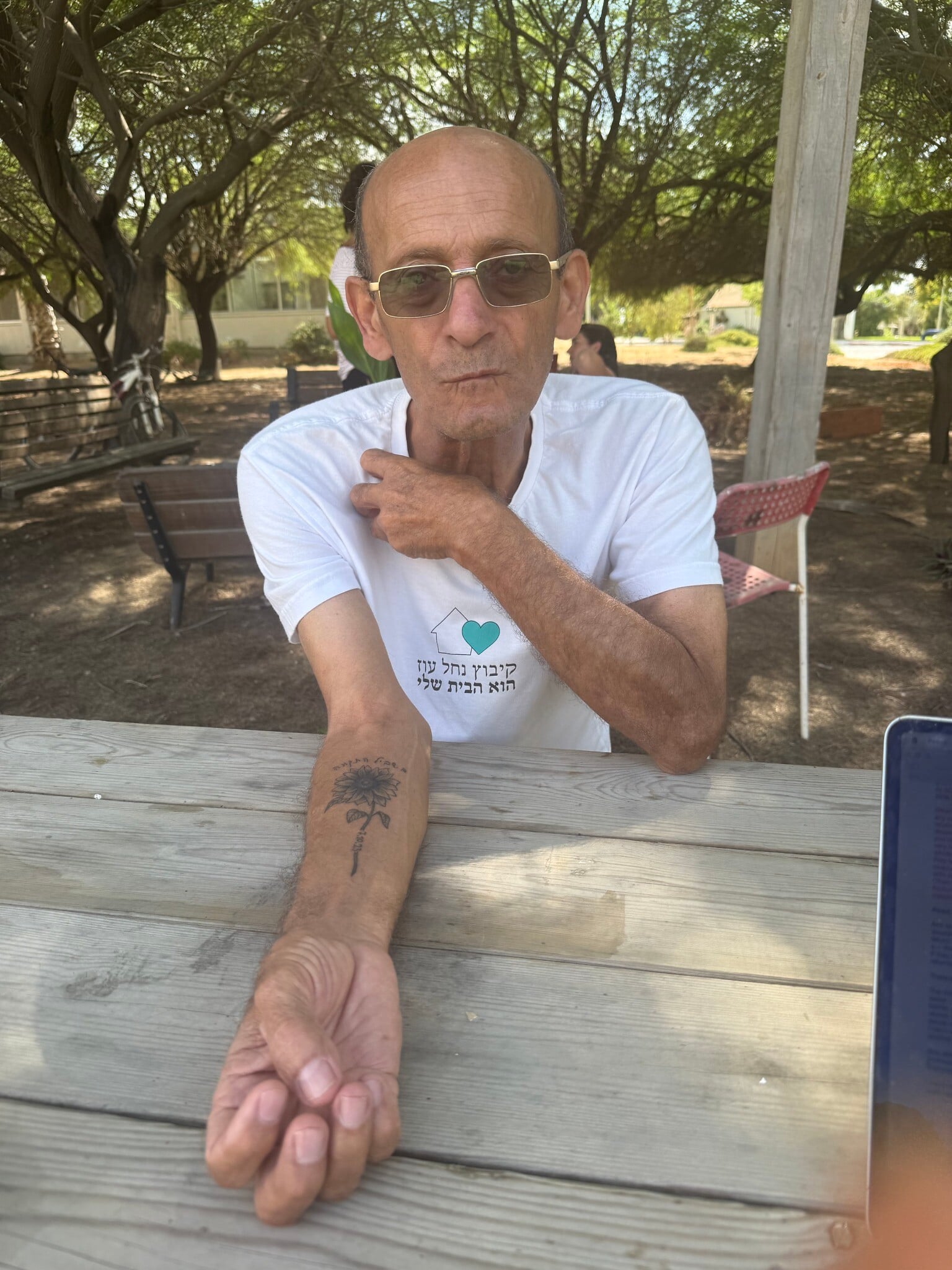
Nahal Oz, the closest of all the border communities to the Gaza fence, is witnessing a burst of physical development. Its lawns and beautifully landscaped paths are manicured, largely thanks to volunteers who maintained the gardens while residents lived in temporary accommodation elsewhere.
But the pain of October 7 is never far from the surface, Rahamim said, showing this reporter a tattoo (“my first and probably my last”) he had inked onto his arm just three weeks earlier.
The tattoo features a sunflower (“a flower that follows the sun”), the date 7.10.23, and the words, “Path of hope.”
“We are here so that hope won’t die, the hope for a different reality,” he explained. “Enough with wars and destruction. As people, we can bring about change.”
The pain of this year’s anniversary was compounded by the upcoming election on October 27 and the government’s refusal to investigate October 7, he went on.
“People want to know how this happened, not to hang someone in the village square but to ensure it never happens again,” he said. “It eats us up from the inside.”
A shared language at Kfar Aza
Some 55 families have already returned to Kfar Aza, one of the worst hit by the terror attack. On October 7, gunmen slaughtered 62 of the kibbutz’s 787 residents (an additional two were killed accidentally by the IDF), and abducted 19 to the Gaza Strip.
Idit and Oded Etinger are among the survivors. However, they will not be going home any time soon.
For now, they are in temporary housing at Kibbutz Ruhama, also in the Negev. Citing the importance of being with the Kfar Aza community, most of which evacuated to Kibbutz Ruhama, Idit Etinger explained, “People understand one another without having to talk.”
During the Hamas invasion, the couple and one of their three children, Shahar, now 28, spent 21 hours in their home’s protected room while terrorists came in and out of the house, scrawled on the walls, ate from the fridge, patrolled on the roof, and fought IDF soldiers outside. The safe room’s handle apparently got stuck on a closet Idit had shoved up against the door. After trying to enter twice, the gunmen miraculously gave up.
Eleven immediate neighbors were murdered that day.
After a spell away from their community, the couple decided to move to Ruhama along with 70 percent of Kfar Aza’s survivors, having been part of the kibbutz for 30 years and playing active roles in its management.
However, Oded, the son of an Auschwitz survivor, feels unable to go back at this stage. Etinger pointed to her “therapy” plants, some in pots, others in the earth. “Like them, we’re also in between,” she said. “My husband is my priority.”
State funding for Kfar Aza evacuees’ rent will end in July.
“We don’t know what the future will bring,” Etinger said.
The weight of memory
The difference between the third anniversary of October 7 and the second was that all 251 hostages taken by Hamas had been returned, Etinger noted.
“A lot of energy went into campaigning for their release,” she said. “Now, there’s more space for the grief and trauma. As time passes, people are thinking about where to go permanently. More of them are managing to pick themselves up and show up at the memorials. Yesterday, we were at three of them.”
Some kibbutz members had lost everyone but remained active and involved, she said, citing Uri Epstein. He heads the Sha’ar HaNegev Regional Council, following in the footsteps of his brother-in-law, Ofir Libstein, who was murdered defending Kfar Aza on October 7. On that day, Epstein also lost his son Netta, another brother-in-law, Uri Russo, his mother Bilha, and his nephew Nitzan.
Others are completely broken, Etinger went on, and many are sick, “as their bodies speak.”
“I can’t process and put it all behind me,” she continued. “Oded put it aside and took to running more than previously. It’s only over the past 12 months that he’s begun therapy.”
After October 7, Etinger quit her job running social services at the Bnei Shimon Regional Council. However, she continues to train therapists and to help couples and families from a clinic at home, having added trauma therapy to her toolkit.
Etinger sees how October 7 has compounded relationship problems that already existed, particularly among couples with small children.
“Disagreements about whether to go back (to the Gaza border) are very common,” she said. “When you live on a kibbutz, it’s frightening to break everything up. But when you’re a refugee, and the ground beneath you is unstable, you begin to consider things anew. Not every partner is able to understand the difficulty the other feels about returning.”
Triggers for a different trauma
For the Tzori family, who moved into their new Kibbutz Ruhama home in February, the October 7 ceremonies are triggering trauma from a different event — the Bondi Beach shooting in Australia in December.
A Jewish Agency emissary for the Progressive Movement, Hadar Tzori, now 37, had taken the oldest two of her four daughters to the Hanukkah candle lighting festivities when Naveed Akram and his father Sajid opened fire on the revelers, killing 15.
Carmel, 8, was shielded by her mother’s body while crawling to shelter under a plastic table during the Bondi Beach shooting. Later, Hadar and Carmel looked for Yarden, 10, for a terrible 19 minutes until she was found alone after running toward the sea.
Kibbutz Ruhama is hosting evacuees from Kfar Aza, and Kfar Aza children go to school with the Tzori girls. So when Carmel tells classmates from Kfar Aza what happened that day, she knows they understand.
Carmel’s teacher told Tzori how the children compare stories. Said Tzori, “One says, ‘They burned my house,’ and Carmel says, ‘A terrorist shot at us,’ and then they talk about which is worse!”
The Bondi Beach experience has left deep scars. With preparations underway for an October 7 memorial ceremony at a regional school full of Gaza-border pupils, Yarden wanted to stay home on the day this reporter visited.
“Our kids know about October 7 because we were ‘the war emissaries’ in Australia,” said Tzori, a social worker. “The only time I didn’t talk about October 7 was during vacation visits to Israel. Now, anything to do with death is hard for them.”
While the girls are terrified of guns, Hadar’s trauma is triggered by the grass in front of the communal dining room because it was through the grass that she and Carmel crawled to escape from the Bondi Beach attack.
She added, “Even the booms we hear at night from Gaza make us jump.”