Lebanon’s trash could be Hezbollah’s treasure
As thousands take to Beirut's refuse-strewn streets to demand change, the Shiite group is looking to hijack popular discontent
It’s hard to imagine a better scenario politically for Hezbollah.
Tens of thousands of young Lebanese — Sunnis, Christians, Druze and others — take to the streets of Beirut and demand the removal not only of trash but also of the old political elite.
“Change the system,” they call.
It’s the same demand that Hezbollah has been making for more than two decades — a demand long written off by Lebanese, who attributed sectarian intentions to the Shiite organization’s call for reform and viewed it as influenced by Tehran.
But the garbage crisis overwhelming the streets of the capital, spotlighted by all those young demonstrators hailing from a broad spectrum of Lebanon’s ethnic and religious groups, points to just how bulky and corrupt the old system of governing is.
The system is based on the 1943 National Pact and further propagated by the Taif agreement of 1989 that ended the civil war there.
Make no mistake: Hezbollah is currently part of the government and part of the political system. But the group finds it convenient to utilize the trash crisis to highlight the many difficulties “the system” causes — silencing of dissent, corruption, and lack of state authority.
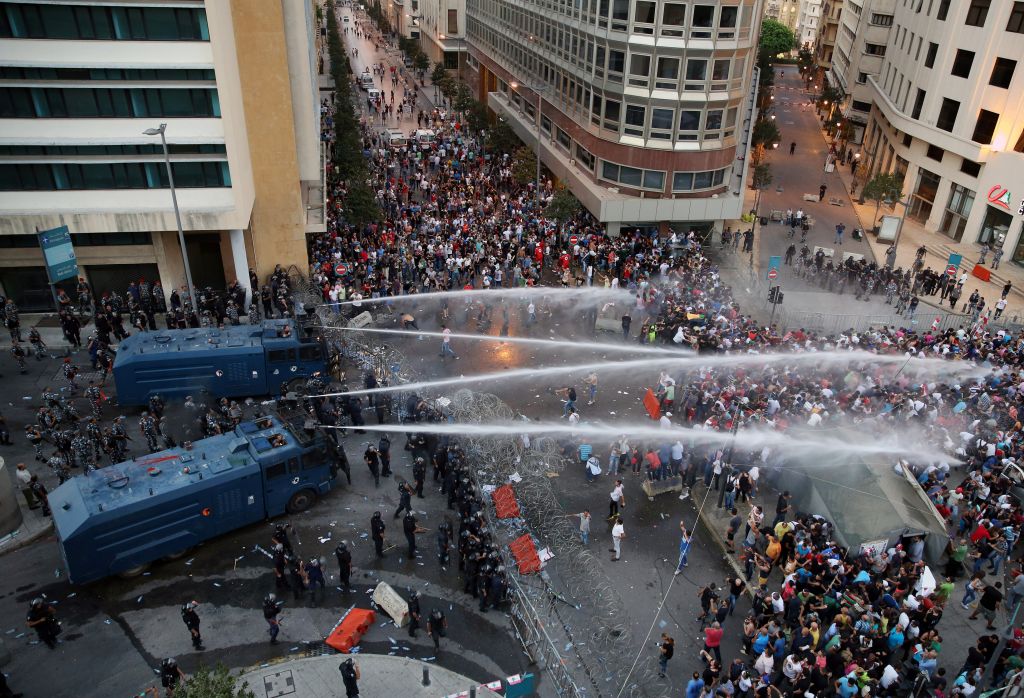
The most obvious example of Hezbollah’s strong desire to exploit the garbage protest occurred last week when Environment Minister Mohammad Machnouk presented the government’s proposal for emergency removal of rubbish.
Hezbollah cabinet ministers got up and left the cabinet meeting midway through, calling it a “farce.”
Lebanon’s inter-sectarian pact is supposed to ensure distribution of the country’s most desirable public offices along ethnic and religious lines. In practice this means a Christian president, a Sunni prime minister and a Shiite parliament speaker. Even other positions such as the military’s top general (Christian) are supposed to be staffed according to ethnic affiliation.
But in recent years, Hezbollah was able to create a blocking majority with enemy-turned-ally Michel Aoun, head of the Maronite Christian “Free Patriotic Movement,” who served as Lebanon’s former prime minister, acting president and army commander.
And since then the country has been almost completely paralyzed.
There is no president and the parliament is unable to agree on a successor; the government is tottering but there is no replacement; and parliament’s governing term has been extended again and again because of the country’s inability to hold elections.
In recent years, Lebanon has effectively ceased to function as a state and has instead turned into a vassal state of the Hezbollah organization.
Yet Hezbollah has lost its support in Lebanon because of its involvement in Syrian civil war as a backer of President Bashar Assad.
It is doubtful whether the garbage crisis can return it to its former glory, as Hezbollah Secretary General Hassan Nasrallah will continue to be perceived as an Iranian emissary.
But failure to remove the refuse lining the streets of Beirut will at least cause great harm to the group’s traditional enemies at home, and may possibly lead to a change in the electoral system, just as Hezbollah wants.