Opposition to put up fierce fight against bill to expand cabinet
MKs to submit 'thousands' of objections after amendment passes first Knesset hurdle by 61-59; second, third readings expected Wednesday night
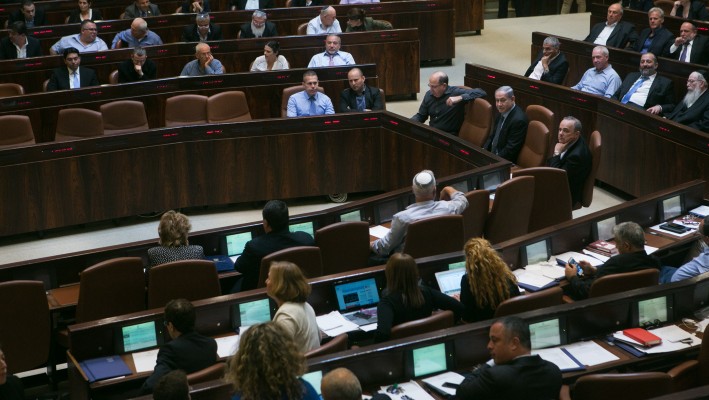
A Knesset bill allowing Prime Minister Benjamin Netanyahu to appoint more than 18 ministers to his cabinet is expected to go to second and third readings on Wednesday night, having passed a first reading Monday by a slim majority of 61-59. The opposition is set to put up a fierce fight against the bill, and submit numerous objections to the amendment on Tuesday.
The first reading was a first test for Netanyahu’s emerging government coalition, made up of the Likud (30 seats), the center-right Kulanu (10 seats), Jewish Home (eight) and the two ultra-Orthodox parties Shas (seven) and United Torah Judaism (six).
All 120 MKs were present in the Knesset plenum during the vote, and all 61 members of the coalition voted in favor of the proposal to freeze implementation of an earlier amendment to a constitutional law that capped the number of government ministers at 18. The amendment to Basic Law: Government was approved in the last government — effectively limiting the cabinet to 19 members, including the prime minister, plus four deputy ministers, and outlawing the institution of ministers without portfolio — and was touted at the time as a major reform.
Netanyahu has said he seeks to increase the cabinet by two ministers and four deputy ministers. Delaying implementation of the 18-minister limit would enable the prime minister to hand out additional portfolios to satisfy the demands of his own party members who missed out on cabinet positions that were given to coalition partners.
The opposition, led by the Zionist Union’s Isaac Herzog, is expected to submit thousands of objections to the amendment on Tuesday, according to Haaretz, having held out for five hours of fierce debate Monday night before Knesset Speaker Yuli Edelstein, a Likud member, insisted the vote be held.The opposition had earlier promised to stage filibusters to block the vote.
The Knesset also voted 60-58 Monday night to set up a committee to advance the bill and prepare it for its second and third readings. The committee is made up of six coalition members and five opposition members, according to Israel Radio.
Netanyahu is then expected to swear in his new government on Thursday but may delay until next Monday.
The prime minister was roundly criticized for the proposal by members of the emerging opposition.
Herzog slammed Netanyahu for not finalizing a government two months after national elections were held on March 17 and for wasting public funds on “gifts” to coalition members.
“Twenty million shekels for every [coalition member]. Netanyahu is breaking all records of cynicism imaginable,” Herzog wrote on Facebook.
The Labor leader called on coalition members to cancel their agreements with Netanyahu.
“A government of 61 [members] will not last. We [the opposition] will not let you lead. You will not be able to function,” he vowed, adding that Netanyahu spent billions of shekels on building a “weak” coalition, funds that could have gone to the education health, or defense budgets.
“There is an opportunity to prevent the establishment of a terrible government for Israel,” Herzog said. “I don’t intend to help him establish a government of 61, but to replace him. If not in this Knesset, then in another round of elections.”
Yesh Atid Chairman Yair Lapid also slammed the proposed cabinet expansion in remarks he made in the Knesset debate before the vote. During his term in the cabinet in the previous government, Lapid had helped push into law the restriction on the number of ministers.
“A year ago I sat at the government table, opposite the prime minister, and we voted on the law to reduce the government. And the prime minister raised his hand in the air,” Lapid recalled. “Afterwards, we came down here to the plenum and voted once, twice, three times [to approve it].”
With the Knesset poised to effectively reverse that legislation, Lapid lamented that “the public says to itself that laws are just a game and no one needs take seriously any law that is passed.”
Former foreign minister and Yisrael Beytenu head Avigdor Liberman, who refused to join the coalition after citing his objections to deals signed with other partners, also took a shot at Netanyahu, pummeling him in comments he made at the start of his party meeting. He said he had rejected the prime minister’s recent offers, which included the much sought-after defense portfolio.
“I have more friends among Likud ministers and activists than Netanyahu has,” Liberman taunted. He also dismissed recent accusations by Likud officials and the media that he had misled his voters by siding with the opposition, against all expectations.
“The man who really cheated the voters was Netanyahu,” Liberman opined. “There is no doubt that the man cheated, lied… to voters from the former Soviet Union. All the things he said about helping to absorb new immigrants — there is no trace of that in any of the coalition agreements.
Liberman’s resignation left the much-coveted Foreign Ministry portfolio free, an office Netanyahu is expected to give to a member of his Likud party.
In response to the criticisms, the Likud party accused the opposition of “hypocrisy” in a statement released shortly after the vote, and defended the financial costs the expansion of the cabinet would incur.
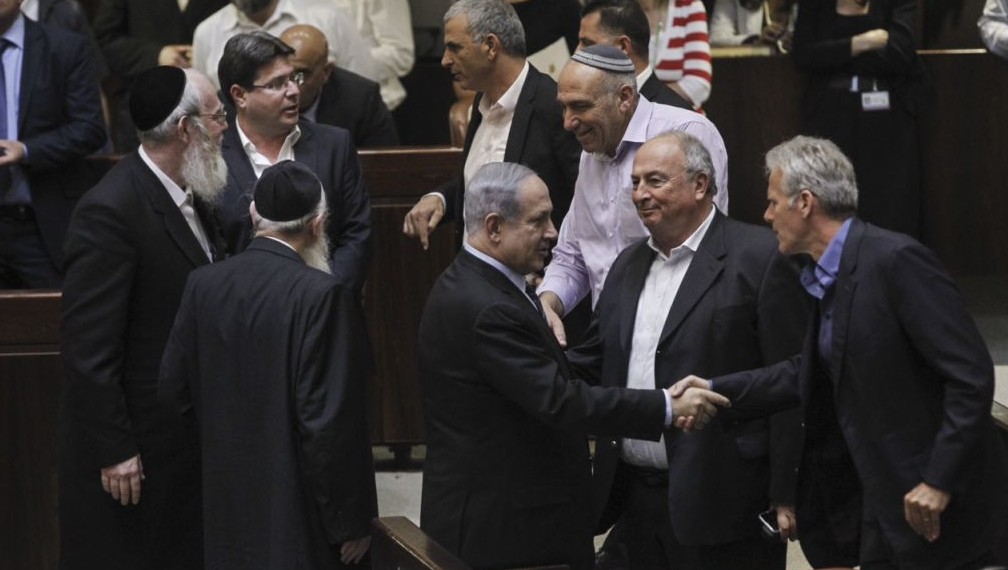
“The incoming cabinet will be smaller than the outgoing one, which had 22 ministers. The expansion of the cabinet will save public funds since it will improve the government’s stability,” the party said. The costs “are negligible compared to the billions wasted when the government goes to elections every two years,” continued the statement.
The Likud said Netanyahu would begin negotiations with party members for the ministerships as soon as the bill passes the second and third readings.
Under coalition deals with his respective partners, Netanyahu agreed to hand over the finance, environmental protection, and housing and construction portfolios, as well as the leadership of the Israel Land Administration to Kulanu; the Economy Ministry, the Ministry for the Development of the Negev and Galilee, the post of deputy finance minister and the chairmanship of the Knesset Education Committee to Shas; the education ministry, justice ministry, and agriculture ministry to Jewish Home; UTJ’s Yaakov Litzman will be handed the Health Ministry and appointed its deputy minister, MK Meir Porush will be appointed deputy Education Minister and MK Moshe Gafni will head the powerful Knesset Finance Committee.
Under the coalition deal with UTJ, several major reforms drafted by the previous government, aimed at integrating the ultra-Orthodox community into Israeli society, will be frozen, including aspects of legislation to phase Haredim into mandatory military or national service. There will, for instance, reportedly be no criminal penalty for non-conscription of yeshiva students. Reforms to ultra-Orthodox education and the conversions process will also be rolled back
AFP contributed to this report.