Pence: US will ‘never’ allow Iran to threaten Israel with nukes
At Munich Security Conference, vice president says nuclear deal has provided Iran with more resources to focus on state-sponsored terrorism
US Vice President Mike Pence said Saturday that Washington was committed to ensuring Iran could never threaten Israel with nuclear weapons.
Speaking at the Munich Security Conference, Pence called Tehran “the leading state sponsor of terrorism” and said it continued to destabilize the Middle East.
“Thanks to the end of nuclear-related sanctions under the [nuclear deal] Iran now has additional resources to devote to these efforts,” he said.
“Let me be clear again: Under President Trump the United States will remain fully committed to ensuring that Iran never obtains a nuclear weapon capable of threatening our countries, our allies in the region, especially Israel.”
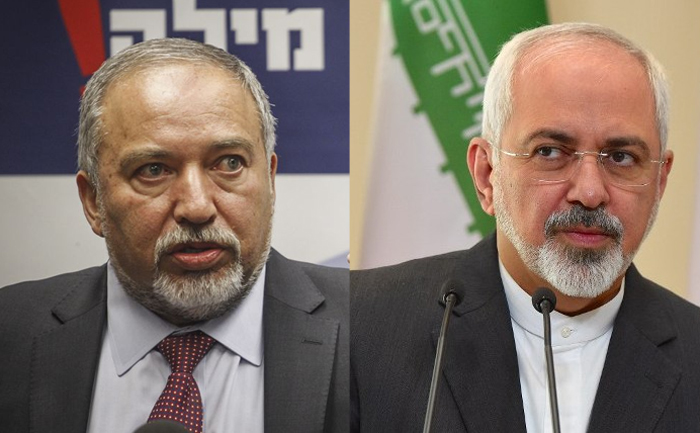
Organizers of the conference had on Friday rearranged the agenda for their Sunday morning sessions, which would have seen Israeli Defense Minister Avigdor Liberman share a panel with Iran’s Foreign Minister Mohammad Javad Zarif.
Liberman and Zarif were set to be two of four participants in a session entitled “Old Crises, New Middle East?” The Israeli minister stated that he was looking forward to the meeting, saying he hoped Zarif would stay in the room to hear “exactly what I think about the ayatollahs’ regime in Tehran.”
However, organizers cancelled the 9:45-11:05 a.m. session, and replaced it with a series of separate statements, with Zarif now set to speak an hour before Liberman, and another panel discussion in between them, leaving no likelihood of the two men encountering each other.
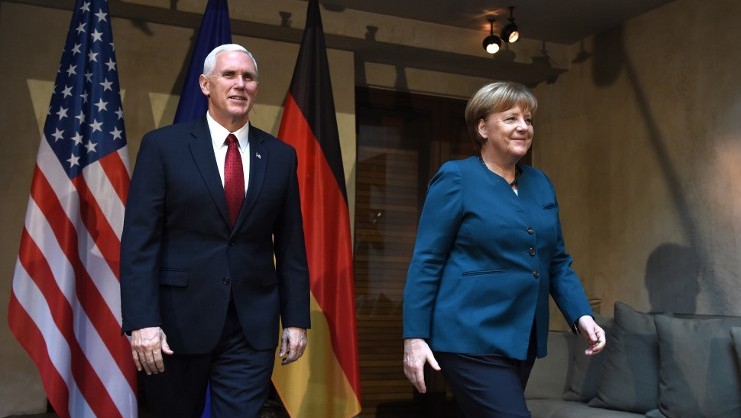
Pence Saturday pledged an “unwavering” commitment to transatlantic ties, in an emphatic reassurance to allies including German Chancellor Angela Merkel who pleaded with nations not to go it alone.
Capping a week of whirlwind diplomacy by American officials who have descended on Europe to calm nerves rattled by Donald Trump, Pence underlined the United States’ devotion to its old friends.
“The United States is and will always be your greatest ally. Be assured that President Trump and our people are truly devoted to our transatlantic union,” he told European leaders including Merkel at the conference.
“The promise to share the burden of our defense has gone unfulfilled for too many, for too long and it erodes the very foundation of our alliance,” he warned, stressing that “the time has come to do more”.
At the same time, he did not go further and threaten, as Trump had done, to walk away if the allies failed to pay their way.
The US, he said, will boost defense spending significantly, “to defend our nation and our treaty allies from the known threats of today and the unknown threats of tomorrow”.
“We will meet our obligations to our people to provide for the common defense, and we’ll continue to do our part to support our allies in Europe and in NATO,” he said.
Trump’s criticism of NATO as “obsolete”, his praise for Britain’s decision to leave the European Union as well as his softer approach towards Russia unnerved Washington’s allies.
But over the past week in Europe, key members of his administration have pressed the message that the United States is not retreating into isolation but remains committed to its global role.
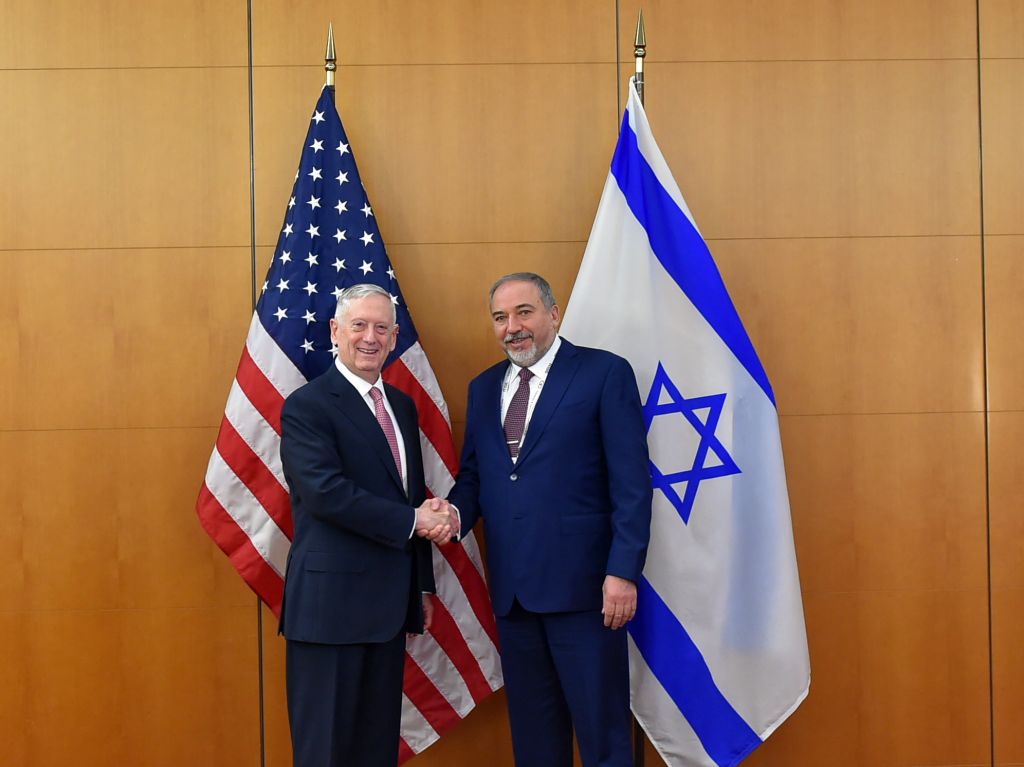
At NATO in Brussels on Thursday, Defense Secretary James Mattis said Russia must first “prove itself” and respect international law before there can be any improvement in relations strained to breaking point by Moscow’s Ukraine intervention and annexation of Crimea.
Mattis said the transatlantic bond was “as strong as I’ve ever seen it”, and stressed America remained “rock solid” in support of Article 5 — NATO’s core “one for all, all for one” collective-defence tenet.
Likewise, Secretary of State Rex Tillerson was cautious in his dealings with Russia.
Following his first sit-down with Russian Foreign Minister Sergei Lavrov in Bonn on Thursday, Tillerson said the US would cooperate with Moscow but only when doing so “will benefit the American people.”
Exasperated and worried by Trump’s calling into question long-standing foreign policy givens, Europe’s top politicians have warned Washington not to take transatlantic ties for granted.
They work both ways, they said, and benefit the United States as much as Europe.
Merkel on Saturday warned countries not to retreat from the international cooperation which she says is the only way to solve global problems.
“In a year in which we see unimaginable challenges we can either work together or retreat to our individual roles. I hope that we will find a common position,” she said.
This includes working not only with Western partners, but also with Russia if possible and if Moscow once again respected the sovereignty and territorial integrity of other states such as Ukraine, she said.
She said it was “regrettable” that Europe had not managed to reach a stable relationship with Russia over the last 25 years.
“I will not give up on finding a way for better relations with Russia despite our different views on many questions,” she said, hours before Russian Foreign Minister Sergei Lavrov was due to address the forum.
Judah Ari Gross contributed to this report.