Prisoners aplenty
26 former Palestinian prisoners go free amid peace talks between Israelis and Palestinians
Twenty-six Palestinian prisoners were released from Israeli prison Tuesday as a precursor to the restarted peace negotiations, and the press takes stock of the situation.
Maariv writes that 14 of the released men were transferred to the Erez border crossing with the Gaza Strip for deportation to the Hamas-controlled territory. Twelve others were sent to Ofer Prison near Ramallah, then handed over to the Palestinian Authority. The paper reports that the decision to release the prisoners late at night was made by senior Israeli politicians “with the aim to prevent joyous celebrations that would likely harm the feelings of Israeli families” whose kin were killed by the prisoners.
Yedioth Ahronoth offers some colorful description of the release from Ayalon Prison in central Israel and reports that “at the same time that the prisoners were making their way toward freedom, the residents of Sderot sat in shelters.”
“A red alert siren was heard [Tuesday] around 9 p.m. in the Sha’ar Hanegev regional council. The rocket fell in open area,” the paper reports. Unlike Maariv, the paper reports that 15 prisoners were dispatched to Gaza and 11 to the West Bank.
Israel Hayom, with the headline “Released, with a heavy heart,” reports that the prisoners’ release came after an appeal by Almagor — a terror victims association — was turned down by an Israeli court. The paper quotes the Israeli judges’ decision, which said that it saw no case to change previous court rulings on the matter of releasing prisoners.
Astonishingly, the story doesn’t make the front page on Haaretz, which suffices with a picture. Buried inside, beneath reports on violence in Russia and the renewal of talks in Ramallah on Wednesday, the paper notes the release of the prisoners. Like the rest of the papers, it reports that the prison trucks bearing the Palestinians had blacked-out windows and that celebrations were on hold in the Palestinian territories until late at night. Of the 26 released Tuesday night, only two were Hamas card-carriers, and the overwhelming majority belonged to Fatah.
As for the negotiations, which are set to reconvene in Jerusalem, the press reports that Justice Minister Tzipi Livni and prime minister’s special envoy Yitzhak Molcho are set to meet with Saeb Erekat and his delegation on Wednesday. Israel Hayom cites a senior political source saying that the two sides will continue to lay out the guidelines of talks that they began to set out in Washington.
Israel Hayom plays down what Yedioth Ahronoth calls US Secretary of State John Kerry’s “strong threat” to Prime Minister Benjamin Netanyahu as reported in Bloomberg.
According to the report, Kerry said that if negotiations between the Israelis and Palestinians break down and fail to yield a political agreement, the US will not be able to prevent international condemnation of Israel.
Haaretz also reports that Kerry spoke to Netanyahu and Livni by phone and expressed concern over the recent approval of settlement construction, which he said was contrary to an agreement to rein in development over the Green Line during the peace talks. He urged Israel to check these construction projects.
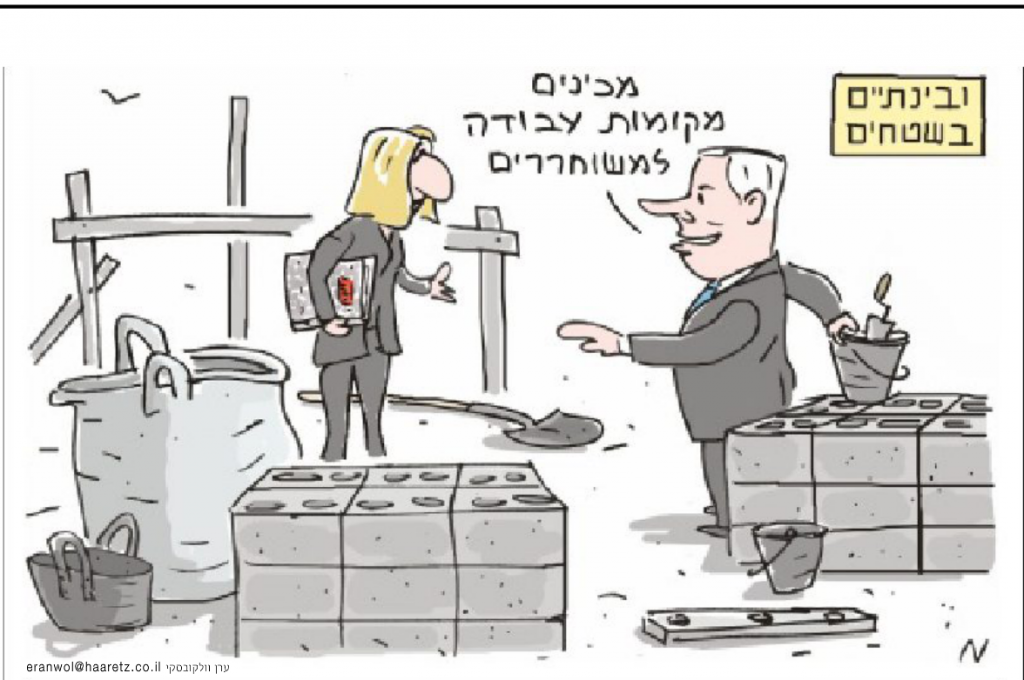
The paper’s political cartoon shows Netanyahu and Livni standing amid construction material. Captioned “meanwhile in the territories,” Netanyahu says to Livni: “We’re preparing workplaces for the released [prisoners].”
Even though it’s two-day-old news, the recent security flare-up in the southern resort town of Eilat takes top billing in Yedioth Ahronoth. The paper headlines its top story: “Eilat in the jihad crosshairs.” Monday’s rocket fire intercepted by the Iron Dome over the Red Sea town is a source for concern in the security establishment, who fear it could spell an escalation of violence from Sinai, it reports.
“The concern is that global jihadist organizations in the Sinai recognized the southern resort town as Israel’s vulnerable point, and decided to turn it into a target,” Yedioth Ahronoth reports.
Shortly after the interception, an Islamist group in the Sinai called the Mujahideen Shura Council of Jerusalem took responsibility for the attack and said it was in response to the targeted assassination of a terror cell in the Sinai by Israel last week.
Maariv reports that the IDF intends to keep the Iron Dome battery stationed in Eilat for the next several months as a precautionary measure.
Despite the heightened pressure, both Israel Hayom and Yedioth Ahronoth run stories on how tourists are nonetheless flocking to the Red Sea resort town to escape the city and catch some surf and sun.