Pundits wade in as Putin’s pullback takes world by surprise
What is the Russian president up to? Israeli dailies are heavy on analysis, short on definitive conclusions
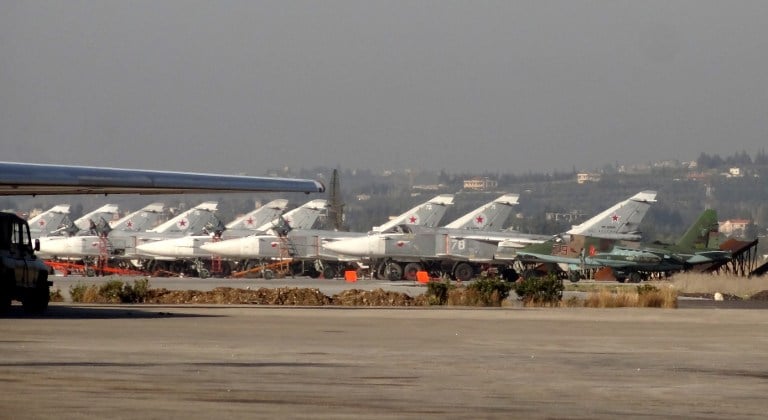
Russian President Vladimir Putin takes center stage in Israel’s dailies on Tuesday, leading the front pages of every major newspaper with column after column about his surprise announcement on Monday of a Russian troop withdrawal from Syria.
Putin ordered a partial pullout and voiced hope that it would contribute to the success of Syria peace talks that began earlier in the day.
The move, which caught everyone by surprise, is a gift for Israel’s Middle East and Arab affairs pundits, who, after months of repetitive analysis of the messy Syrian quagmire, produce hefty articles on the possible consequences of the move for the region and for Israel.
Haaretz leads its front page with the headline, “Putin orders the army to pullout from Syria: ‘We have achieved our goals,'” setting up military analyst Zvi Bar’el to question what Russia had hoped to achieve in the first place and what its new aims will be.
“… because Putin never actually spelled out what the objectives of the Russian military intervention were, and because most of his military attacks were aimed at the opposition forces and not the Islamic State group, only he can determine what constitutes success and when it was achieved,” writes Bar’el, drawing a comparison to the US withdrawal from Iraq in 2011 and Afghanistan in 2014.
“It seems Putin recognized that the Russian air force could not achieve more than what it already has without the assistance of Russian ground forces; that Russia’s policy influence on Syria is assured in any event; and that it was time to implement the Russian plan to divide Syria into districts that would be united under a federal regime – a plan that Russia can only advance if it looks like a friend to all the parties,” he concludes.
Laying out the possible scenario that Russia could return its troops with ease — a claim bolstered by Syria’s state news agency quoting President Bashar Assad as saying that the Russian military would draw down its air force contingent from Syria but won’t leave the country altogether — Bar’el presents Putin’s plan as a calculated move to ensure Russian control over Syria by entrenching the stalemate he has encountered.
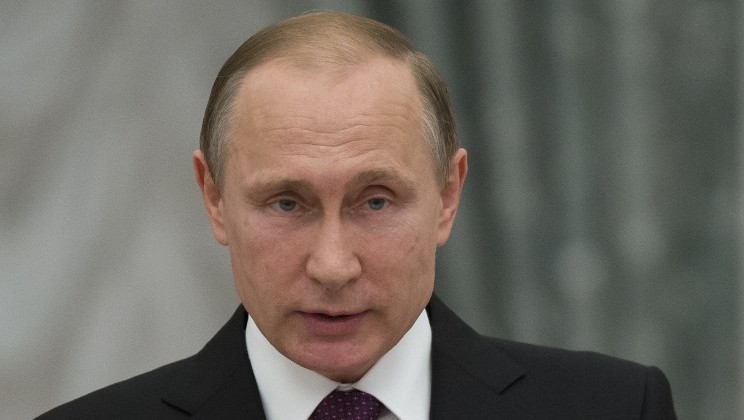
The front page of Yedioth Ahronoth shouts simply, “The withdrawal,” next to a smug-looking photo of the Russian leader. But the paper’s coverage is not void of nuance, featuring lengthy pieces by Arab affairs correspondent Smadar Perry — “Leaving Syria” — and military analyst Alex Fishman — “The smell of a deal.”
Perry agrees with Haaretz’s Zvi Bar’el, writing that in the same breath that Putin announced the withdrawal from Syria he made it clear that Russia would be holding onto its strategic assets in the country.
Nonetheless, she says the announcement may encourage other forces in the region to reengage in the Syrian battlefield.
“It will be interesting to see if now Assad will succeed in persuading Iran’s Qassem Suleimani to return the Revolutionary Guard to Syria, if Tehran will give orders to Hezbollah to increase its troops in Syria, and what Islamic State and the other fundamentalist militias in Syria and now planning,” writes Perry.
“But in any case,” she concludes,” even if the soldiers are packing up and getting on planes, the Russians are not leaving Syria; they are simply diluting their military presence.”
Fishman suggests that despite the seemingly unexpected announcement, a number of factors point to a carefully planned deal with other countries — possible Saudi Arabia, perhaps the United States, he muses — to bring about the Russian withdrawal.
“In order to stop the plummeting oil prices so badly hitting Russia, the (Russians) need to do Saudi Arabia a small favor: bring them Assad’s head on a plate. The US sanctions can also be dealt with easily, by paying the small price of limiting their involvement in Syria,” he writes.
In Israel Hayom, Eyal Zisser, a professor of Middle Eastern History at Tel Aviv University, offers some context in his piece headlined “Just before Afghanistan II,” arguing that Putin’s reasoning is as simple as it seems — he doesn’t want to get bogged down in a long, unwinnable war.
“The bottom line is that the Russians failed to vanquish the Syrian uprising. Despite sustaining considerable damage, the Syrian rebels are far from defeat or surrender. Putin apparently came to this realization and chose to pull out before Syria becomes Russia’s second Afghanistan. Thus Putin, the Russian czar, is learning that not every problem can be solved with force, and that even a powerful ruler like himself has his limitations,” he writes.
Israel Hayom’s Dan Margalit, writing on whether the move could benefit Israel, says that because we don’t yet understand Putin’s motives, we cannot yet answer the question, “Is this good for the Jews?” He also takes pot shots at those who claim to know what the Russian president is up to.
Just like when Russia went into Syria, word of its departure leaves Israel worried and anxious, he writes. “At first, Israel was concerned by Russia’s intervention, but the coordination mechanism (between Jerusalem and Moscow) that was established put Israel at ease. So now, Israel is watching with some uncertainty as Russia leaves the scene.”
“If Israel now finds itself under fire again from Iran and Hezbollah, it will have greater freedom of action due to the Russian military pullout from Syria,” Margalit writes. “But Israel has no interest in such a conflict erupting,” he concludes.
Bottom line: The Syrian mess is as perplexing as ever, leaving plenty of room for more punditry to come.