Rains, snow dwindle as winter storm abates
Skies expected to clear by evening; thousands travel to higher elevations to enjoy unusual snowy conditions
Though some rain, winds and snow were still expected in the country throughout the day, meteorologists said Saturday that the worst of the winter storm that hit Israel over the weekend had passed.
The latest weather forecast anticipated local showers in the central and southern part of the country as well as sleet in the Jerusalem mountain region.
Floods were likely in southern riverbeds and cold temperatures would persist throughout the day. However, precipitation was expected to decrease and taper off by evening, and on Sunday temperatures would rise slightly.
Thousands flocked to Jerusalem and higher elevations on Friday and Saturday, once roads were opened, to enjoy the rare snow accumulation.
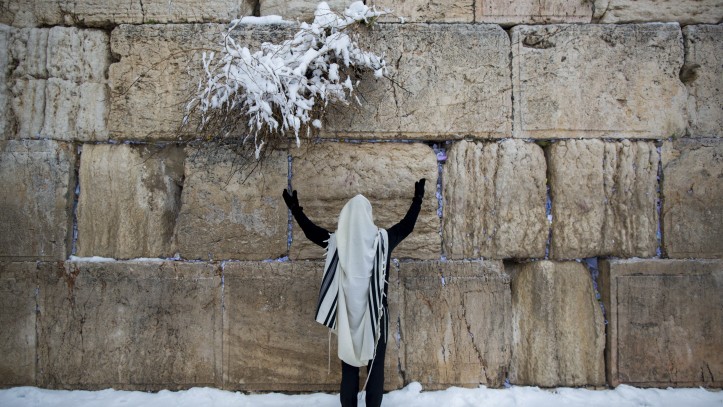
Social media was awash with photos and videos of streets, gardens and mountain vistas blanketed in white.
President Reuven Rivlin seized the opportunity to have some fun outside.
“The ‘snow holiday’ is one that does not appear in either the Hebrew or Gregorian calendars,” Rivlin said. “Sometimes it skips a year, sometimes two, and every time it manages to surprise and excite (us).”
Snowfall was also reported in southern towns where it had not been seen in years: Beersheba, Arad, Mitzpe Ramon; in Yeruham snowflakes were seen for the first time since 1991, Haaretz noted.
The storm was not without its casualties. Four people were reported lightly injured when a tree fell on their car near Kibbutz Mishmar Haemek outside of Haifa. In the northern town of Safed, ten people were taken to hospital after slipping on ice and injuring themselves. Paramedics and rescue teams were called upon to deal with various mishaps and accidents related to the cold weather throughout the day.
Despite the preparations made for the tough weather, power cuts lasting several hours were reported in several Jerusalem neighborhoods on Friday. The Israel Electric Corporation said these were the result of exceptionally high demand that caused some systems to collapse. It was unclear how many homes were affected.
In the southern Ein Gedi region searches continued Saturday for 31-year-old Shai Yaakov Noam who apparently went trekking Friday in an area prone to flash floods.
The Ein Gedi area, renowned for its cliffs, streams and waterfalls, is currently overflowing with water. Such desert floods are known for their beauty, but are also incredibly dangerous. They have often proved to be a deadly attraction for nature enthusiasts.
On Friday afternoon police reopened the highways leading into Jerusalem after heavy snowfall the previous night forced road closures and the shutdown of public transportation in the capital. The Tel Aviv-Jerusalem train line remained operational on Friday, but at a slower pace than usual.
Schools in and around Jerusalem as well as in many northern towns were closed.
Prime Minister Benjamin Netanyahu had attended a situation assessment meeting in Jerusalem on Thursday, laying out goals for authorities and emergency services.
“The first objective is to save lives, the second to open roads and the third to supply electricity,” he said, according to a statement released by the Prime Minister’s Office.
Netanyahu urged citizens to heed the warnings and instructions of authorities.
The precautions were driven by memories of a surprisingly heavy storm in December 2013, which blanketed the capital for days, blocking roads, bringing down power lines and trees, causing blackouts and cutting off the capital to travel.