Rattled Israelis cluster in Nepal’s ruins
Some 200 backpackers yet to make contact; Israeli teams set to leave for disaster-stricken country on Sunday
The massive natural disaster in Nepal, one of the most popular destinations for post-army Israelis, sparks feverish news coverage in the Hebrew dailies on Sunday, which spotlight the 200 or so Israelis who have not yet made contact and Israeli relief efforts.
With attention diverted eastward, the three weekend attacks on soldiers and an alleged Israeli airstrike in Syria are put on the back burner.
Haaretz quotes concerned parents awaiting signs of life from their kids abroad, as insurance companies — who are sending teams to the area, in addition to the official delegation — attempt to convey a reassuring message.
Zohar Shavit, whose daughter is on a Nepal trek, said the group his daughter is hiking with has transmitted an SOS message, but says he has not managed to reach her directly. “There was a message sent from their satellite phone that they need help. No one spoke to them personally. They sent an SOS at 11 a.m. Beyond that we have no details. No one spoke to them. We have no idea if they are equipped or if they have food,” he says.
A representative of the Harel insurance company, which is set to dispatch a rescue team, says: “We are in touch with people on treks and we know they are okay. There is another group we are not in contact with, right now we can’t say whether this is as a result of the lack of communication — because a lot of the infrastructure was badly destroyed — or because something happened.”
Israel Hayom reports that the Israeli embassy in Nepal was damaged, and 120 Israelis were in tents out in the yard.
The daily stresses that “as of last night, the Foreign Ministry assesses that there are no Israeli victims in the catastrophe.”
Both Israel Hayom and Yedioth Ahronoth write that Maayan Etzion, whose father was killed by a mortar in last summer’s Gaza conflict, is among the missing. The two papers also note that the current death toll, standing last night at 1,200, was projected to climb by thousands.
Yedioth dedicates several pages to the Nepal disaster, offering eyewitness accounts from Israeli backpackers in the area. A number of the accounts praise the cool-headed Israeli response to the quake.
“On the way [to the embassy], we saw a lot of European tourists who were just unfocused. They sat under the buildings and looked for wi-fi — unlike the Israelis, who have a survival instinct and immediately know what to do… In these situations, the most moving thing is that the Israelis are all together. It’s amazing. When there were aftershocks, we all hugged each other and waited for it to pass,” Talya Naigat says. Itai Shohat, 26, describes the “ghost town” after the earthquake. “We stayed close to the floor until it passed,” he said. “When we got up, the city simply looked different. Within minutes everyone closed their shops, and the city emptied out in a moment, became a ghost town. We didn’t hear screams, or ambulances, or chaos. Only quiet, and the silence of death.”
With all eyes on Nepal, the wave of attacks on soldiers and police over the weekend — in which two Palestinian attackers were shot to death, and five cops were injured — and the alleged Israeli strike in Syria are pushed deeper into the papers.
Haaretz reports that the family of the Palestinian teenager who was killed after police said he tried to stab soldiers at an East Jerusalem checkpoint overnight Friday-Saturday denies the charges. “First police said he clashed with cops, and the second time they said he came with an ax. If they had to stop him, why did they shoot him right in the chest?” Muhammed Mahmoud, the family’s attorney, says.
Yedioth provides a different account of the event, saying the teenager attempted to stab several soldiers and ran away. Police fired warning shots in the air, the report says, and alerted troops at a nearby checkpoint that the assailant was headed their way. “The teen pulled out another knife and ran toward the checkpoint. The security guards and troops at the checkpoint called at him to stop. He continued running, was shot and critically wounded.” He was pronounced dead at the scene by paramedics, it adds.
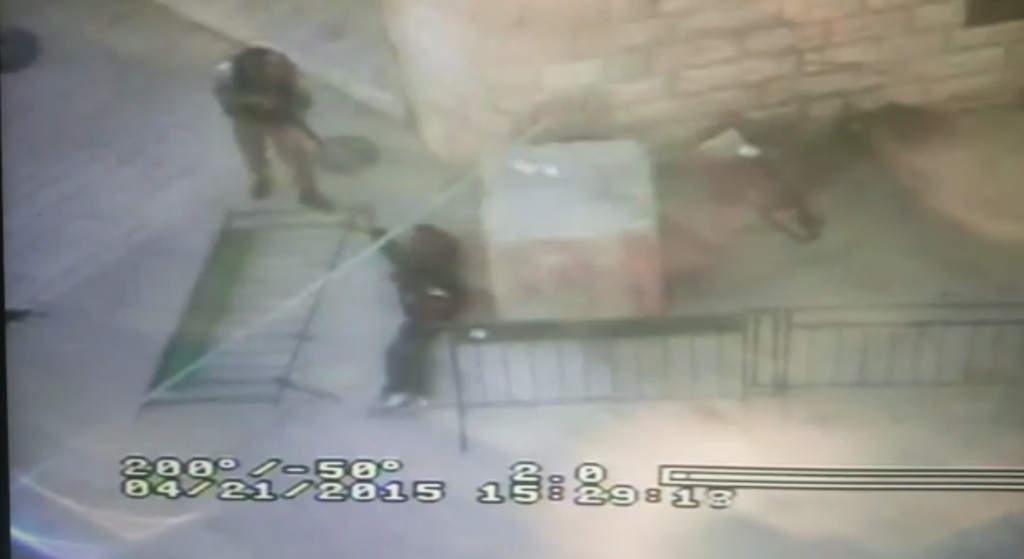
Later that day, a soldier was stabbed several times in Hebron, and was hospitalized in moderate condition. The Palestinian assailant, 19, was shot to death. On Saturday night, four cops were injured in a car-ramming attack in the capital.
The paper also reports that Shira Klein, the woman who was seriously injured in a car-ramming attack in Jerusalem on April 15 that killed Shalom Sherki, 25, has regained consciousness. She is breathing on her own, and has communicated with her family, it says. As of last night, her family had not told her that Sherki was killed, and that she had been hurt as part of a terror attack, the report says.
Writing in Yedioth, columnist Yossi Yehoshua downplays the alleged strike on Syria, terming it “a drop in the sea.”
“Even if the strike on Syria over the weekend attributed to Israel accomplished its goal and the missile shipment headed to Hezbollah was destroyed, and even if we believe past reports that the IDF launched strikes several other times, we must remember that this is a drop in the sea. The monstrous arms supply of Hezbollah will not be destroyed by surgical strikes once every six months,” he writes. “In the past few years, Hezbollah is emptying out the arsenal of its ally, Syria, and with all due respect to Israel’s impressive intelligence capabilities, there is no way to locate every truck crossing the long border between the two countries [Syria and Lebanon].”