Refugee resentment
Hebrew-language papers are dominated by a court ruling allowing Israel to continue its controversial practice of deporting illegal migrants
The High Court of Justice ruling yesterday, which placed limitations on the expulsion of African migrants and the terms of their incarceration for infiltrating into Israel, dominates Hebrew-language newspapers on Tuesday.
The backlash from the ruling — which allows Israel to continue its controversial practice of deporting illegal migrants to a country not of their origin but bars the state from imprisoning them indefinitely — is reflected in the print media.
The free Israel Hayom daily devotes nearly its entire front page to the decision, complete with a frenzied headline quoting Public Security Minister Gilad Erdan who slammed the ruling as “incentivizing the infiltrators.”
Similarly, the rest of its coverage of the ruling almost entirely focuses on the angry reactions to the decision by lawmakers and residents of South Tel Aviv, where many African migrants in Israel live. Its page 2 headline quotes angry residents who took to the streets to protest the ruling claiming: “Bagatz [The high court] buried us alive.”
Its columnists also have plenty to say about the decision. Akiva Bergman slams the court for “denying coercive mechanisms” designed to discourage illegal migration, saying the decision “has a dramatic impact on Israel’s ability to defend its borders.”
Columnist Shefi Paz accuses the court and human rights organizations of “using procrastination to create facts on the ground” regarding the 40,000 or so illegal migrants in Israel.
A minority opinion was expressed by Prof. Aviad Hacohen, who praises the ruling as “consistent with Jewish and democratic values, especially in light of recent Jewish history.” He says court president Miriam Naor’s ruling took into consideration the “human, moral and Jewish duty in regards to the particularly sensitive issue.”
The ruling on asylum seekers also leads Haaretz’s Tuesday print edition.
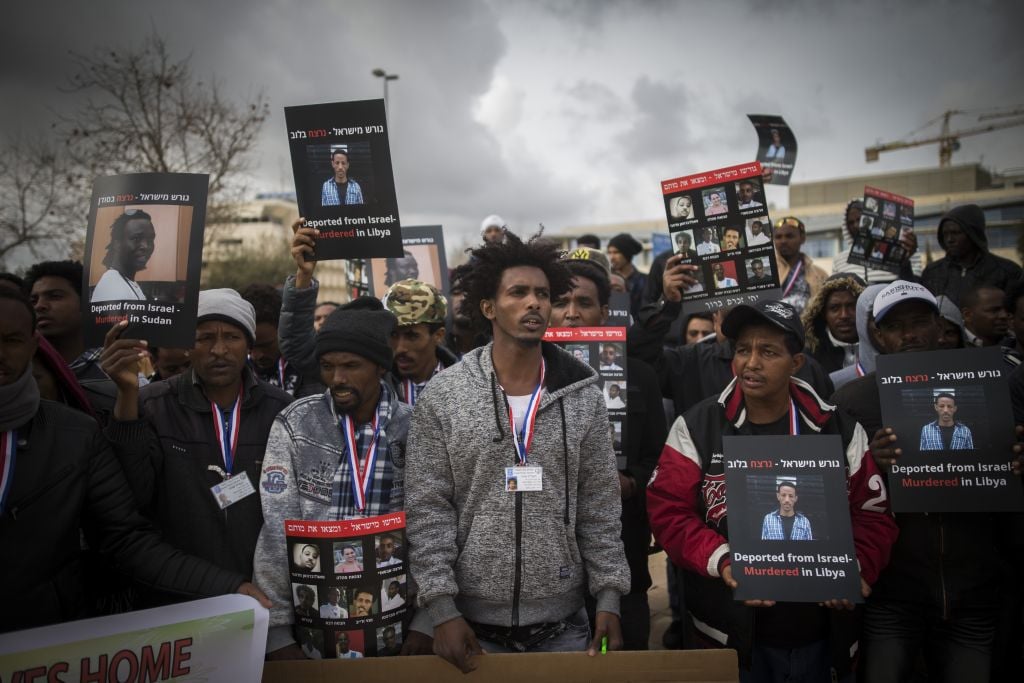
The left-wing newspaper strikes a markedly less panicked tone in its coverage, and gives little attention to the angry reactions of residents. Haaretz instead offers testimony from already-expelled asylum seekers who claimed they were not afforded the protections promised by Israel in exchange for leaving the country.
Unsurprisingly, its columnists are unimpressed by the ruling, with most bringing up international human rights laws and norms regarding the protection of refugees and asylum seekers.
Ilan Lior slams the ruling as inhumane and evidence the government is choosing to ignore reality instead of dealing with illegal immigration from Africa.
“Maybe instead of looking for any way possible to make these people’s lives miserable and to pressure them to leave, the government will finally grasp that it must grant them reasonable living conditions and basic rights,” Lior writes.
Meanwhile, the Yedioth Ahronoth daily doesn’t address the ruling on migrants until page 8 of Tuesday’s paper, giving precedence to what it says is Netanyahu’s “failed” diplomacy with Russia vis-a-vis Iran. Yedioth in its lead story quotes Russian newspaper Pravda that Netanyahu was “stressed bordering panicked” during his meeting with Russian President Vladimir Putin.
In its coverage of the migrant ruling, Yedioth carefully uses the word “voluntary” in quotes throughout its report, casting doubt on whether or not the migrants are in fact leaving Israel of their own accord.
The paper’s lone op-ed on the issue slams the court for ruling on the issue. Yoaz Hendel is careful to note that while he doesn’t necessarily disagree with the ruling from a human rights perspective, it was wrong for the High Court to intervene on a clearly defined government policy
“Whoever doesn’t have compassion for innocent people who have gone though much suffering only to give their children a better life has a problem,” he writes. “But in the same breath, whoever confuses healthy compassion with government policy has an even greater problem.”