Rick Perry throws hat back in ring for US presidency
Critics say former Texas governor gunning for Republican nomination might not be able to recover from failed 2012 campaign
Former Texas governor Rick Perry announced on his website Thursday he will run for the Republican Party’s presidential nomination in 2016. He previously ran for the nomination in 2012.
A formal announcement is expected later Thursday.
Perry will join an already crowded Republican field that includes Senator Ted Cruz (TX), Senator Lindsey Graham (SC), Senator Rand Paul (KY) former Arkansas Governor Mike Huckabee and potentially former Florida Governor Jeb Bush, the brother of George W. Bush.
Perry launched his presidential campaign four years ago as an instant front-runner — a proven job-creator with solid conservative credentials, formidable fundraising prowess and perhaps enough cowboy swagger to take Republicans by storm. Then came Perry’s “Oops” moment — his response when he failed to name the three federal departments he wanted to eliminate during a debate — and his tumble from powerhouse to punchline.
He also became the subject of internet memes parodying him for his conservative positions on gay marriage and religion.
Now he’s back, hitting the key early-voting primary state of Iowa, New Hampshire and South Carolina hard and early, and studying up on policy to become better prepared.
As Perry returns to presidential politics, the question remains: Will he get another solid chance?
“It’s going to be hard to make a first impression a second time,” said Ford O’Connell, a Republican strategist in Washington told AP.
Despite his brain freeze on a Michigan debate stage in November 2011, Perry still has the policy record that made him an early force last time.
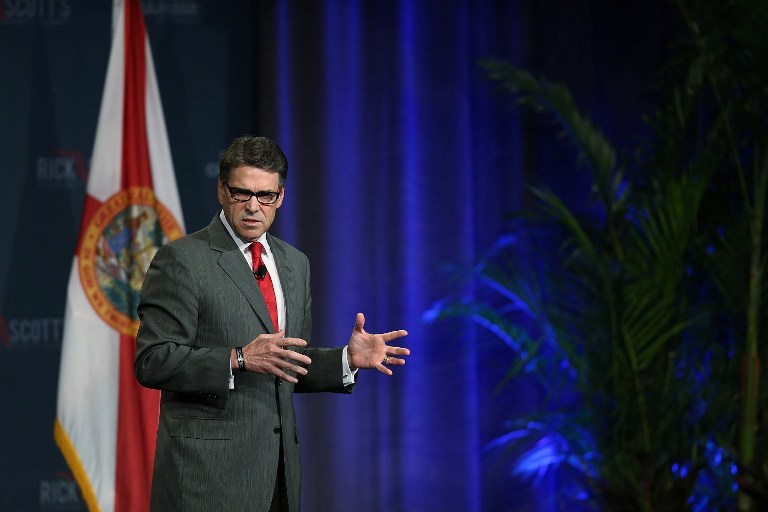
Perry left office in January after a record 14 years as governor. Under him, the state generated more than a third of America’s new private-sector jobs since 2001.
While an oil and gas boom fueled much of that economic growth, Perry credits lower taxes, restrained regulation and limits on civil litigation damages. He also pushed offering economic incentives to lure top employers to Texas and repeatedly visited states with Democratic governors to poach jobs.
Perry was thought to be a cinch for four more years as governor in 2014, but instead turned back to White House ambitions, leaving office in January.
Perry may face an uphill battle on account of a recent felony indictment for abuse of power and coercion charges, from when he threatened — then carried out — a veto of state funding for public corruption prosecutors. That came when the unit’s Democratic head rebuffed Perry’s demands that she resign following a drunken driving conviction.
Perry calls the case against him a political “witch hunt,” but his repeated efforts to get it tossed on constitutional grounds have so far proved unsuccessful. That raises the prospect he’ll have to leave the campaign trail to head to court in Texas.
Perry blamed lingering pain from back surgery in the summer of 2011 for part of the reason he performed poorly in the 2012 campaign. He has ditched his trademark cowboy boots for more comfortable footwear and wears glasses that give him a serious look.
Perry also traveled extensively overseas and studied policy with experts and economists at Stanford University’s Hoover Institution. He met such business moguls as Warren Buffett and Rupert Murdoch.
Lately, Perry has traveled to Iowa, which kicks off presidential nomination voting, more than any Republican White House candidate.
As an underdog, Perry has visited out-of-the-way places in Iowa, often traveling with a single sport utility vehicle rather than the busloads in his 2012 entourage.
One thing Perry hopes to emulate from 2012 is his fundraising, when he amassed $18 million in the first six weeks. He has strong donor contacts nationwide as a former Republican Governors Association chairman. Yet, he might face stiff competition as many past supporters have shifted to Senator Cruz and Governor Bush, whose brother George W. was governor in the Lone Star State 1997-2001.
Perry’s camp notes that many past Republican candidates, including Mitt Romney in 2012, rebounded to win the party’s presidential nomination after failing in a previous bid. But his former political adviser David M. Carney told the New York Times he faces a very talented field of candidates.
“With so many new shiny objects in the race this cycle, this will be the hardest hurdle he will need to climb,” Mr. Carney said. “The question remains: Can he put the other pieces into play, and has his time passed?”
comments