Rivlin says all lawmakers must condemn Halamish attack
In veiled reference to Arab officials, president says 'impossible for public representatives and elected leaders to be silent'
In a veiled reference to Arab-Israeli lawmakers, President Reuven Rivlin on Sunday said that all Israeli politicians must condemn the recent terror attack in the West Bank settlement of Halamish, in which three were people were murdered.
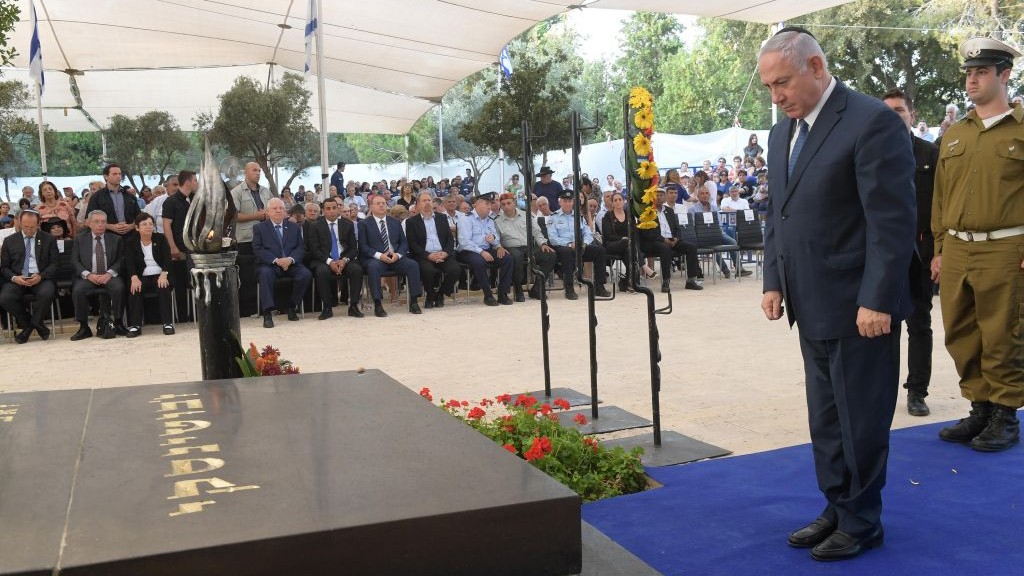
“The heart breaks at such moments of mourning and turmoil, but it is impossible for public representatives and elected leaders to be silent. The acts of terror, the violence on and off the mountain so holy to Jews and Arabs, must be condemned and must be stopped,” the president said at a memorial event for pre-state Zionist leader Ze’ev Jabotinsky.
Although Rivlin did not explicitly call out Arab-Israeli leaders, few denunciations of the fatal stabbing have been heard from Arab-Israeli officials, and last week, the president said the failure of Arab-Israeli lawmakers to condemn the July 14 shooting at the Temple Mount was akin to an endorsement of the shooting.
Prime Minister Benjamin Netanyahu also spoke at the memorial event at Jerusalem’s Mount Herzl military cemetery, where he said that Israel will not give in to terror.
“The pain is deep but our roots in the land are no less deep. Terror will never defeat us. Terror will never defeat us. We will continue to strengthen our state; we will continue to build up our land,” he said.
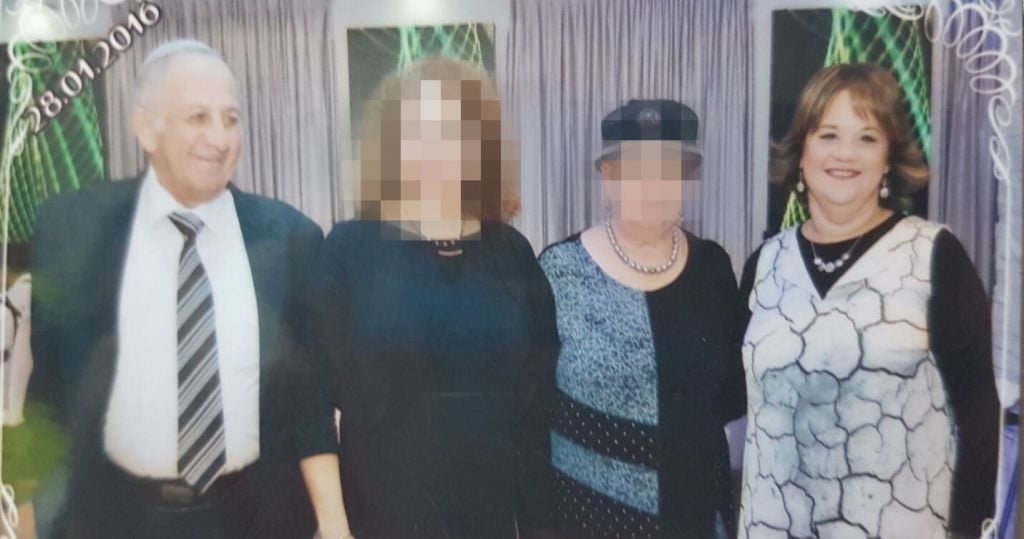
On Sunday, Yosef Salomon, 70, and his two children Chaya Salomon, 46, and Elad Salomon, 36, were buried in a funeral attended by thousands of mourners. They were stabbed to death by 19-year-old Palestinian Omar al-Abed while celebrating Shabbat at home Friday evening.
In initial questioning, Abed said he bought the knife two days before the stabbing, wanting to commit a terror attack because of the tensions surrounding the Temple Mount since the July 14 attack at the holy site, in which police officers Haiel Sitawe and Kamil Shnaan were shot to death by three Arab-Israelis using weapons they had smuggled into the Al-Aqsa Mosque.
Following the attack, Israel took the rare step of closing the complex to worshipers on a Friday — the holiest day of the week for Muslims — in order to search for additional weapons at the site.
Israel reopened the holy site two days later to Muslim worshipers after installing metal detectors at a number of entrances to the Temple Mount, which previously were only at the Mughrabi Gate, the only entrance to non-Muslim visitors.
The decision to install metal detectors at the gates to the Temple Mount has been met with widespread anger by Muslims, who say their placement is a violation of the status quo in place since Israel’s capture of the Old City of Jerusalem in the 1967 Six Day War, when the Jewish state agreed to leave control over the holy site in the hands of the Jordanian trust that administers it. Israel denies changing the status quo, saying the July 14 attack necessitated bolstered security at the holy site.
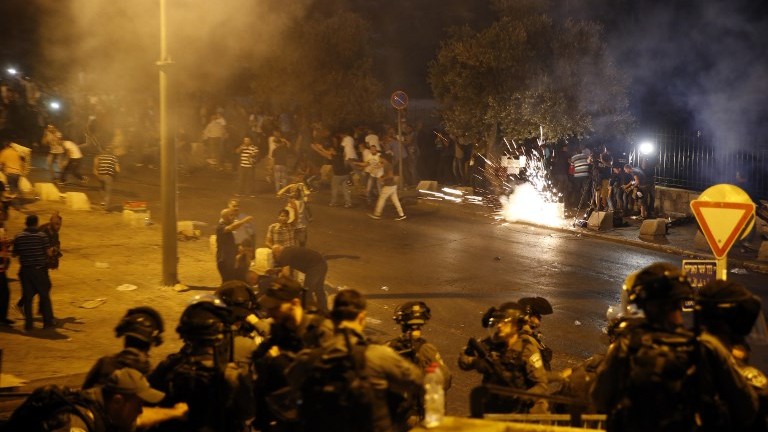
Since the launch of mass protests over the Temple Mount metal detectors, four Palestinians have been killed in clashes with Israeli forces, while another was killed Saturday when a petrol bomb he was planning to throw at Israeli security forces exploded prematurely.
In light of the escalating violence, Israel has sent additional security forces to East Jerusalem and the West Bank in order to prevent further terror attacks.
Amid the tensions, the security cabinet was scheduled to convene later Sunday to review the Temple Mount security measures. A previous meeting on Thursday night decided to leave the metal detectors in place.
Overnight Saturday-Sunday, Israel installed new security cameras and other surveillance outside Lions Gate.
Times of Israel staff contributed to this report.