Scowl, you’re on Kerry’s camera
As top US diplomat announces scheme to put Temple Mount on CCTV, Palestinians and Israelis seem to agree that the 'understandings' announced in Jordan may not do the trick
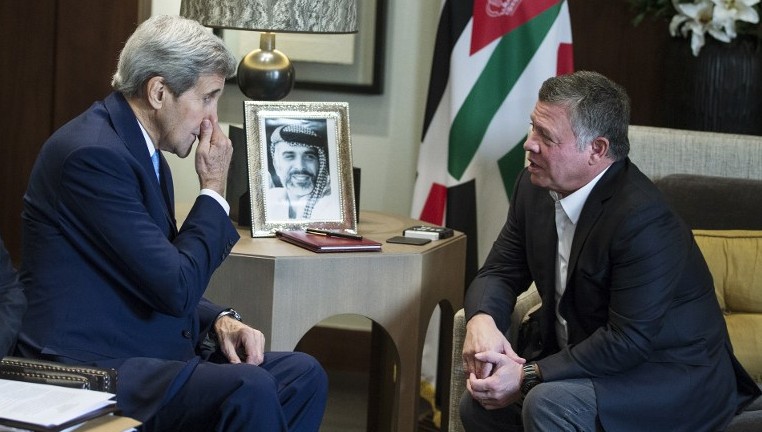
US Secretary of State John Kerry’s ideas for easing tensions are “like trying to cure a cold in a cancer patient” — or at least that’s how senior Palestine Liberation Organization officials described the understandings announced Saturday by Kerry between Jordan’s King Abdullah II, Palestinian Authority President Mahmoud Abbas and Prime Minister Benjamin Netanyahu.
These officials are not in Abbas’s inner circle, but they were closely following the reactions of the Palestinian public to the results of Saturday’s US-led talks in Amman. The response is best reflected in developments on the ground: Saturday night, Palestinian party leaders in Ramallah called for yet another “day of rage” for Tuesday, and more clashes took place between Israeli security forces and young Palestinians in a-Tur, near Jerusalem.
What the agreement actually demands is not entirely clear, and will be subject to the interpretation of each side. Palestinian sources leaked on Saturday that Kerry committed in Netanyahu’s name not to release new housing construction tenders in West Bank settlements. But the leak was immediately followed by statements from anonymous diplomatic sources who said no such assurances were made, and then a direct denial by Netanyahu himself.
Likewise, on the Temple Mount, it is not clear that anything is going to change. Israel will install cameras that will record events on the mount 24 hours a day and pass the footage to the Islamic Waqf that administers the site, but it’s hard to see how those cameras might lower tensions.
Indeed, we can safely assume that there are already cameras tracing every movement on the Mount. And let us assume that these images will in fact be passed to the Waqf. Will the Waqf be able to stop groups of religious Jews who have gone up to the Mount in recent months, obeyed police orders to leave their ritual phylacteries at the Mughrabi Gate as they entered, and then immediately inside the compound proceeded to pray, even as they are surrounded by police? How will that activity be stopped? Will it stop the members of the Islamic Movement’s Northern Branch from continuing to incite tensions and to claim that Israel is causing harm to the Al-Aqsa Mosque, or prevent Palestinian youths stockpiling materiel inside the mosque?
MK Yinon Magal (Jewish Home) responded to the agreements by insisting that, “at the end of the day, nothing will prevent Jews from praying on the Temple Mount, their holiest place in the world.”
Right-wing activist Yehudah Glick, who’s a slot or two away from being a Likud Knesset member, wrote in a similar vein that “the situation on the Temple Mount won’t be decided by speeches, and not even by international commitments to place cameras, but by facts on the ground.”
Or, in other words, quite a few people, Israelis and Palestinians alike, understand that these agreements are just talk.
Yet there is reason for optimism nonetheless. Kerry’s statement suggests that the two leaderships, Israeli and Palestinian, show a willingness to work to lower tensions and violence. That may have an effect on the ground, perhaps even a reduction of the number of attacks in the coming days.
The problem, as those senior PLO officials noted, is that none of the deeper issues have been resolved. Negotiations were not restarted, and likely won’t be restarted anytime soon. There is no diplomatic horizon, and while the Palestinian Authority is still limping along, it’s not clear what influence it has on the pace of attacks. The Netanyahu government, too, has failed to do anything substantive against settler violence. The video of a masked knife-wielding Jewish extremist beating Rabbi Arik Ascherman of Rabbis for Human Rights bears this out.
And to all these one must add Hamas. Hamas denounced Kerry’s announcement on Saturday and claimed it was an attempt to rescue Netanyahu from the crisis in which he finds himself. We may be certain the group’s fighters are making extraordinary efforts to carry out terror attacks in the West Bank, if only to demonstrate that Abbas is weak, and to ensure the violence against Israel continues.
Israeli security officials who have followed developments in the West Bank over the course of the latest deterioration have engaged in energetic debates about the nature of these events. Intifada? Wave of planned terror? Violent outburst? Yet they all agree on one thing: even if calm is restored it will be temporary, and will be followed by a worse deterioration if there isn’t a more dramatic and meaningful development on the diplomatic front.
Let us hope they are wrong.