Secular Tel Aviv flirts with spirituality
In the White City, long a bastion of Israel's nonreligious, Jewish observance is slowly gaining ground
It’s a Friday night in Tel Aviv, and while the closet-sized boutiques that dot Dizengoff and Bograshov Streets are shuttered, the sidewalk cafes that share space on these squeezed main boulevards are overflowing with diners.
Down the road at Dizengoff Center, the shops may have gone dark for the weekend, but the multiplex movie theater is full, as are the bars, theaters and 24/7 food marts on the surrounding streets. Shabbat is coming in, and the city’s sliver of religious residents are tucked away at their corner synagogues or setting the china for their private family meals. But for the vast majority of Tel Avivians, it’s the start of the weekend, and the city is gearing up for the debauchery, secularism and unreligious fun that hold sway.
Zoom north to Kikar Atarim, however, a beachfront public square where abandoned office spaces compete with a looming strip club for the title of most offensive eyesore, and you’ll find a most surprising pocket of public Jewish spirituality. Here, as the sun sinks into the Mediterranean behind the dilapidated stone buildings, a quiet little minyan has gathered on the rooftop of the Aish Tel Aviv building, in full view of the surfers and beach-strollers below.
Tel Aviv, the secular stronghold of Israel, is learning how to celebrate Shabbat. It’s a subtle shift, but nevertheless a steady one. And to Rabbi Shlomo Chayen, the educational director of Aish Tel Aviv who will lead the minyan, it makes sense that the start-up city is tapping into its spiritual side.
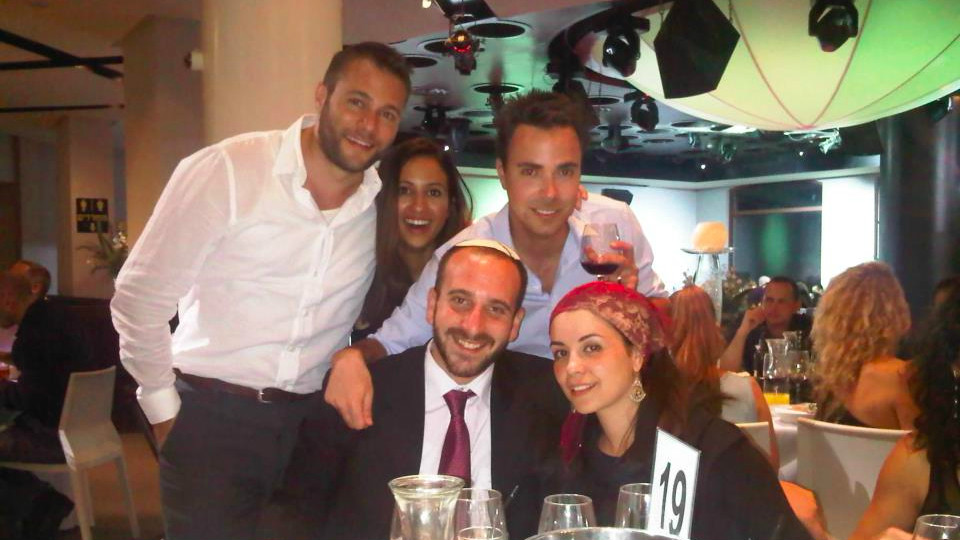
“The oldest start-up and the greatest start-up is Shabbat,” he says. “Because I can be on my iPhone until a minute before Shabbat enters, answering peoples’ questions or getting them to come to a Friday night dinner or something like that, and once Shabbat comes in I put it down for 24 hours. Any addiction that I have has to end for 24 hours.”
Chayen, a 30-year-old former paratrooper, founded Aish Tel Aviv — a branch of the Aish International movement, which promotes egalitarian Jewish outreach — six years ago. His motto, sourced in the writing of influential early 20th century Rabbi Abraham Isaac Kook, is that “no Jew is a stranger.” He was frustrated by the growing chasm between Israel’s religious and secular communities, he says, and felt the best way to bridge the gap was to tap into what most Israelis share – a Jewish heritage.
“For most people, that disconnect from their heritage is not because they know what’s in their heritage — it’s because they don’t know,” he says. “Instead they’ve just built up a hatred and an antagonism toward it.”
The creation of Aish Tel Aviv came along with a wave of other organizations, all of which have offered non-Haredi Jews in Tel Aviv a place to tap into their spirituality and explore their Jewish heritage without having to leave the city. The jaw-droppingly beautiful Great Synagogue on Allenby Street, which for 30 years stood padlocked and abandoned, is now once again the site of regular prayer groups thanks to a grassroots funding effort. White City Shabbat, an Anglo-led, municipality-embraced project of Friday night dinners, set a Guinness World Record earlier this summer for the largest communal Shabbat meal in history. And The Moishe House, a project of the Jewish Federation of Los Angeles County, is following a model proved successful in Diaspora cities around the world in housing young Tel Avivians – under 30, both religious and secular – while serving as a communal hub of dinners and learning, all with the engine of their shared Judaism chugging steadily below.
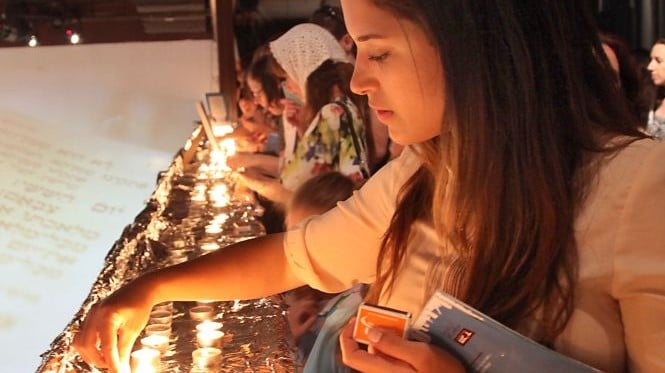
Like the Moishe House, Aish Tel Aviv sponsors holiday meals, learning sessions, and community nights where secular Jews and religious Jews come together to discuss Torah and its applications to everyday life. The Kikar Atarim center is the pulse point for its community programs, but the organization also has a business side. Thanks to a steady flow of donations from the United States, it last year moved its fundraising and organizational offices into a sleek headquarters on the 23rd floor of Azrieli Center, where massive glass windows offer sweeping views of Tel Aviv’s nonstop traffic and white Bauhaus sprawl.
For the average secular Tel Avivian, for whom Friday night more often than not means clubbing or bar-hopping, a community dinner alongside 25 black-hatted Jews still feels improbable. But Chayen insists that about half of the members of Aish Tel Aviv’s events skew secular, and that no one would ever be turned away or made to feel uncomfortable because of their lack of learning or their style of dress.
“The idea [for Aish] is to create something called a Jewish center,” he explains. “You have a rabbi and people aren’t scared of us – we’re pretty young and we’re not scary. Our center is better than a bar because we have beer and we have whiskey, but there aren’t sleazy people here. It’s a place that can act as a Jewish home, for anyone.”
A few blocks south, inside one of Tel Aviv’s thousands of nondescript apartment complexes, there is another gathering of young Jews, even more informal but perhaps equally surprising.

It’s a weekly gathering by Minyan Shivyoni, a Friday night prayer group and sometimes potluck that can attract up to 100 young people at a time. Held in various apartments around the city, sometimes in collaboration with the Moishe House, the minyan was started by two American immigrants in 2012 as an egalitarian place for young, unaffiliated Jews to celebrate Shabbat together in a warm and open environment.
“There was a need for the minyan for a long time,” says Teddy Fischer, one of its two founders. “We always get young people who are Jewish but not necessarily Orthodox, and a lot of them are Anglo because a big part of being a Jew in America is being in this gray area. In Israel it feels like you really have to be either religious or either secular, and it’s sometimes hard for Israelis to realize that there is something in the middle, too.”
Most weeks, Fischer says, the minyan draws about 20 worshipers, or closer to 40 if there is also a potluck dinner. On weeks when they collaborate with Moishe House, those numbers can double or triple. Communication is done via a Facebook group, with invites open to anyone and members taking turns playing host.
Their efforts, and the bigger wave of spirituality-minded organizations that are making inroads in the city, is changing the way Tel Aviv looks to outsiders, says Maya Liss of Nefesh B’Nefesh, a nonprofit that promotes immigration to Israel.
“To olim [immigrants to Israel], there is a stigma that if you want to live a religious life, you should be in Jerusalem as a young single or a couple,” she says. “But I think Tel Aviv is really changing in that perspective. For young people who want to keep religion as part of their life, they aren’t only looking at Jerusalem anymore.”
For Chayen, if the interplay between religious and secular Jews is going to change in Israel, that change will start in Tel Aviv.
“It’s the jugular vein of Israel,” he says. “The heart of the world is Am Yisrael [the people of Israel], and the main artery of that heart is Tel Aviv. It decides everything. Everything comes from there. If we want to influence the leaders, the leaders are here.”