Senate panel books hearing for Trump Israel envoy pick this week
J Street calls on lawmakers to block nomination of David Friedman, who once called dovish group 'worse than kapos'
WASHINGTON — US President Donald Trump’s nominee for ambassador to Israel will be grilled by the Senate Foreign Relations Committee Thursday, when he will likely face questions from lawmakers on past controversial statements and his reported support for Israeli settlement building.
The nomination hearing for David Friedman will place him among the first non-cabinet level nominees to commence the confirmation process. The hearing will come as Prime Minister Benjamin Netanyahu wraps up a four-day trip to Washington, where he is slated to meet to Trump and other officials.
Friedman, a New York bankruptcy lawyer, has been a source of intense controversy since Trump announced him for the post, drawing denunciation from liberal Jewish groups like J Street.
As an Israel policy adviser to Trump during the campaign, Friedman was outspoken in his skepticism of a two-state solution; and in a column for the far-right Israel National News website, he accused supporters of the dovish J Street of being “far worse than kapos,” referring to Jews who aided Nazis during the Holocaust.
The 57-year-old Long Island native, who is a long-time friend of the president, is also a vocal and financial supporter of West Bank settlements.
On Sunday morning, J Street released a statement calling Friedman’s views “extreme and hateful” and urging senators to block his nomination.
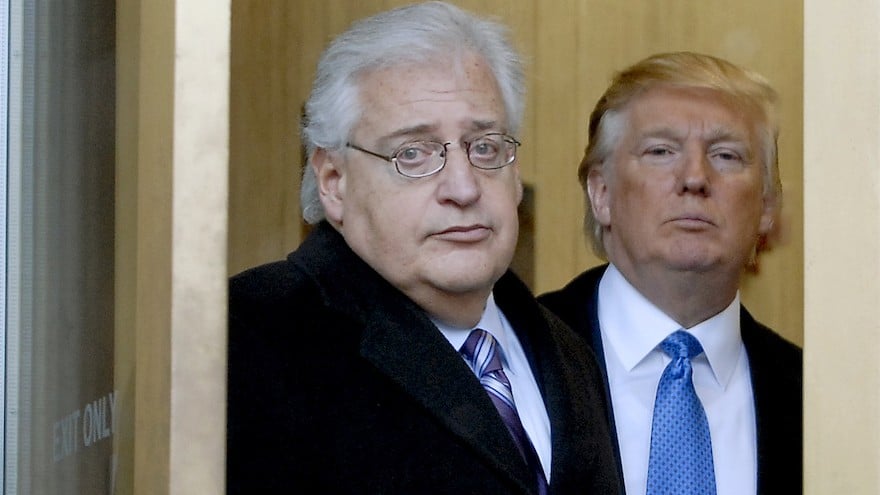
Friedman will still need to be confirmed by the full Senate following the hearing.
In a November 2016 interview with The Times of Israel, Friedman stated that, based on his discussions with Trump, “a two-state solution is not a priority” for the president-elect. “I don’t think he is wed to any particularly outcome. A two-state solution is a way, but it’s not the only way.”
He also suggested that Trump would not apply pressure to Israel over approving settlement construction projects in the West Bank, saying he would not “dictate to Israel where it can and cannot build.”
In a statement announcing his nomination, Friedman said he intended to assume his responsibilities from the “US embassy in Israel’s eternal capital, Jerusalem,” an indication at the time of the administration’s resolve to follow through on their campaign pledge to move the mission from Tel Aviv to Jerusalem — a move put on hold for now.
During a recent interview with the Sheldon Adelson-owned Israeli newspaper Israel Hayom, Trump was noncommittal on his plans regarding any relocation.
“I am thinking about the embassy, I am studying the embassy [issue], and we will see what happens,” he said. “The embassy is not an easy decision. It has obviously been out there for many, many years, and nobody has wanted to make that decision. I’m thinking about it very seriously, and we will see what happens.”
Trump also contradicted statements Friedman made on the trail about his plans for dealing with the settlement issue.
“Every time you take land for settlements, there is less land left,” Trump said. “But we are looking at that, and we are looking at some other options we’ll see. But no, I am not somebody that believes that going forward with these settlements is a good thing for peace.”