Shuttering Old City may calm Jerusalem, but it won’t last
Calling move a stopgap measure, expert argues closure can work in the short term until a real solution -- not politicians' gut reactions -- is found
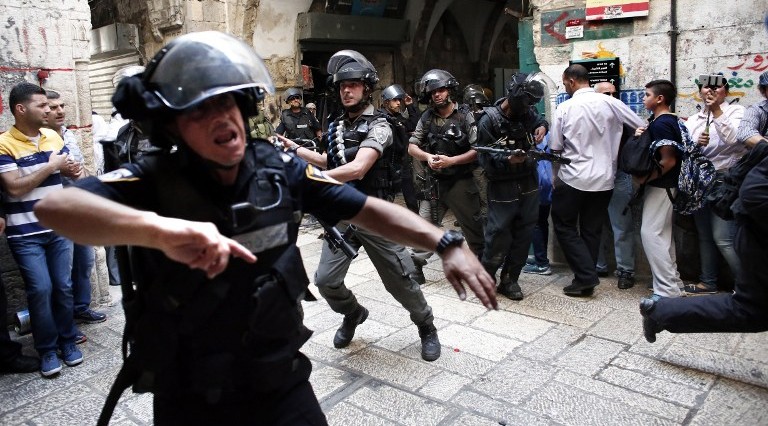
Police closed off the Old City of Jerusalem to Palestinians following a deadly attack Saturday night, which may indeed help calm the situation, a security expert said, but the current vicious cycle of terror won’t be solved by stopgap measures alone.
With the Temple Mount at the center of the friction, there has been an escalation in violent attacks in Israel in recent weeks, but Kobi Michael, former deputy director general and head of the Palestinian desk at the Strategic Affairs Ministry, is loath to refer to it as an “intifada,” or Palestinian uprising, as many politicians and journalists already have.
“Using the term intifada,” Michael said, “raises the awareness, which raises the expectations.”
Despite the escalating violence — which came to a peak in the period from Thursday night to Sunday morning, during which two lethal terror attacks claimed the lives of four Israelis, and those and additional attacks injured many more — Michael told The Times of Israel Sunday he believed calm could still be restored.
There is no clear and easy way to fully head off the confrontation, according Michael, who currently serves as a senior researcher at the Institute for National Security Studies.
“But there are steps that can be taken to calm things down,” he said.
One of these steps has already been put into effect.
Shutting down the Old City
The police held a meeting Sunday to assess the security situation in Jerusalem and determine their next course of action. The top brass decided to increase the already heightened police presence in the Old City and the rest of Jerusalem, restrict access to the Temple Mount to men older than 50 and women of all ages and — most dramatically — to close off the Old City of Jerusalem to all Arabs who do not live there.
“Entrance to the Old City is only for residents of the Old City — that is significant and important,” Police Spokesman Micky Rosenfeld said.
“Thousands of Jewish visitors are expected to come to the Old City,” the police official said, due to the Sukkot holiday that was continuing Sunday and the Simhat Torah festival on Monday.
While effective, this can only be a stopgap measure, Michael said. “It will do something in terms of the feeling of security, but it’s Acamol,” he explained, referring to an Israeli over-the-counter pain medication.
There are hundreds of thousands of Arab residents in East Jerusalem and more than 40,000 in the Old City alone, he added. “You can’t close it off indefinitely.”
However, Michael said, this could potentially calm down the situation, until a more viable long-term solution can be found.
Calming down the situation in Jerusalem, Michael said, can also help calm things in the West Bank.
“What’s happening in Jerusalem sets off the West Bank,” he explained, referring to the violent demonstrations by Palestinians atop the Temple Mount in response to perceived changes of the Israeli status quo toward the holy site. “And what happens in the West Bank — last week’s shooting, for example — gives motivation to Jerusalem,” he added.
The IDF, meanwhile, is monitoring the situation, but has not yet implemented any additional restrictions on the Palestinians in the West Bank, a security source said.
Cooperation with the Palestinians
Since Thursday night’s shooting near the West Bank settlement of Itamar, in which a man and wife were murdered in front of their children in their car, politicians and pundits have called out PA President Mahmoud Abbas for not condemning the wave of attacks.
Such condemnation will not come. An official Palestinian Authority spokesman on Sunday publicly denounced Israel’s escalation of the violence — not the actions of Arab terrorists.
The statement, released to the official Palestinian news agency, called for the international community to castigate Israel for “the killing of two young men in the occupied city of Jerusalem” — presumably the two men who attacked Israeli civilians with knives on Saturday night and Sunday morning, respectively.
But even if the PA did condemn the attackers, Michael said, mere lip service would not be helpful. We need “condemnation in action, not in words” to further calm Jerusalem and the West Bank. “This effort was have not yet seen,” he said.
The Palestinian security services helped the IDF maintain calm in the West Bank throughout last summer’s small-scale “Operation Brother’s Keeper,” in which IDF forces conducted searches and arrests following the kidnapping and murder of three Israeli teenage boys. The PA’s forces even helped maintain a relative calm throughout the large-scale Gaza conflict, which followed later that summer.
That support has since dried up, however.
It is being prevented by instability in the Palestinian leadership, Michael said. “Abu Mazen is becoming irrelevant, and the Palestinian Authority is already irrelevant,” he asserted.
Hamas, meanwhile, attempted to further push its rival, the PA, aside. Qais Saadi, a member of Hamas’s militant wing Izz ad-Din al-Qassam Brigades, who the IDF attempted to arrest in the Jenin Refugee Camp on Sunday morning, lambasted the Palestinian Authority, accusing it of collaborating with the IDF.
“Everyone is targeted by the PA,” Saadi told Hamas media from his hiding place on Sunday. “God willing, the PA occupation operating under the Israeli occupation will disappear.”
Without support from the top, Palestinian law enforcement is wary of becoming involved in the conflict. If the Palestinian leadership changes, Michael explained, those who assisted the Israeli forces could find themselves being killed “in the central square of the town.”
When there is no strong political leadership, he said, you get the kind of terrorism that we have seen slipping through the cracks.
Politicians speaking from the gut
In the hours following Saturday night’s attack, Knesset members from the entire political spectrum spouted ideas and recommendations for how to handle the escalating violence.
Jewish Home party leader and Education Minister Naftali Bennett recommended more settlements and firmer hand in dealing with Palestinians.
Transportation Minister Yisrael Katz, who served as acting prime minister while Benjamin Netanyahu was in New York to address the United Nations, threatened a second “Defensive Shield,” a reference to the 2002 large-scale operation in which the IDF moved into six Palestinian West Bank cities in an effort to curb the suicide bombings that had racked Israel in the months prior to the military action.
“Abu Mazen and his deputies are not only not denouncing, they are for the most part supporting the attacks. If on the way to the Western Wall Jews are being murdered — Israel must act,” Katz told Army Radio Sunday morning.
Katz even threatened to take away some of the rights of East Jerusalem residents, including freedom of movement and work permits.
“They will have to be closed off within their neighborhoods and not be able to work in the most attractive places in the city,” he said.
What Katz believes a disgruntled, newly unemployed population will do with its newfound free time was left unexplained.
“You would add people to the conflict,” Michael warned. With more people involved in demonstrations, “instead of injuring a few Palestinians, [Israeli forces] would kill a few Palestinians. And then there would be retaliations.”
These are recommendations that come “from the gut,” Michael said, not from any serious consideration.