Signed, sealed, destroyed
To the press, Israel's decision to bomb an anti-aircraft battery in Syria sends enough strong messages that the plane firing the rocket may as well have had Fedex written on it
If there’s an overriding theme in Tuesday morning’s Hebrew language papers it’s that things are sometimes not as they seem, except when they are exactly as they seem.
In the former category, Haaretz leads off with Labor leader Avi Gabbay seemingly selling his party’s platform down the river by expressing support for keeping West Bank settlements in place, while Israel Hayom’s top story is a supposed expose on how the Fatah-Hamas reconciliation is actually just designed to pave the way for former Hamas head Khaled Mashaal to become Palestinian president.
However, there’s nothing hidden behind Yedioth’s lead story, on Israel bombing a Syrian anti-aircraft battery after it fired at a jet, with the message so clear that the tabloid splashes it across its front page: “Israel to Syria: Don’t play with fire.”
Columnist Alex Fishman writes that Israeli jets have been harassed by Syrian anti-aircraft fire for half a year and Israel has threatened time and again to destroy the battery if it didn’t stop, which it finally made good on on Monday.
“Once it became clear that the Iranians were not taking us seriously (Tehran did not get worked up over Israel’s statements that it won’t accept Iranian bases in Syria) Israel was no longer able to afford making threats without taking action,” he writes. “Yesterday an opportunity was created for the IDF to carry out its open skies policy and along the way clarify to the Iranians that we are completely serious.”
The paper’s Yossi Yehoshua, meanwhile, writes that Israel wasn’t the only one sending a message Monday.
“There’s no doubt that the decision to attack the Israeli jets was made at the highest levels of the Syrian regime, and would not have happened without their approval. One can assume that Syrian President Bashar Assad did not give the actual order to fire, but the new Syrian outlook, which holds that they respond severely to extraordinary IDF overflights in Lebanon, he definitely approved. From this, one can learn much about the self-confidence that has returned to the Syrian president in the wake of his recent victories against the rebels and the solidifying of his reign.”
Haaretz’s Gili Cohen writes that the message was actually meant for Russia, given the visit of Kremlin Defense Minister Sergey Shoigu just a few hours after the exchange, and not seeing any other reason Israel would suddenly shift its policy of threatening but not actually responding.
“Israel has waited a long time for Shoigu’s official visit, and had planned to use it to demonstrate Iran’s efforts to consolidate its position in Syria,” she writes. “Russia doesn’t see eye to eye with Israel about the impact of Iran’s activity in the region in general, and Jerusalem is particularly worried over the difference in approach toward Iran’s activity in Syria. … Thus a new item was added to the agenda of Monday’s meeting, which was also attended by the army chief of staff and the director of Military Intelligence: an update about the Israeli strike in Syria. Message delivered and received.”
In Israel Hayom, columnist Yoav Limor agrees that the anti-aircraft missile didn’t actually threaten the Israeli jet directly, but notes that by shooting at a Syrian battery that shot at an Israeli jet over Lebanon, Jerusalem is actually trying to avoid war and not further entangle itself.
“In order to avoid war, which can come from an unexpected acute event, Israel needs to do everything it can to keep its arenas separate. To leave Syria in Syria, Hezbollah in Lebanon (and it would be nice if Iran stayed in Iran). Otherwise, a mix of interest could lead the situation to deteriorate and create an unwanted escalation in hostilities,” he writes.
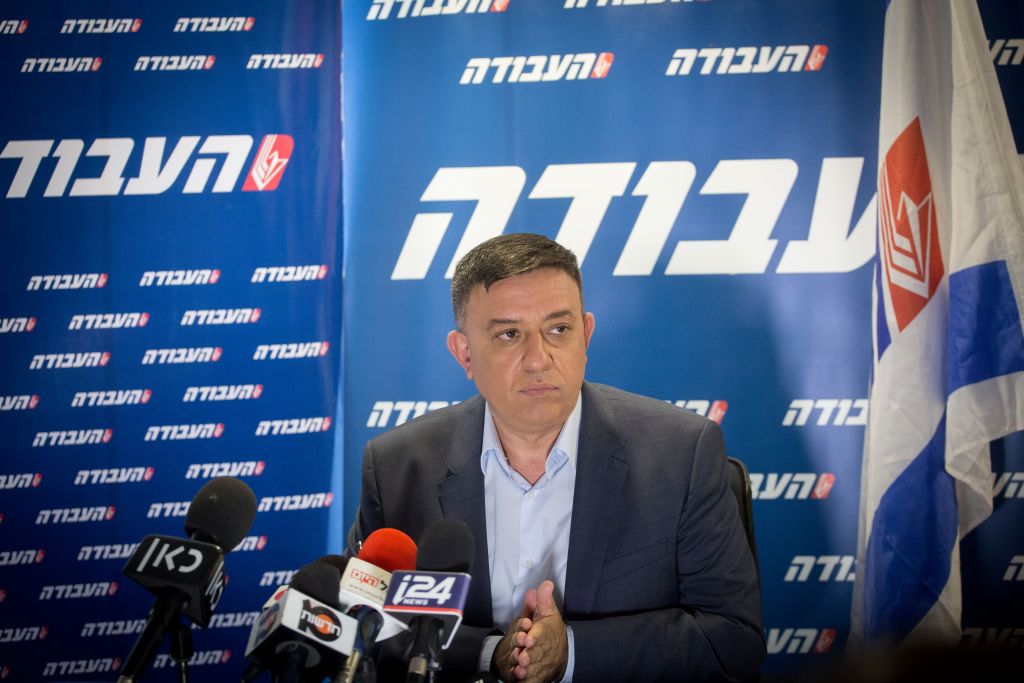
For another example of an equation that doesn’t seem to add up at first glance, one need only turn to Haaretz’s top story, which looks at the head of Israel’s dovish Labor Party saying that reaching peace with the Palestinians does not necessarily mean evacuating settlements (long thought to be the most basic of prerequisites). The paper notes that while some people expresses surprise, many in the party were unwilling to challenge their new leader openly and spark more infighting just as the faction is trying to right itself.
One unnamed person notes that righting the party is exactly what Gabbay was trying to do, saying the leader “made a deliberate decision to take the risk that his base would flee in order to wink at centrist and soft-right voters.”
Sometimes a leader isn’t necessarily the guy representing the views of all of those he represents. That would be the case if ex-Hamas leader Khaled Mashaal becomes Palestinian president, which Israel Hayom’s lead story says is a very real possibility should the Hamas-Fatah unity deal take effect.
The paper, going off what it says is info confirmed by Palestinian and Egyptian sources, says the presidency gambit was the real reason Hamas was willing to sign on the dotted line and make nice with Fatah.
“Senior officials told Israel Hayom that even though he left his post as Hamas politburo chief, Mashaal has never hidden his desire to take the Palestinian presidential throne and in private conversation has even told colleagues that he would support a wide-ranging reform in Hamas’s charter in order to get the group to join up with the Palestine Liberation Organization — a step that would allow him to run for the presidency,” the paper reports.
Lest you think Hamas reforming might be a good thing, the paper plays up how bad of a dude Mashaal is, running a picture of him with Iranian Ayatollah Ali Khamenei. Indeed, Prime Minister Benjamin Netanyahu, whose viewpoint is represented by the paper, is not a fan of the reconciliation, Haaretz reports. However, the broadsheet writes that the prime minister told his cabinet while he does not support the rapprochement, he won’t cut off ties to the PA because of it.
In Yedioth, Amos Yadlin praises Jerusalem’s decision to not take an active stand against the agreement, saying it’s not worth getting worked up over.
“In Jerusalem, as in Washington and other places around the world, they know the current reconciliation deal, like similar ones before it, will dissipate as well,” he writes, “so long as it does not deal with the basic problems that still remain without any real effort to address them.”