Spain to meet on suspending Catalan autonomy as crisis deepens
Development comes after Catalonia president Puigdemont threatens to move further ahead with independence if Spain takes back self-rule
The Spanish government said the prime minister will hold a specialcCabinet meeting on Saturday to trigger the process to take some or full control of Catalonia’s semi-autonomous powers.
The government was responding Thursday to a letter from Catalan president Carles Puigdemont who threatened to explicitly declare independence from Spain if no talks are offered.
“The Spanish government will continue with the procedures outlined in article 155 of the Constitution to restore legality in Catalonia’s self-government,” it said in a statement, referring to an article that allows for Madrid to take direct control over a region in exceptional circumstances.
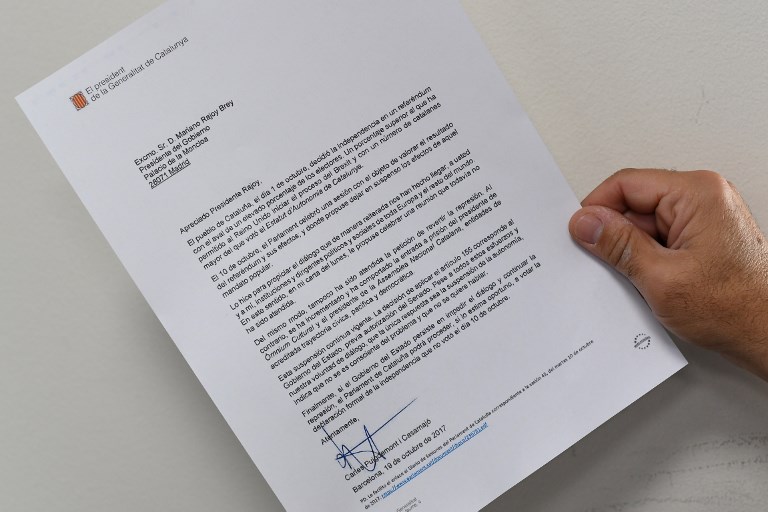
Puigdemont said in the letter that if Spain’s government continues to “impede dialogue and continues its repression,” Catalonia’s parliament will proceed to hold a vote on declaring independence from Spain.
Spain replied that the government would hold the special Cabinet meeting and “approve the measures that will be sent to the Senate to protect the general interest of all Spaniards.”
The measure falls under Article 155 of Spain’s 1978 Constitution, but has never been used in the four decades since democracy was restored at the end of Gen. Francisco Franco’s dictatorship.
Catalans would consider the application of the measure an “invasion” of the region’s self-government, while Spain’s central authorities are portraying it as an undesired move, yet a necessary one, to restore legality after Puigdemont’s government pushed ahead with a banned referendum that violated the country’s constitution.
More than 40 percent of Catalonia’s 5.5 million eligible voters cast ballots in the illegal October 1 referendum as police used violence to try to enforce a court order to stop it from going ahead. Opponents boycotted the vote.
Catalan officials say that hundreds of people were injured in police violence, while Spanish authorities say hundreds of police officers were also hurt and the use of force was proportional to the resistance they met.
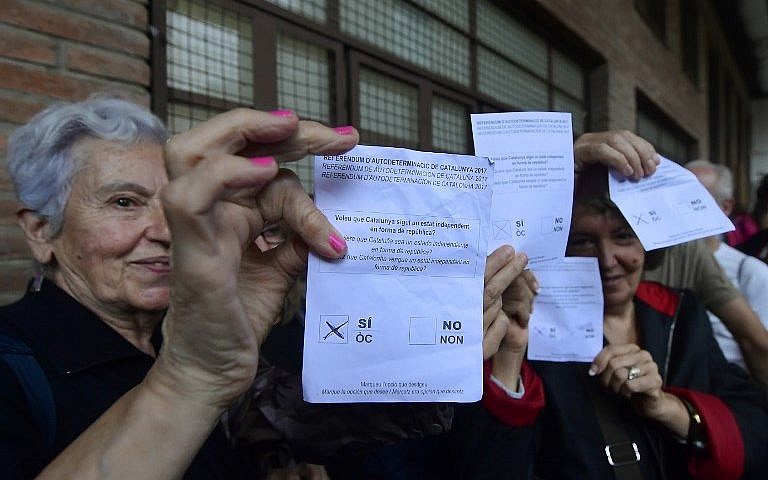
The separatists declared an overwhelming victory despite the boycott by opponents and on the grounds that it was illegal and lacked basic guarantees such as an independent electoral board.
Spain’s government has said it would be willing to hold off on applying Article 155 if the Catalan separatist leader were to call a snap regional election. But Catalan officials have ruled that out.