Syrian official: Israeli strikes an attempt to disrupt truce
Military source claims Israeli retaliation for shelling on Golan is in fact effort to boost anti-regime jihadist rebels
A top Syrian army official on Wednesday accused Israel of trying to stymie the new ceasefire agreement between the regime and rebel groups.
The unnamed official told the state-sponsored SANA news agency that recent Israeli strikes on Syrian territory — conducted in response to repeated shelling of the Israeli Golan Heights — were “a clear attempt to escalate and disrupt the application of the Russian-American agreement.”
The official further claimed that Israel’s actions sought to boost a former al-Qaeda offshoot group — the jihadist Fateh al-Sham Front, formerly known as the al-Nusra Front.
Shelling from Syria on Monday and Tuesday, thought to be errant fire, came shortly after a ceasefire brokered by Russia and the United States took effect in Syria.
That truce does not cover terror groups like Fateh al-Sham, which Syrian regime forces have recently sought to push out of the Golan.
Israel maintains a policy of retaliating against Syrian army positions in response to cross-border fire no matter the source, which has led to charges that Jerusalem is backing jihadi rebel groups.
On Tuesday morning, a Syrian army statement accused Israel of carrying out sorties to help rebel groups fighting in the Syrian Golan.
“There is no doubt that the Israeli attack came in support of the armed terrorist groups and in a desperate attempt to raise the deteriorating morale of their members due to the heavy losses they have suffered,” the statement read.
Israel has struck in Syria several times in the past week, each time responding to mortar shells being launched at Israeli territory from the war-torn Arab state.
There have been at least nine such mortar attacks in the past two weeks.
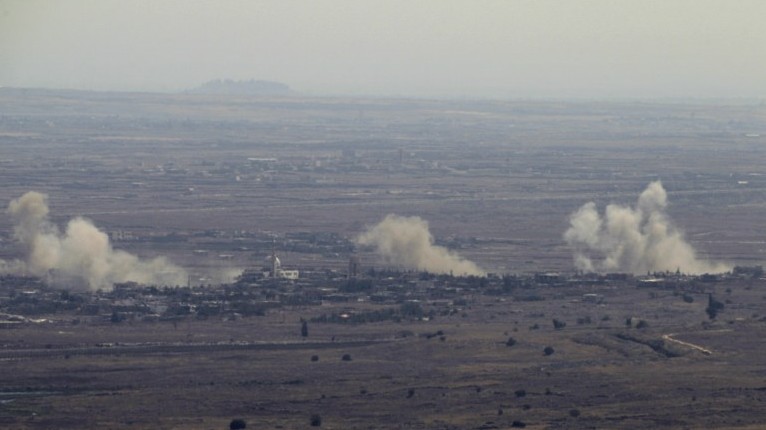
The most recent strike occurred late on Tuesday night, when warplanes hit regime artillery batteries in southern Syria in response to three projectiles that hit the Golan Heights earlier in the day.
According to Arab media, Syrian anti-aircraft units fired at the Israeli Air Force bombers as they made their attack runs, but scored no direct hits. The IDF would not confirm those reports.
On Tuesday morning, Israeli aircraft also carried out bombing runs on Syrian artillery batteries near the border, after two projectiles fired from Syria hit the Golan.
Following those airstrikes, Syria said it had downed an Israeli plane and a drone in that reprisal raid — a claim firmly dismissed by Israel.
The recent upsurge in incidents stems from the growing success of Assad’s forces in recent days, which has forced rebel fighters into areas closer to the Israeli border, Israeli analysts said Tuesday.
“The reality along the Golan has changed over the past few weeks. With his self-confidence and Iranian and Russian assistance, Assad is successfully managing to reclaim property and land….and he’s pushing the rebels once again towards the border with Israel and so the shooting now comes as no a surprise,” Col. (res.) Kobi Marom, a Golan Heights resident and former deputy commander of the local Hermon Brigade, told Israel Radio on Tuesday.
The initial 48-hour truce came into force at 7 p.m. local time (1600 GMT) on Monday across Syria except in areas held by jihadists like the Islamic State group.
The UN’s Syria envoy on Wednesday said the first 24 hours had seen a “significant drop” in violence
In war-ravaged Aleppo, AFP correspondents in both the rebel-held east and the government-held west reported nearly 24 hours had passed without air strikes or rocket fire.
AFP correspondents in government-held Damascus and its rebel-controlled suburbs reported quiet too, with residents taking advantage of the lull in violence to mark the Eid al-Adha Muslim holiday.
AFP and Judah Ari Gross contributed to this report.