Turnout down as French head to polls in high-stakes vote
First results of presidential election pitting centrist Macron against far-right Le Pen expected at 9 p.m. Israel time
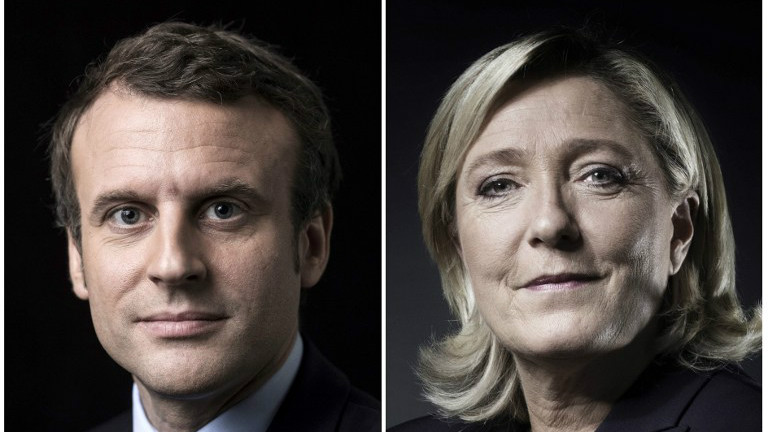
PARIS — Turnout in France’s presidential election stood at 65.3 percent Sunday afternoon, as French voters headed to the polls Sunday to pick a new president, choosing between centrist Emmanuel Macron and far-right leader Marine Le Pen in a crucial election for the future of the country and Europe.
The interior ministry said turnout figures were down from 71.96% at the same point at 5 p.m. in France in the 2012 presidential ballot.
Polling day follows a rollercoaster campaign marked by scandal, repeated surprises and a last-minute hacking attack targeting Macron, a 39-year-old former investment banker who has never held elected office.
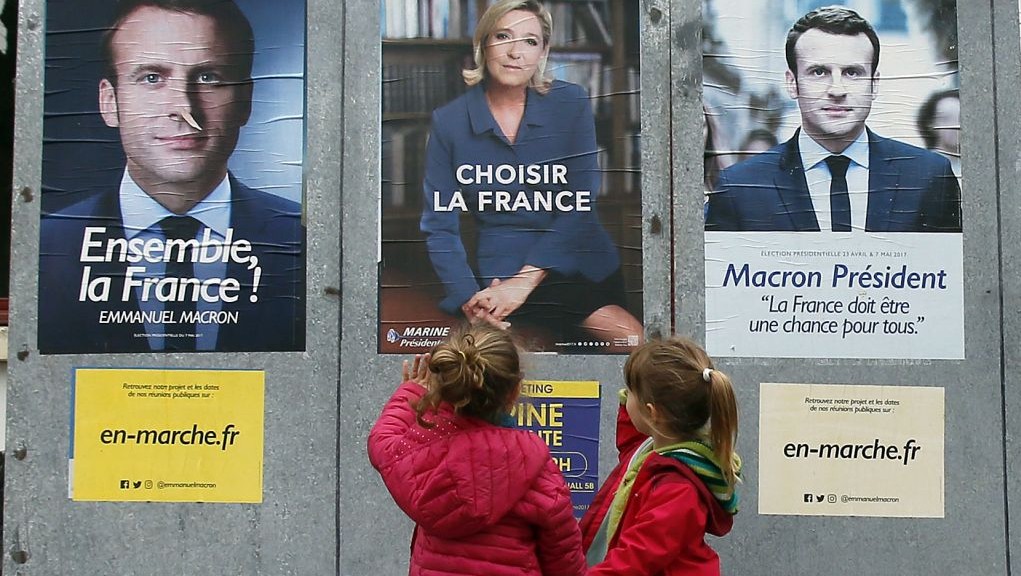
The run-off vote pits the pro-Europe, pro-business Macron against anti-immigration, anti-EU Le Pen, two radically different visions that underline a split in Western democracies.
Le Pen, 48, has portrayed the ballot as a contest between the “globalists” represented by her rival — those in favor of open trade, immigration and shared sovereignty — against the “nationalists” who defend strong borders and national identities
She is hoping to spring a shock result that would resonate as widely as Britain’s Brexit decision to withdraw from the European Union or the unexpected victory of US President Donald Trump.
The vote, falling in the middle of a three-day weekend, is the first in the six decades of the Fifth Republic in which neither the traditional left nor right has a candidate.
Sunday’s figure was down on the mid-afternoon participation rate of 69.42% recorded during the first round of the election on April 23.
Overall turnout for French presidential elections is usually high, at around 80%.
A recent voter survey found that seven in 10 voters are unhappy with the choice between Macron and Le Pen.
Some 47 million people are eligible to vote. About 70,000 polling stations across the France opened at at 8 a.m. local time (9 a.m. in Israel) Sunday, for a maximum of 12 hours. Voting in French overseas territories starts Saturday.
The first estimated results are expected shortly after 8 p.m. in France (9 p.m. in Israel).
The last opinion polls showed Macron, who won the first round vote last month, with a widening lead of around 62% to 38% for Le Pen before the hacking revelations surfaced on Friday evening. An information blackout entered into force shortly after.
Hundreds of thousands of emails and documents stolen from the Macron campaign were dumped online and then spread by anti-secrecy group WikiLeaks, in what the candidate called an attempt at “democratic destabilization.”
France’s election authority said publishing the documents could be a criminal offense, a warning heeded by traditional media organisations but flouted by Macron’s opponents and far-right activists online.
“The world is watching,” said 32-year-old marketing worker Marie Piot as she voted in a working-class part of northwest Paris.
“After Brexit and Trump, it’s as if we are the last bastion of the Enlightenment,” she said.
Le Pen cast her ballot in her northern stronghold of Henin-Beaumont, where bare-breasted Femen activists climbed scaffolding on a church and unfurled a banner reading: “Power for Marine, despair for Marianne,” referring to the symbol of France.
Macron voted in the northern seaside resort of Le Touquet where he has a holiday home.
Outgoing Socialist President Francois Hollande, who decided in December against seeking re-election, cast his ballot in his former electoral fiefdom of Tulle, in central France.
Hollande, who plucked Macron from virtual obscurity to name him economy minister in 2014, said voting “is always an important, significant act, heavy with consequences”.
No traditional parties
Whoever wins Sunday’s vote it is set to cause profound change for France, the world’s sixth-biggest economy, a permanent member of the UN Security Council and a global military power.
It is the first time neither of the country’s traditional parties has a candidate in the final round of the presidential election under the modern French republic, founded in 1958.
Macron would be France’s youngest-ever president and was a virtual unknown before his two-year stint as economy minister, the launchpad for his presidential bid.
He left the Socialist government in August and formed En Marche! (On the Move), a political movement he says is neither of the left nor the right and which has attracted 250,000 members.
Macron campaigned on pledges to cut state spending, ease labour laws, boost education in deprived areas and extend new protections to the self-employed.
He is also fervently pro-European and wants to re-energise the soon-to-be 27-member European Union, following Britain’s referendum vote last June to leave.
“France is not a closed country. We are in Europe and in the world,” Macron said in an acrimonious face-to-face debate with Le Pen on Wednesday.
Backlash against globalization
National Front leader Le Pen sees herself as part of the same backlash against globalisation that has emerged as a powerful theme in the United States and in recent elections in Britain, Austria and the Netherlands.
She has pledged to organise a referendum on withdrawing France from the EU and wants to scrap the euro, which she has dubbed a “currency of bankers”.
Le Pen has also vowed to reduce net immigration to 10,000 people a year, crack down on outsourcing by multinationals, lower the retirement age and introduce hardline measures to tackle Islamist extremists.
Many voters still see her party as anti-Semitic and racist despite her six-year drive to improve its image.
Macron topped the first round of the election on April 23 with 24.01 percent, followed by Le Pen with 21.30 percent in a crowded field of 11 candidates.
The results revealed Macron was favored among wealthier, better educated citizens in cities, while Le Pen drew support in the countryside as well as depressed areas in the south and rustbelt northeast.