UN Mideast envoy urges Palestinian unity amid Gaza pay cut protests
Nickolay Mladenov calls on Hamas to allow the PA to resume governance over the coastal territory
The United Nations envoy for the Middle East on Saturday called for Palestinian political unity amid fresh protests against civil service pay cuts in the Gaza Strip.
In a statement, Nickolay Mladenov expressed “deep concern by the growing tensions” in the Palestinian territory, and called on the Hamas leadership to allow its West Bank-based rival government, the Palestinian Authority, to “assume its responsibility in Gaza.”
“I am deeply concerned by the growing tensions in Gaza,” he said. “While the Palestinian Government needs to ensure its fiscal sustainability under increasingly difficult economic conditions, it is important that reforms or decisions to reduce expenditures are fairly distributed and made with consideration to the harsh conditions under which people in Gaza live.”
Mladenov said Gaza is “an integral part of the future Palestinian state and no efforts should be spared to bring about real national reconciliation that ends the division.”
“I urge the responsible parties to work together to find a solution to the current crisis and call on all factions to allow the Palestinian Government to assume its responsibility in Gaza,” the UN envoy said.
“Leaders have a responsibility to avoid escalation and bridge the growing divide between Gaza and the West Bank that further fragments the Palestinian people,” his statement added.
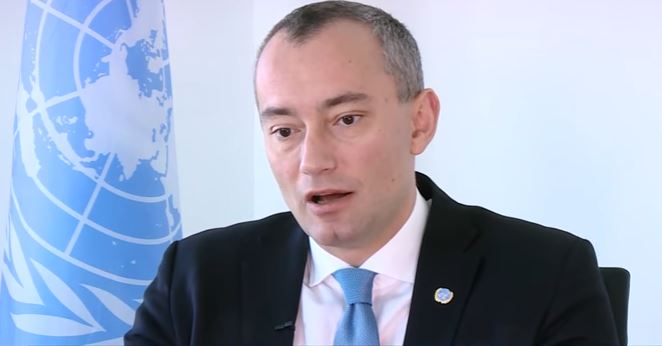
Mladenov’s statement was released as tens of thousands of Palestinians took to the streets of Gaza City to protest the recent salary cuts announced by the PA.
The decision last week by Ramallah to impose pay cuts on its civil servants in the coastal territory has sparked anger among affected government employees. Demonstrators at Saturday’s protest, the largest since the 30 percent cut was announced, called on PA President Mahmoud Abbas to sack his government.
The decision further deepened the divide between the West Bank and Gaza — two territories that the Palestinians hope to turn into an independent state — and increased hardship in already impoverished Gaza.
The internationally backed PA, which controls the West Bank, ordered all of its roughly 50,000 workers to step down after the Islamic militant group Hamas seized power in 2007. But it has continued to pay the salaries of the former policemen, teachers and civil servants.
Israel and Egypt have maintained a blockade over Gaza since Hamas, a militant group sworn to Israel’s destruction, took power. Israel says the measure, which has restricted the movement of people and goods in and out of Gaza, is needed to prevent Hamas from importing arms. But the blockade has hit Gaza’s economy hard, and unemployment is now over 40%, according to the World Bank.
The faltering economy has remained afloat through sales of consumer goods. The PA employees have provided a large slice of the purchasing power that business owners rely on to keep their commerce alive.
Hamas, which hired more than 40,000 people to fill the gaps left by the absence of the Palestinian Authority workers, also struggles to pay its employees.
After repeated efforts to reconcile with Fatah failed, Hamas is increasingly relying on hefty taxes on imports, utility fees and customs to pay its employees just half of their regular salaries.
Hamas condemned the PA salary reductions as “abusive and irresponsible,” while the Democratic Front for the Liberation of Palestine terror group said they were “illegal and unacceptable,” according to Ma’an.
On Friday, the Islamic Jihad terror group held a rally in the southern Gaza city of Khan Younis protesting the pay cuts, which demonstrators said were meant to “drown” the residents of Gaza, Ma’an reported.
Agencies contributed to this report.