UN official, European leaders urge others to pitch in on migrants
Migration representative says governments shouldn't 'buy their way out'; Merkel wants EU quota system with no cap on refugees
The United Nations’ top official in charge of migration said Tuesday the crisis rocking Europe needs a “global response,” insisting that countries worldwide must be asked to do their share.
At the same time, leaders in Germany and Sweden called for other European countries to do more to take in their fair share of refugees.
“We should have a European response as part of a global response,” UN Special Representative for Migration and Development Peter Sutherland told reporters in Geneva, hinting at the need for an international conference “where every country is held up to the spotlight.”
Europe is dealing with hundreds of thousands of migrants — many of them fleeing violence in places like Syria — pouring across the Mediterranean and taking a land route up through the continent.
Syria’s neighbors are meanwhile struggling to host more than four million refugees from the war-ravaged country.
Sutherland insisted geographical proximity to a crisis should not determine who takes in refugees, pointing out that during the Vietnam War, refugees were welcomed into countries around the globe.
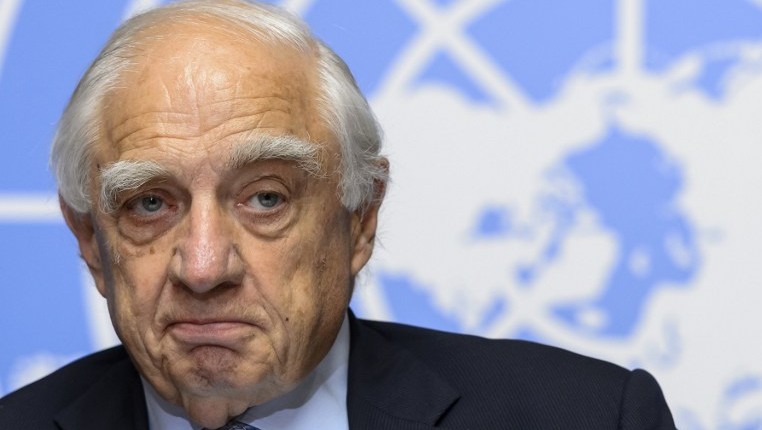
The same, he said, was true following the Hungarian revolution in 1956, when an international conference was held to help distribute the some 200,000 people who fled the Soviet crackdown.
He called for “a much more proactive response by the international community.”
“We have to find a method, perhaps as we did in 1956 in the conference that took place then, to get specific commitments from every state in regard to taking refugees,” he added.
He also insisted on a system to evaluate who constitutes a refugee that is consistent across all nations, noting that at present, different countries are using different criteria.
European quota system
Germany and Sweden meanwhile called for fellow European Union countries to accept a system of quotas to ensure a fair distribution of refugees across all 28 member states, with no upper limit on the overall number the bloc will receive.
Current EU rules require that people fleeing war and persecution apply for asylum in the first member state they reach. This has overwhelmed some countries on the EU’s outer borders, leading them to encourage migrants to keep traveling to countries such as Germany.
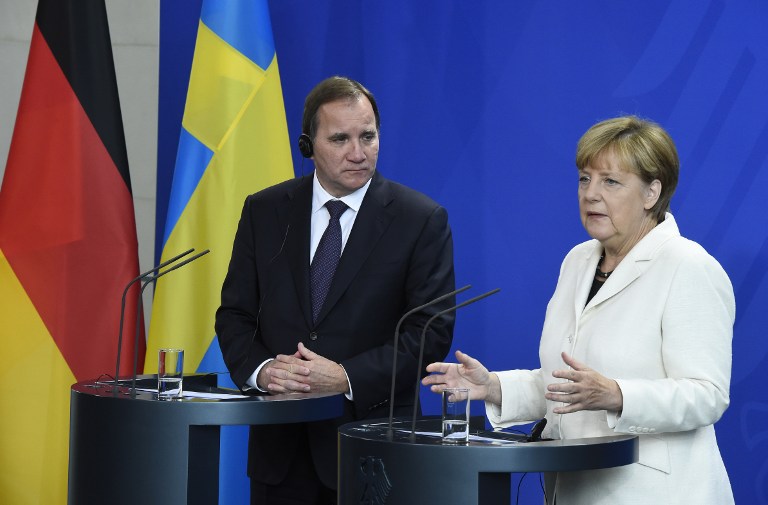
“We need binding quotas for refugees who have the right to asylum so they are fairly distributed according to strict principles among the member states,” German Chancellor Angela Merkel said after meeting Sweden’s Prime Minister Stefan Lofven.
European Commission President Jean-Claude Juncker is expected to put forward a proposal for a quota system Wednesday that Merkel said would be a first step, though a final agreement was likely still far off.
“This is a challenge that will decide the future of Europe, whether we are accepted as a continent of values and individual freedom,” Merkel said. “In this question, where the whole world is looking to us, we can’t simply say Syria is too far away, we’re not going to deal with the problem.”
The open-ended quota system envisaged by Germany and others would take into account a receiving country’s population size, economic prowess and unemployment. German officials anticipate some 800,000 asylum requests this year, and Merkel’s deputy, Sigmar Gabriel, has said the country can sustain “something in the order of a half-million for a few years.”
Lofven said he was disappointed some countries were ignoring their responsibility to help those in need. “If people knock on the door who are fleeing from war, terror, rape, then we have to open the door,” he said.
Defining moment for Europe
Sutherland, from the UN, also stressed that sending aid money to help Syrians at home or in the region should not be seen by governments as a substitute to taking in a fair share of refugees.
“Buying your way out of this is not satisfactory,” he said, pointing out that a number of the wealthy Gulf states had been very generous in their contributions, but had taken in very few refugees.
The same, he said, is true of the United States and Britain.
Sutherland called for a much fairer distribution of the refugee burden within Europe, pointing out that only five European countries have taken 72 percent of all refugees, while others take “virtually none.”
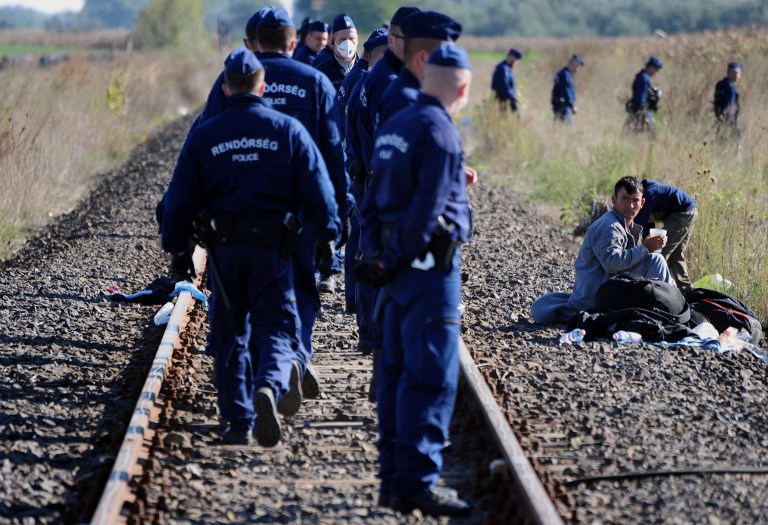
He was especially critical of Hungary, which instead of welcoming refugees is building an anti-migrant fence along its southern border.
“History will judge this as a defining moment for Europe, a Europe that proclaimed itself to be created on the principle of values,” he said.
Sutherland also stressed that far more resources needed to be channeled into the UN agencies and other organizations trying handle the refugee crisis and the humanitarian impact of Syria’s war.
The UN refugee agency warned Tuesday that increasingly brutal fighting in Syria and the dire underfunding of aid operations aimed to help the refugees in neighboring countries are pushing many to risk the perilous journey to Europe.
“For the vast majority, who are not living in formal camps, hope is dwindling as they sink ever deeper into abject poverty,” UNHCR spokeswoman Melissa Fleming said.
The UN’s World Food Programme (WFP) meanwhile said severe underfunding had forced it to halve its food assistance to 1.3 million Syrian refugees, most of whom are now living on the equivalent of 50 US cents (44 euro cents) per day.
It has cut out food assistance altogether to 229,000 refugees in Jordan and 131,000 in Lebanon, as it tries to focus on feeding the most vulnerable.