UN report: Tunnels into Israel legitimately targeted IDF
Gaza probe says it can't conclude goal of underground infrastructure; credits Hamas rocket threats as warnings to Israeli civilians
The United Nations Human Rights Council report on the 50-day Gaza conflict said there was no indication Hamas’s cross-border tunnels were constructed to attack Israeli civilians, since the terror group exclusively targeted “legitimate” Israel Defense Forces positions during the summer war.
The report, released on Monday and roundly condemned by Israeli officials, also interpreted several Hamas threats as warnings to Israeli civilians in compliance with international law, while accusing both sides of possible war crimes.
The commission, headed by American jurist Mary McGowan Davis, said that the network of tunnels reaching into Israel did not conclusively prove a threat to Gaza border communities and were used legitimately.
“The commission cannot conclusively determine the intent of Palestinian armed groups with regard to the construction and use of these tunnels,” the report said. “However, the commission observes that during the period under examination, the tunnels were only used to conduct attacks directed at IDF positions in Israel in the vicinity of the Green Line, which are legitimate military targets.”
Nine IDF soldiers were killed in tunnel attacks during the summer conflict, in four separate incidents.
In October 2014, the IDF confirmed a report in Vanity Fair that Hamas had planned to carry out a massive assault by penetrating Israeli communities via tunnels under the border from the Gaza Strip, and then killing or kidnapping as many civilians as possible.
IDF Spokesperson Peter Lerner said the terror group planned to use the tunnels to attack civilian areas in Israel and “inflict mass casualties.
“Hamas had a plan,” Lerner added. “A simultaneous, coordinated, surprise attack within Israel.
“They planned to send 200 terrorists, armed to the teeth, toward civilian populations,” continued Lerner. “This was going to be a coordinated attack. The concept of operations involved 14 offensive tunnels into Israel. With at least 10 men in each tunnel, they would infiltrate and inflict mass casualties.”
Destroying the tunnels was one of the main goals of the ground war launched by Israel, which says it destroyed dozens of subterranean passages.
Officials have warned of indications that Hamas has begun re-digging the tunnels in preparation for a new round of violence.
‘Warnings’ by Hamas
The UN report also credited Hamas with extending warnings to Israeli civilians of impending attacks on several occasions.
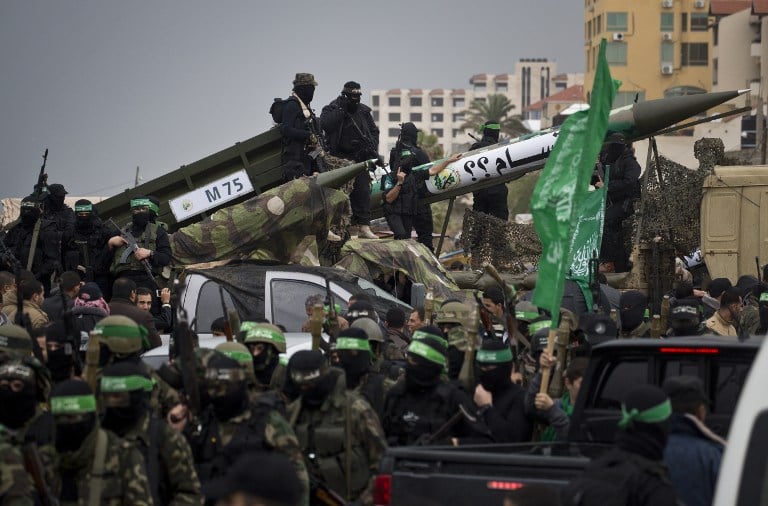
During the conflict, the Gaza-based terror groups frequently issued threats of rocket fire at the Jewish state as an intimidation tactic. The threats were interpreted by the commission as warnings alerting Israelis of the rocket fire so they could successfully seek safety.
The international law, cited by the report, maintained that “effective advance warning shall be given of attacks which may affect the civilian population, unless circumstances do not permit.
“Palestinian armed groups appear to have provided advance warning in a very few instances before launching attacks that may have killed Israeli civilians,” added the report.
“Airlines were warned in advance of the possible targeting of the airport, providing them with the time to suspend flights. Warning civilians in Tel Aviv that a rocket would be fired in the direction of the city at 9 p.m. provided the opportunity for residents to seek shelter. Warning civilians to evacuate communities located in the vicinity of the Green Line could also realistically be acted upon because — unlike in Gaza — residents could flee to other areas of Israel less exposed to threats, in great part due to the existence of the Iron Dome system,” according to the document.
On August 20, a Hamas spokesperson threatened that rockets would target Ben-Gurion Airport the next morning, forcing the cancellation of at least one flight, although no rockets were shot at that time. Two-thirds of foreign airlines stopped flying to Israel for a day-and-a-half during the war after a rocket landed near the airport, in what Hamas called a “great victory.”
The group also warned Tel Aviv and other cities that it would launch barrages of rockets at them at different times. The warnings were viewed in Israel as psychological warfare and the lion’s share of rocket attacks came without warning.
Despite the “warnings,” the UN probe concluded that “given the apparent absence of any possible military advantage” the rocket fire may be considered a war crime.
“While the commission cannot know what the intended target of each rocket attack was, statements made by Palestinian armed groups with regard to the firing of rockets indicate intent to direct those attacks against civilians. In addition, international tribunals have ruled that in certain circumstances, indiscriminate attacks may qualify as direct attacks against civilians,” it said. “The launching of rockets by Palestinian armed groups may therefore amount to war crimes.”