Union chief calls for elections, says PM should resign, threatens to join protests
Netanyahu 'took Israel to the edge,' says Histadrut chief Arnon Bar-David, who slams divisive policies, economic conduct: 'The country can't carry on like this, it needs a restart'
Arnon Bar-David, the head of the powerful Histadrut labor union, on Saturday, called on Prime Minister Benjamin Netanyahu to take responsibility for the failure to prevent Hamas’s October 7 massacres in southern Israel and to call elections by the end of the year, warning that the union could join anti-government protests.
The Netanyahu government “brought disaster upon Israel,” Bar-David said at a conference in the southern city of Beersheba, as reported widely by Hebrew media.
“He took us to the edge, to a place we should not have been… We’re at a dead-end, and there’s only one way out: elections,” said Bar-David. “He should take responsibility for what happened, and then he should make decisions regarding himself. If I were prime minister, I would resign.”
Netanyahu’s Likud party hit out at Bar-David, saying it was “shameful that amid this war, as the nation cries out for unity, Histadrut chairman Arnon Ben-David chose to deal in petty politics that divide the nation and weaken the war effort.”
Netanyahu has faced criticism for his refusal to take responsibility for October 7, while virtually all other military and civilian leaders who had a hand in events have done so. Many top officials are also expected to resign once the war concludes, while Netanyahu has signaled he has no such intention. The prime minister has pushed back against investigating the failures that enabled the Hamas attack so long as the war continues.
The union chief called on Netanyahu to set a date for new elections, and warned that the union — which can shut down much of the economy — will join protests if Netanyahu tries to cling to power.
The protest movement that swept through Israel’s streets for much of 2023 amid the Netanyahu government’s intensely contentious judicial overhaul efforts has fallen largely silent since October 7, but has recently started to pick up steam again as the war drags on, with many hostages still in Hamas’s hands and opponents of the premier accusing him of making decisions based on political considerations.
Bar-David did say, however, that elections now would not be prudent, with the war ongoing, and the danger of escalation in the north, but said an agreed date for new elections should be set “for the end of the year, December — by then the war can be won.”
“The country cannot carry on like this… the State of Israel needs a restart,” he said.
He added: “We need to build something new. Everyone wants something new… for new people to enter politics… We can’t continue with the [current] 120 people in the Knesset… who do almost nothing for us.”
“We may have to take to the streets” to press for elections, he warned. “I hope that won’t be necessary.”
“And if the people [when they vote] want the same coalition… so be it. And if the people want change, there will be change.”
In March of last year, the Histadrut announced a general strike amid mass protests as the coalition attempted to push multiple bills through parliament to overhaul the country’s judiciary. That strike lasted a single day as Netanyahu quickly halted the legislation to allow for talks with opposition party representatives.
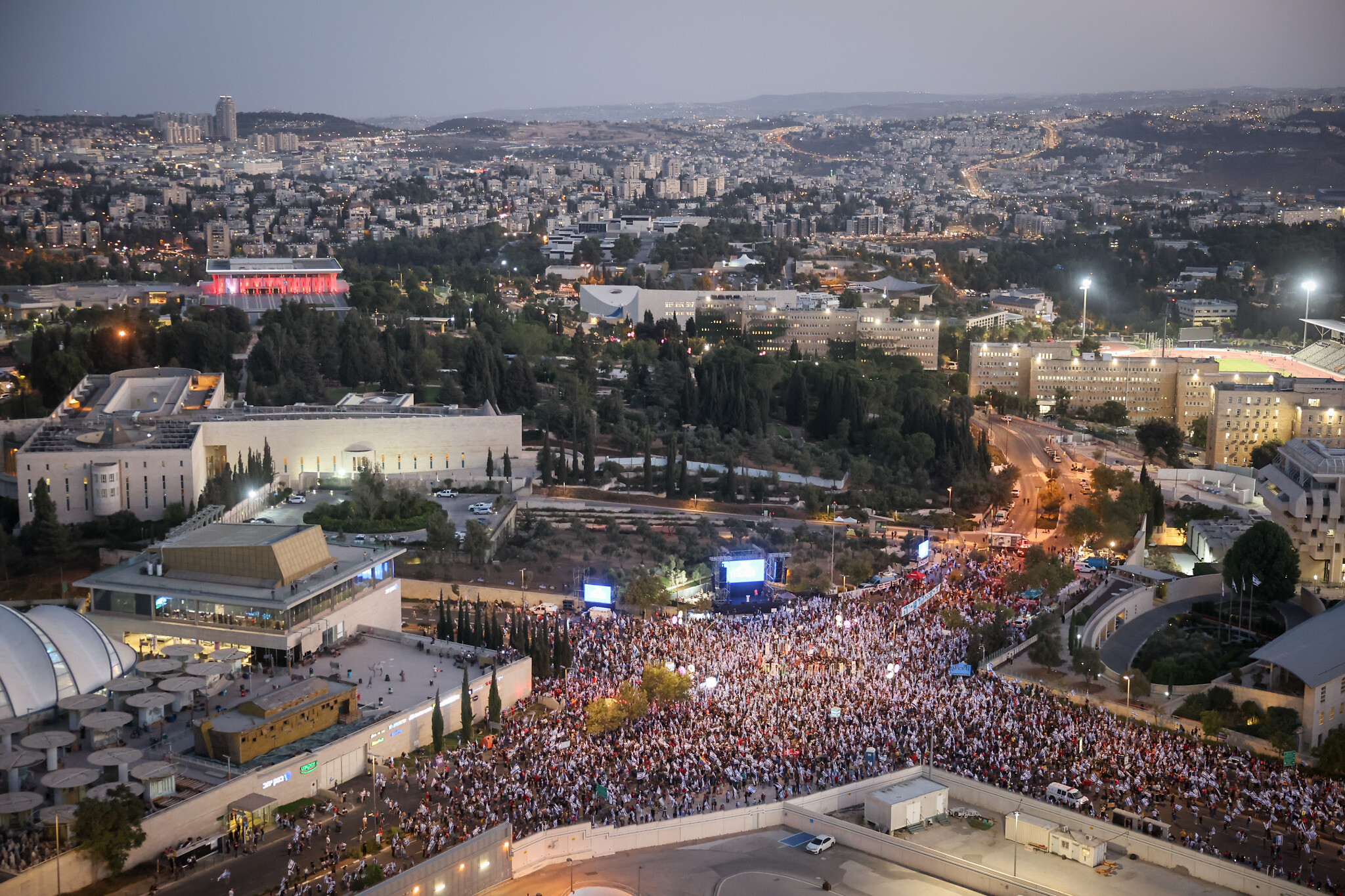
Bar-David later resisted opposition pressure for further strikes as the national conflict over the overhaul continued throughout the year. The war that began in October, and the High Court decision in January to strike down a central pillar of the overhaul, have halted the government’s efforts for now.
Even before the war, Israel had gone through “the worst year in its history, a year of polarization and divide and judicial revolution,” Bar-David said, referring to the coalition’s polarizing attempt to curtail the judiciary. “And someone turned us into one another’s enemy, someone stirred up one sector against the other; the writing was on the wall.”
He denounced the pre-war focus on the judicial overhaul, when Israel should have focused on its external enemies.
Bar-David also appeared to accuse Netanyahu of holding up a deal to free the hostages who remain in Gaza for political reasons.
“There is a deadline. We have to free the hostages and reach a deal, if it doesn’t happen because it doesn’t suit someone politically, then the government will fall apart,” he said.
Bar-David was also highly critical of the government’s economic conduct, saying the recent decision by Moody’s to downgrade Israel’s credit rating was “a scandal” on the part of the government.
“It’s something we could have avoided if the government and the finance minister had taken the right steps… I spoke to them about this. If they had taken the correct steps, not very complicated ones, we could have stabilized the economy, stabilized public trust in the government, which is now nearly non-existent.
“They should have prepared a much more serious budget, tighter, smarter, forward-facing; to understand we have a problem with the world and our credit is running out.”
He said economists around the world were not blind to Israel’s failure to take such steps.
“There was a unique opportunity here to change the paradigm in the country,” he said, referring to the recent updates to the budget amid the war. “They should have canceled all the superfluous ministries, they should have canceled all the discretionary coalition funds and poured it all into the military, the war and Israeli security. This wasn’t done and the world did not miss this.”
He said all this had not been done because Netanyahu was mostly concerned with political survival.
“There have been mistakes upon mistakes and it’s caused us terrible damage.”