Unlikely allies on Israel-Syria border, as Assad watches his country split
Israel should beware: The al-Nusra Front is creating a real stronghold on the Syrian Golan Heights, and is no less dangerous than IS
In the Golan Heights border area, a strange reality has emerged: Israel and local Syrian opposition groups are cooperating in order to manage the humanitarian situation. And all the while, al-Nusra Front fighters, theoretically affiliated with al-Qaeda, are in the background. This organization, mostly Syrian, was born with the Islamic State, and split off after a personal fight between two leaders.
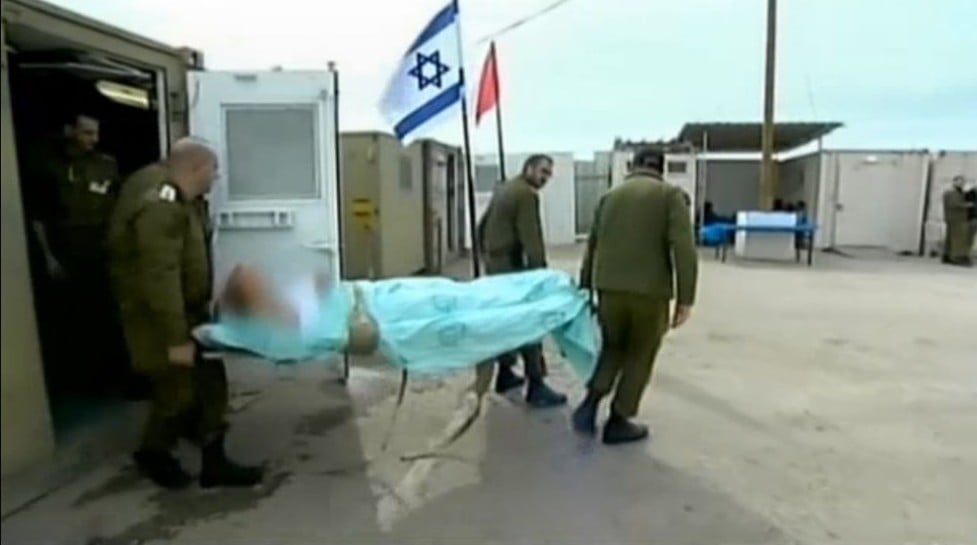
How does the improbable cooperation actually work? When there are Syrian civilians trying to get treatment at the field hospital Israel set up on the other side of the border, opposition members do the initial security check and make sure they are not terrorist operatives.
Next, the sick or wounded cross the border to Israel, and undergo another security check before going on to receive medical care. The Israeli side also supplies blankets, medical supplies, baby food, and more to the Syrians.
This is an area that is mostly controlled by the al-Nusra Front. That means that the good news for Israel from Syria is that, for now at least, the Sunni terror groups are focusing their efforts on Bashar Assad and Hezbollah. The bad news is that this is only temporary. The al-Nusra Front is creating a real stronghold on the Syrian Golan Heights, and despite what the media believes, it is no less dangerous or extreme than Islamic State, just different in its methods of operation. It is these practices that make it in many ways more dangerous for Israel in the long run.
Daraa, the poorest province in Syria, not far from the Israeli border, has become the center of activity for al-Nusra. One can see how different its practices are compared to IS in places like Raqaa. While the latter captures an area and immediately imposes on the local population prohibitions and punishments, including executions, al-Nusra is more user-friendly. In other words, it tries to enlist the local population by running a Dawa network, in a manner reminiscent of its rival, the Muslim Brotherhood: The organization provides food to the poor, arranges a longer school day, and of course provides plenty of religion classes, during which al-Nusra members will try to explain in a friendly manner why it would be better for the females to hide their faces with a veil.
At the other end of Syria, in the northeast, IS’s progress continues. It is slower because of the international coalition’s operations, forcing the organization to change its methods in order to survive. Still, IS continues to expand overall, especially on the ideological level. In areas that IS takes, it tries to present an alternative government, though one more violent and frightening than the al-Nusra Front for the locals.
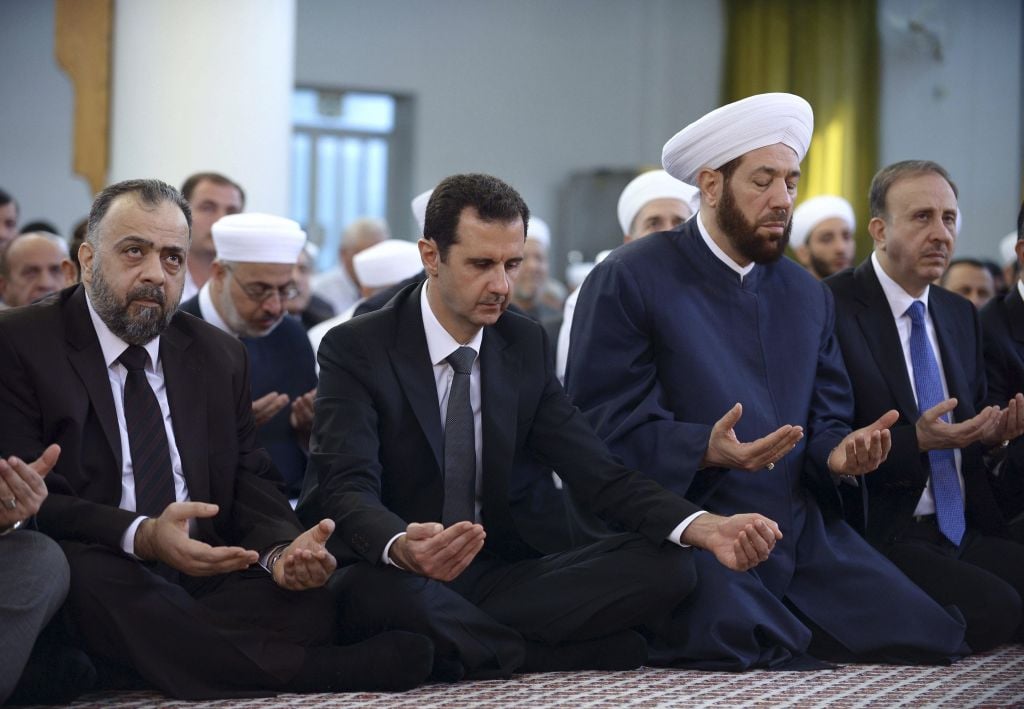
Meanwhile, President Bashar Assad sits in between and controls what is left of Syria, the pockets on which he focuses his effort to survive.
In many ways, the Syrian president is holding on thanks to the fact that he has given up the dream of ruling the entire country once more. Now he realizes that in order to stay alive, he must base and cement his rule in Damascus, Aleppo, and Latakia, with no choice but to watch as the rest of Syria splits apart.