What does an old-new foreign minister bode for peace talks, Iran, Turkey?
Ministry officials are happy to have a leader again, but might soon wish he'd consult them before making drastic policy decisions
At around the same time that the Jerusalem Magistrate’s Court exonerated Avigdor Liberman from corruption charges Wednesday morning, paving the way for his return to the Foreign Ministry, Prime Minister Benjamin Netanyahu was meeting with US Secretary of State John Kerry across town. Besides Iran, the agenda was dominated by the faltering peace negotiations with the Palestinians. “I’m concerned about their progress,” Netanyahu told Kerry, who had invested so much effort into restarting earlier the talks year.
Right after his meeting with Kerry, Netanyahu called Liberman and congratulated him on his return to the cabinet. “We will continue to work together for the good of Israel,” he said. But the truth is that Liberman’s return to the helm of Israel’s foreign policy apparatus gives Netanyahu even more reason to be concerned about the peace talks.
It is not the foreign minister but Justice Minister Tzipi Livni and Netanyahu confidant Yitzhak Molcho who are negotiating with the Palestinians. And the cabinet, even without Liberman, has no shortage of voices opposing any two-state deal with Abbas. But few are so vocal in their open hostility to Israel’s would-be peace partner.
“Abu Mazen is a man of terrorism,” Liberman said last year, using Abbas’s nom de guerre. “The political terrorism that Abu Mazen engages in is more dangerous for us than the armed terrorism that [Hamas’s Gaza Prime Minister Ismail] Haniyeh and all the other Hamas leaders are involved with.”
But the old-new foreign minister is not only liable to hasten the peace talks’s demise with his inflammatory rhetoric. He will also hold a vote in the security cabinet. In that powerful role he could potentially prevent the next release of Palestinian prisoners, scheduled to take place in about three months, thus giving the Abbas the perfect reason to quit the talks.
Quiet concern in the international community
In the international community, the return of Israel’s most controversial politician — who during his four years in office said then-president of Egypt Hosni Mubarak could “go to hell,” accused Europe of a willingness to sacrifice Israel to the Arabs “without batting an eyelid,” and issued countless other provocative statements — is certainly cause for concern.
Last year, Austria’s then-defense minister Norbert Darabos said “a Mister Liberman as a member of the Israeli government is unbearable.” Most Western leaders are more diplomatic, but many share Darabos’s assessment, and not only because of the Yisrael Beytenu chairman’s often incendiary rhetoric. Liberman’s bleak position on the peace process — his own plan centers around an “exchange of populated territory,” i.e., the establishment of a Palestinian entity that would include major Israeli-Arab population centers but not Jewish settlement blocs near the Green Line — not only embarrasses Netanyahu (who rejects this approach) but also causes significant discomfort to Israeli diplomats in capitals across the world.
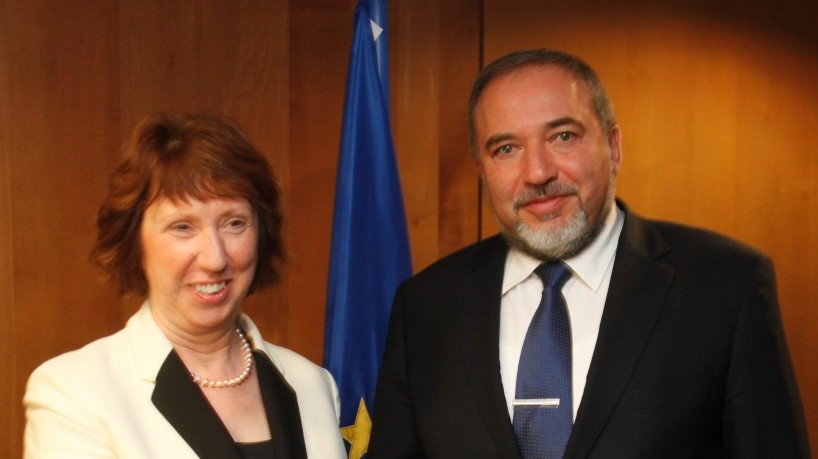
Upon Liberman’s expected return to his old post — he’ll reportedly be sworn in next week in the Knesset — he will find a different Foreign Ministry from the one he left. “The ministry is totally demoralized and he will have to put it back on track,” a diplomatic official told The Times of Israel Wednesday.
For the 10 months since Liberman’s resignation in December, the ministry lacked a strong leader and management, and had no one to represent its viewpoint in the cabinet, the official lamented. “Our responsibilities were taken from us and given to other ministries, and we’re still bitter about the ongoing struggle of the workers’ union over better working conditions. We’re also still upset about a police raid following corruption charges in the administrative part of the ministry.”
Indeed, the workers’ union on Wednesday welcomed Liberman’s anticipated return: “We hope that Liberman will bring back to the ministry its responsibilities, act toward solving the workers’ hardships and advance Israeli diplomacy,” a statement read.
Turkey, Iran, the UN — whither Israeli foreign policy?
Besides the small matter of possibly torpedoing the peace process, Liberman is unlikely to drastically change the direction Israeli foreign policy took in his absence.
On the Iranian nuclear program, he and Netanyahu are on the same page.
But what about Turkey? While Liberman was — and still is — emphatically opposed to Israel’s apology for the 2010 Mavi Marmara incident, there is little he can do to make bilateral ties much worse than they already are. The negotiations between Jerusalem and Ankara that followed Netanyahu’s March phone call with his Turkish counterpart Recep Tayyip Erdogan have long been stalling, mainly because the Turks aren’t interested in burying the hatchet because of the political climate at home, according to Israeli diplomats. “Liberman can’t un-apologize,” an Israeli official said. “He will listen to Erdogan’s statements [denigrating Israel] and from time to time respond in kind, but he won’t start any anti-Turkish initiatives.”
‘He’s not scheming far ahead as much as people think. He left the Human Rights Council on a whim, not because he had well-researched strategic plan’
One of Liberman’s most memorable actions as foreign minister was overseeing Israel’s unilateral withdrawal from the United Nations Human Rights Council in early 2012. Angry over a planned fact-finding mission into the West Bank settlements, he cut all ties with the Geneva-based body. Israel rejoined the council last month, but only after Western countries promised to work toward stemming its anti-Israel bias and helping Jerusalem join the Western European and Others regional group.
These are significant achievements, mostly attributed to Deputy Foreign Minister Ze’ev Elkin, and it is improbable that Liberman would move to endanger them by threatening to leave the council again. (It should also be noted that some observers credit Liberman for this success, arguing that if he hadn’t left the council, Israel wouldn’t have been able to come back under the new conditions.)
However, analysts say Liberman’s foreign policy is often volatile and capricious; hence it is difficult to predict which erratic move to expect from him. “He’s not scheming far ahead as much as people think,” the diplomatic official said. “He’s impulsive and an improviser. He left the Human Rights Council on a whim, not because he had well-researched strategic plan.”
Even during his months of political exile, Liberman wasn’t sparing with provocative statements. Just last week, he warned South African Jews of a looming “pogrom” after International Relations Minister Maite Nkoana-Mashabane had said she was losing sleep over the Palestinians’ plight and that Pretoria would downgrade relations with Israel. The South African Jewish Board of Deputies, an umbrella organization representing South African Jewry, rejected Liberman’s suggestion as “alarmist and inflammatory.”
Liberman also accused Pretoria of being “anti-Semitic” and hypocritical, which more than one Israeli diplomat criticized as inappropriate and counterproductive.
Liberman is a man of strong political convictions, and when it comes to managing Israel’s foreign policy, he often shoots from the lip. While the Foreign Ministry’s diplomats are happy today to have a strong leader again, they might soon enough wish he would consult them more when it comes to managing Israel’s relations with its neighbors and the world at large.