What was this latest Gaza kerfuffle about, anyway?
Hamas risked outright war by firing on the Sharon region on Monday - and for what? To embarrass Netanyahu? To prepare for Saturday's 'million man march?'
It is hard to know who to believe. Do we believe the politicians who told us that “there was no cease-fire”; the army, which at that same moment lifted restrictions in the south, or perhaps the leader of Hamas, who said, summing up the flare-up, that “the resistance had its say and the occupation got the message?”
As of this writing, late Wednesday, the cease-fire is being kept, even if the Israeli prime minister will not acknowledge that there is one, due to his election campaign. Hamas succeeded in scuttling his plans time and again — first by keeping him from appearing on the stage he loves so much, the annual AIPAC conference in Washington, which he “abandoned” to Benny Gantz — and then by shattering his image as “Mr. Security” by showing what every child in Gaza knows: that the Israeli government wants Hamas in the Gaza Strip.
Neither Netanyahu nor his ministers will admit it, but the alternative to Hamas’s regime in Gaza would be far more chaotic and dangerous, which is why the prime minister would rather reach an agreement with Hamas, of whatever kind, than start a war that will lead nowhere.
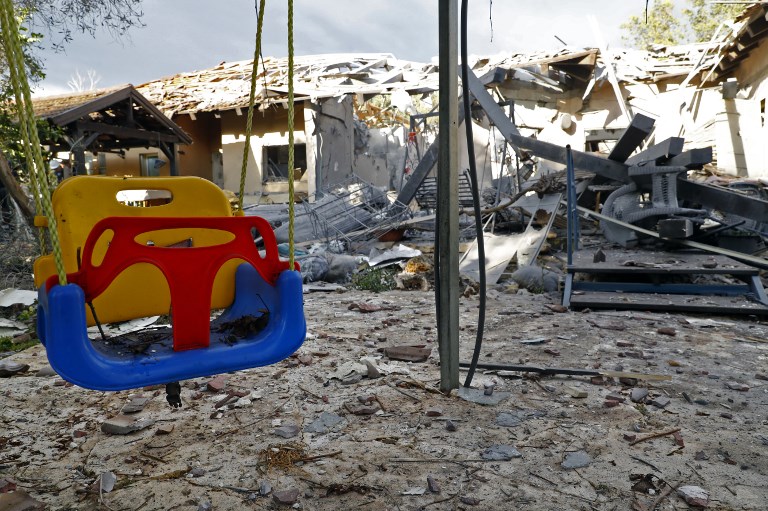
Yet even now it is not clear what Hamas was trying to accomplish in this week’s escalation — which began with a rocket attack that flattened a home and injured seven Israelis early Monday — other than keeping Gaza in the headlines.
It was willing to risk war, firing a rocket at the Sharon region while fully aware that no real change would happen on the ground from any fallout, at least until after the elections. Hamas’s leaders realize that a brief round of rocket strikes, such as the one we’ve just witnessed, proceeded according to the Arabic saying: “Titi titi, zay ma ruhti, zay ma jiti” — As I came in, so I went out.
The situation in Gaza remained unchanged, and Hamas continues to make a show of wanting escalation without actually doing anything that might precipitate a war. The best that might be said for this policy, from Hamas’s perspective, is that it proves Hamas has not become like the Palestinian Authority, which cooperates with Israel.
The question now is how fragile the non-cease-fire will prove to be, after it was reached in the nick of time through the mediation of Egypt and of UN envoy Nickolay Mladenov. The latter two are growing used to serving as babysitters of sorts to quarreling children who keep calling on them to break up the latest fight.
With no comprehensive solution in sight for the Gaza Strip, the next fight is only a matter of time — very little time; it may come as soon as this Saturday. That’s the date, March 30, that Hamas has slated to mark the one-year anniversary of its “march of return” protests. The group continues to plan its “million man march” (which may actually reach as high as a few tens of thousands of participants) for that day, and will want to make the event particularly bloody.
And with images of dead and wounded boosting Hamas’s credibility, what will be the response from Palestinians and Israelis? Will the rocket fire at Israel resume? Will the Israeli election campaign turn to focus once more on Gaza? Or will it all pass quietly by, returning Israelis to more comfortable regular campaign chatter about hacked telephones, submarines and other ordinary things?