Why is it so hard to know how many Israelis are poor?
And some harsh lessons being learned in Shas about the steep political costs of schism
Three major reports on the troubled Israeli economy is a lot to absorb in a single week — especially in the middle of an election campaign, and especially when they all seem to tell a different story.
First came last Tuesday’s official poverty report by the National Insurance Institute, which found that almost one in five households — 18.6% — live below the poverty line. But the NII counts the poor by income alone, and sets the income-based poverty line as a percentage of the median income (where half of incomes are above it and half are below). The poor are thus measured by comparison of their incomes to those of wealthier Israelis, and not by any objective measure of their circumstances. For all the NII measure can tell, the poor could be wealthy, healthy and happy in objective terms, just not as much as their millionaire neighbors. Or, conversely, they could be in dismal straits, needy and hungry, with the better-earning middle class hovering only slightly above their stricken condition.
Into this question stepped this week’s report by the charity Latet, an umbrella of Israeli food banks and poverty advocacy groups. Latet polled Israelis about their real-life experiences, and produced a startling measure of need. Measured by their own testimony about housing, food security, health, education and the high cost of living, as many as 2.5 million Israelis — in a population just over 8 million — are classified by Latet as “poor” or “severely poor,” by which the organization means that they lack some measure of access to those necessities.
As a measure of poverty, Latet’s figures add nearly a million Israelis to the ranks of the “poor” than does the NII.
And then there’s the Taub Center’s annual “State of the Nation” report, which came out last Wednesday. Taub’s report offered some startling insights that help bridge the vast gaps between those two radically different ways of thinking about poverty.
Among Taub’s findings: Israel’s untaxed “shadow economy” may be as large as 20% of the nation’s GDP. This helps to explain why the NII report found as many as half of Arab and Haredi households live below the poverty line, while Latet, which reported higher rates of poverty in every other group, actually measured a lower rate among these minorities when they were asked to report their own conditions. A great deal of their economic activity, this gap suggests, simply goes unreported and untaxed.
At the same time, Taub pointed to a stark reality when it comes to cost of living — as many as 80% of Israeli households may be spending more than they earn. Even if they earn above the poverty line, most Israeli families find themselves spending beyond their means, a finding that may explain why so many told Latet that life’s necessities are beyond their reach even as their incomes, by the accepted measures of the NII, are not low.
The vast, untaxed cash economy concentrated in the Haredi and Arab sectors, educational deficiencies in Israel’s social and geographic peripheries, the difficulty in assessing what the competing measures of poverty actually mean — all these questions, which are fundamental to understanding and thereby relieving the real-life suffering of the poor, come into stark relief when one reads the reports.
But, of course, it’s election season, where honest discussion and measured policy debate go to die. It doesn’t matter that Netanyahu’s free-market reforms are a major factor in the dramatic economic growth of the past decade, or that he raised the minimum wage in 2011 while lowering child and other welfare benefits that sustained the highest non-work rates in the developed world among Haredim and Arabs — poverty, Labor explained this week, is entirely his fault. Yet the Likud’s claim that the economy is in great shape is equally wrong and egregiously tone-deaf. Vast swaths of Israeli society struggle to make ends meet; Israeli education is declining even as the nation’s dependence on the highest-skilled portion of its workforce is growing; and all the while, state-sanctioned monopolies, ownership “pyramids” and other dubious anti-competitive legal inventions have placed much of the Israeli economy under the control of either government functionaries or a tiny handful of billionaire families.
Instead of discussing these serious challenges, politicians are engaged in sterile finger-pointing. One can only hope that when one side or another finally wins in March, they will approach their governing with greater seriousness than they displayed in their electioneering.
Lessons learned
A strange thing is happening in Shas. Party leader Aryeh Deri spent the past few days coming to terms with the political ramifications of losing his ally-turned-nemesis Eli Yishai, who broke away to form a competing party last week.
With Yishai’s exit, Shas dropped steeply in the polls from roughly nine seats two weeks ago to five in a Monday Knesset Channel poll and as low as four in a Tuesday Channel 10 poll. Yishai, meanwhile, broke the four-seat electoral threshold in both polls, and stands a good chance of leading his faction into the next Knesset at Shas’s expense.
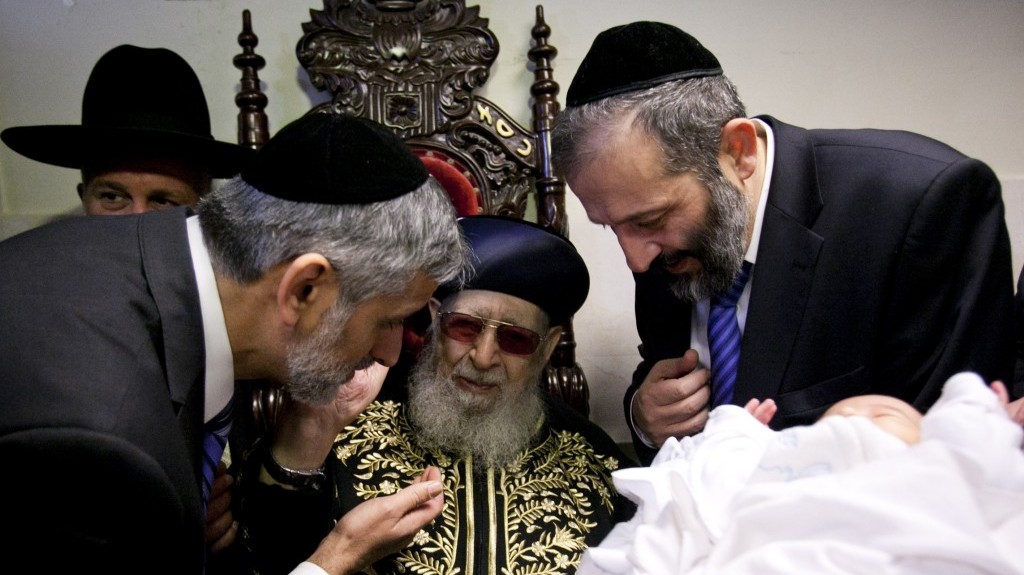
It must be gratifying for Yishai, the former Shas leader unceremoniously ejected from the top spot by the party’s spiritual leader Rabbi Ovadia Yosef in 2012, to see how much sway he still holds among the party’s voters. Yet he must be as worried as Deri of poll numbers showing him dangerously close to the electoral threshold.
These polls leave the splintered halves of the Shas empire in a strange standoff. Deri sees his faction — and future political sway — cut in half. Yishai knows he stands a decent chance of being left out of the next Knesset altogether. Both sides are growing more aware each day of how desperately they need each other, and how devastating their division may prove at the ballot box.
So it is no surprise that on Monday, Yishai’s political-religious mentor Rabbi Meir Mazuz sent a letter to Shas’s Rabbi Chaim Rebi urging a meeting with Yishai and Deri.
According to sources close to Deri, the letter signals that Yishai’s camp “blinked first” and is trying to “crawl back” to the Shas fold. According to Yishai’s confidants, Mazuz is committed to Yishai’s “Ha’am Itanu” (“The people are with us”) party, and merely wishes to urge both sides to run a clean campaign.
For all the bluster, however, neither side has said no to the meeting.