World leaders condemn Copenhagen attacks
European public figures decry twin shootings, as mourners gather outside synagogue in Danish capital
Public figures across Europe and beyond on Sunday condemned the attack by an unidentified gunman against a free speech event and a synagogue in Copenhagen that left three people dead, including the suspected perpetrator. Investigators in the Danish capital said the gunman could have been inspired by the terror attacks in Paris last month, in which three Islamic radicals killed 17 people at the Charlie Hebdo newspaper, a kosher grocery store and elsewhere.
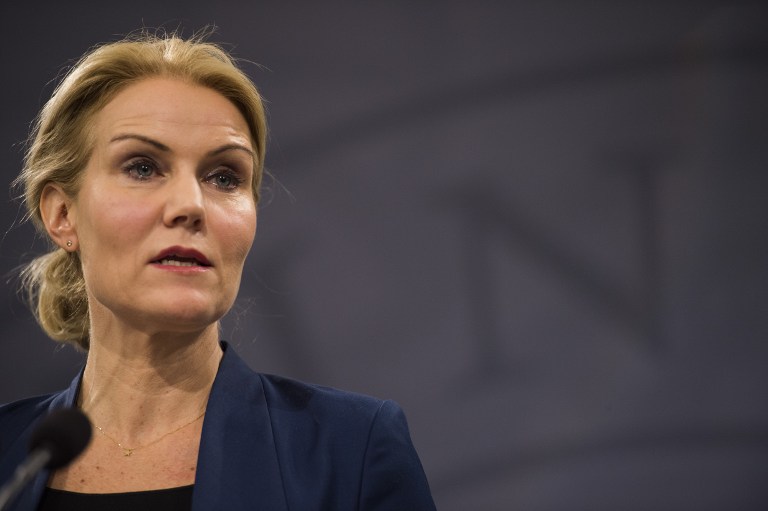
“Denmark has been hit by terror,” said Danish Prime Minister Helle Thorning-Schmidt. “As a nation we have experienced a few hours that we will never forget. We have tasted the nasty taste of fear and powerlessness that the terrorists want us to taste.”
“We do not know the motive for the alleged perpetrator’s actions, but we know that there are forces that want to hurt Denmark. They want to rebuke our freedom of speech,” she added.
The suspect on Sunday was identified in several Danish media outlets as Omar El-Hussein. Ekstra-Bladet, a Danish tabloid, reported that the 22-year-old and Danish-born man was released from jail only two weeks ago after serving a term for aggravated assault.
French Foreign Minister Laurent Fabius said on Europe-1 radio he was struck by how closely the bloody sequence of events in Copenhagen tracked the January 7-9 attacks in Paris.
“First, an attack against the symbol of freedom of expression. Next an attack against the Jews, and then the clash with police,” Fabius said.
British Prime Minister David Cameron denounced the “appalling attack on free speech and religious freedom.”
“Two innocent people have been murdered simply for their beliefs and my thoughts are with their loved ones and all those injured at this tragic time,” Cameron said.
German Chancellor Angela Merkel expressed her “deepest sympathy for the family members of the victims in these difficult hours,” spokesman Georg Streiter wrote in a statement.
Merkel confirmed that Germany is standing firmly on Denmark’s side and assured Danish Prime Minister Thorning-Schmidt that Germany would continue to closely cooperate in all measure regarding the fight against terrorism.
‘It feels less safe, especially in the Jewish community’
Small groups of people gathered Sunday at Copenhagen’s main synagogue in a mood of fear and defiance after two people died at the hands of a lone gunman in the city.
Some left flowers and candles or signed their names in the guestbook as they remembered one of the victims, a 37-year-old member of Denmark’s small Jewish community, who was killed outside the synagogue shortly after midnight as a bat mitzvah was being celebrated inside.
The shooting came just hours after a 55-year-old man died when the same gunman attacked a cultural center where a debate on Islam and free speech was taking place.
“It feels less safe, especially in the Jewish community. I came in solidarity. Everyone is blasting the Jews, and then we hit them as they celebrated bar mitzvah,” a 65-year-old man who gave his name as Liebecke told AFP.
As Copenhagen woke to the news of both the second shooting and the killing by police of the gunman believed to be responsible, people reacted with mixed emotions.
Denmark has prided itself for decades on being one of a tiny number of nations that were able to save the majority of their Jews during the Nazi Holocaust.
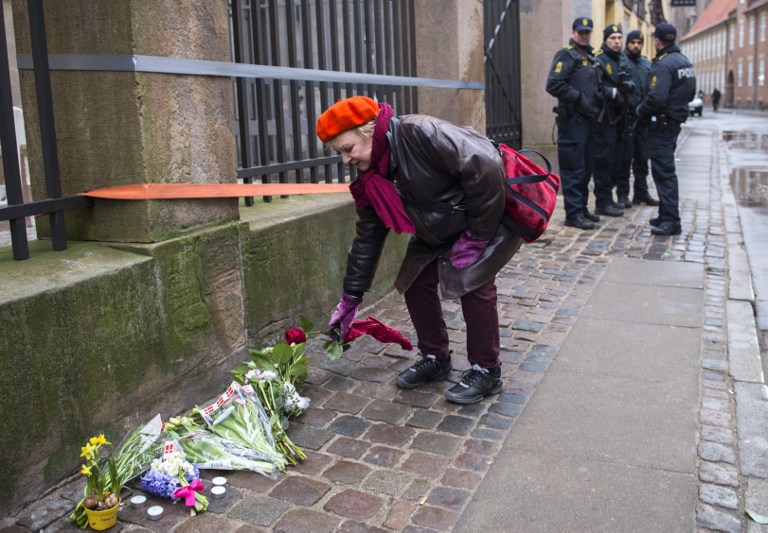
For some in the city, the events of the past 24 hours are a reminder that they are not immune to the scourge of violent extremism such as the January attacks in Paris that killed 17 people including four at a kosher supermarket.
“It’s terrible. It’s an attack on the free world,” said 84-year-old Joergen Johanssen. “Fortunately, this morning there were a lot of police.”
On a chilly February day, Kristian and Camilla, both 44, said they had made a point out of maintaining their habitual Sunday promenade with their young children.
“We live here in the center, and we do not intend to change our routines. But from what has happened it is now clear that there is an awareness that everyone can be affected,” Kristian said.
Tobias Hansi, a 19-year-old street vendor, called the situation “scary.” But then he added, apparently reassured: “The police did a good job.”
“We don’t expect these types of events, but we know they can happen,” added Jens, a psychologist.
Nearly a decade ago, Danes saw the anger that could be caused by cartoons considered to have insulted the Prophet Mohammed.
Protesters as far apart as the Palestinian Territories, Afghanistan and Nigeria torched the red-and-white national flag after the publication of 12 cartoons of the Prophet in the Danish daily Jyllands-Posten.
The country has also had to grapple with the the problem of radicalized Muslim youths travelling to Syria and Iraq to fight.
In December, the Security and Intelligence Service published estimates that at least 110 jihadists had gone from Denmark. Sixteen of them lost their lives — but others have returned.
Emma, a 20-year-old waitress in a cafe on the corner of the street housing the synagogue, said she had been fearful that attacks could eventually be seen on home turf.
“In a sense, we were prepared. We talked about it not so long ago, saying that with the proximity of the synagogue, it could happen there in the street,” she said.
“But of course, we did not really believe it.”