Zionist Union tries to speak Anglo Israelis’ language
Herzog, Livni and others attempt to convince English speakers that their party is only viable alternative to Netanyahu
It’s been 19 years since David (who did not reveal his last name), a veteran English-speaking immigrant to Israel, has exercised his right to vote. The last time he went to the polls was in 1996, when he cast his ballot for Benjamin Netanyahu and the Likud party. Deeply disappointed with Israeli politics over the past two decades, he has preferred to stay home on Election Day.
Things will be different on March 17. David plans to vote this time around, and he intends to give his support to the Zionist Union.
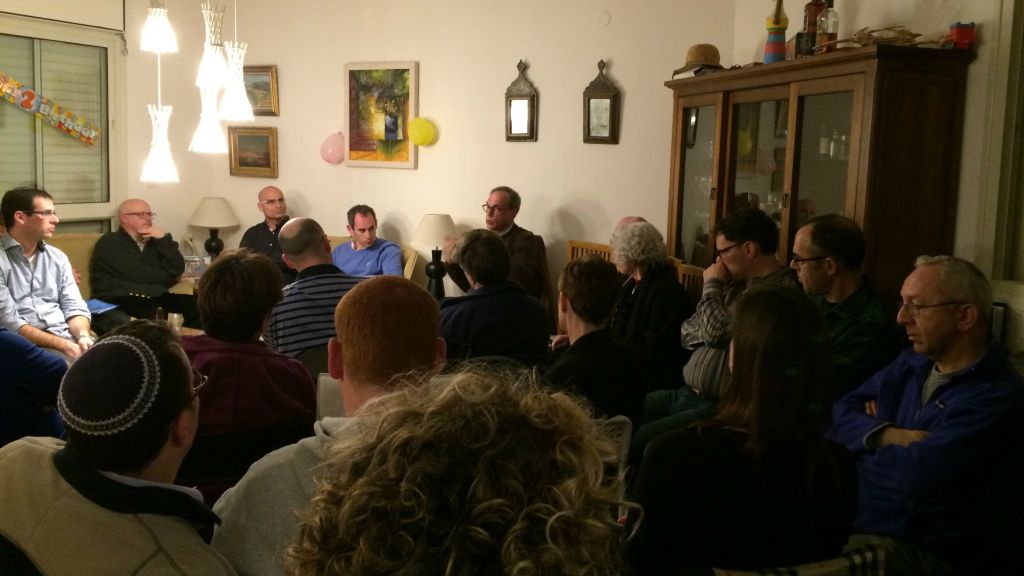
David was basically already decided by the time he went to hear Zionist Union MK Nachman Shai last Saturday night at a parlor meeting in Modiin organized by the Zionist Union’s English-language campaign. Some of the 50 people packed tightly in the living room and spilling out into the hallway, had, like David, already concluded they would vote for the Zionist Union. Others were still on the fence.
While the English-speaking community in Israel is only 170,000-strong, comprising just 2.9% of the eligible electorate, it appears that the center-left Zionist Union is putting more time and resources than its predecessor Labor Party ever did into wooing the Anglo vote.
“We are reaching out to voters with a national affinity for the party, but this time it is really important to go after the undecided and the traditional nonvoters so we can reach a critical mass to be able to get rid of Netanyahu and right-wing rule, and to form a ruling coalition with the least amount of concessions,” said Ricki Lieberman, a volunteer with the Zionist Union’s English-speakers’ steering committee who has decades of experience working on Democratic campaigns in New York.
Lieberman usually votes for a different party, but in these elections she will “enthusiastically and optimistically be voting for the Zionist Union,” as she wrote in a blog for The Times of Israel. She believes that a large center-left bloc led by the Zionist Union is the only hope for “finally rid[ding] ourselves of a deluded man and his compatriots, and his stranglehold on our future.”
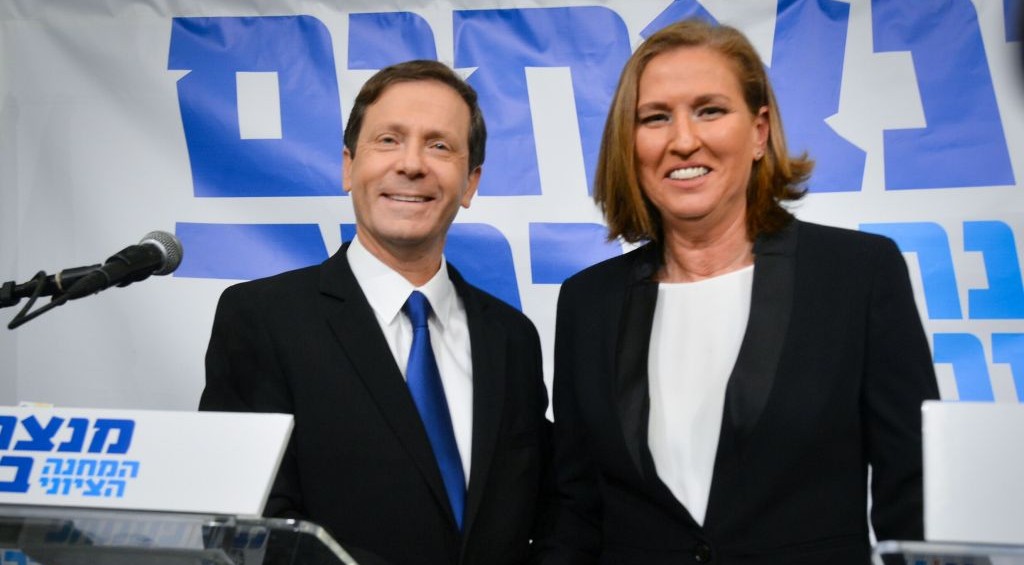
In recent weeks, members of the Zionist Union list with good English skills have been out in force at lecture halls, house parties, bars and pubs to make the Zionist Union’s case in English to English-speakers—something that some believe was missing from the Labor Party’s campaign strategy last time there were national elections. (The Zionist Union is a merger between Labor, led by Isaac Herzog, and Hatnua, led by Tzipi Livni.)
“Going into the last elections, English-speakers were pretty much split between Labor and Likud. But then in the end, most of them voted for [the centrist] Yesh Atid because that party paid attention to English speakers,” said Jay Shultz, founder of TLV Internationals, a community organization for young professional immigrants from Western countries, 20,000 of whom live in Tel Aviv.
“The two largest parties were not focused enough on Western olim [immigrants] that time, but we are seeing an improvement in this election campaign,” Shultz said.
According to popular perception, especially as reflected in international media, immigrants to Israel from English-speaking countries tend to be mainly religious families who move to West Bank settlements and vote for right-wing parties like Likud, or even farther-right ones like the nationalist, pro-settlements Jewish Home led by Naftali Bennett.
Shultz claimed this was an incorrect “cliché,” especially when considering young Anglophone immigrants who have arrived in recent years.
“The majority of them are coming to Tel Aviv and the country’s center, and they are focused on jobs, and building a civil society — not a religious one,” he said.
This is also the opinion of Eytan Schwartz, head of the Zionist Union’s international campaign.
“The new olim of the last 10 years are more secular, and even the religious ones are ‘Obama voters,’ he said, referencing American politics.
Indeed, being religious does not preclude Anglo voters from taking an interest in the Zionist Union. There were plenty of yarmulke-covered heads at the parlor meeting in Modiin, as well as at another Zionist Union event attended by this reporter—a gathering that brought together former justice minister Tzipi Livni with young English speakers at a Tel Aviv bar in mid-February.
“The Zionist Union’s platform represents where I am at,” said yarmulke-wearing Jonny Steel, who immigrated to Israel from the UK a decade ago and was at the Modiin meeting.
“I came here very Zionist and I am challenged day to day. This is not the country I dreamed of,” he said.
“It’s currently a very bleak outlook. Labor offers a positive alternative that focuses on the possibility of returning to the peace process and speaking with [Palestinian and other Arab] moderates. It offers more than just fear.”
Steel said he hoped that other religious Israelis would realize that “the Bibi-Bennett way,” as he put it, is not in the national interest.
“It is not anti-religious to vote Zionist Union,” he said.
Ari (a pseudonym), a secular English-speaking Israeli who grew up in Rehovot after his American parents immigrated in 1969, is less confident about this. He thinks the widely-held perception of Anglophone immigrants as being generally right-wing and religious is basically accurate, and he’s not particularly optimistic that many of them will vote center-left this time.
“In the last 10 to 15 years they have taken over the conversation and the identity of American olim,” he said of the religious immigrants.
Another area in which he feels he probably differs from many newer English-speaking immigrants is in his openness toward Labor’s more socialist approach to economic policies.
“I think the biggest impact of my American background is on my liberal values in terms of culture and religion. But because I am older, I know what it was like to grow up in Israel in a more socialist time, and I appreciate how I benefitted from that,” Ari said.
Not all English-speakers will be in favor of the Zionist Union’s economic policies, but the party believes its Anglo campaign will gain significant traction thanks to the recent strain on US-Israel relations surrounding negotiations with Iran on its nuclear program, as well as Prime Minister Netanyahu’s lack of coordination with the Obama administration for his March 3 speech to the United States Congress.
According to Schwartz, American immigrants are outraged by how Netanyahu is conducting relations with the US administration. Comments from some attendees at the Modiin parlor meeting confirmed this.
“Iran is a strategic threat, but Bibi has failed miserably. He is losing European and American allies’ support. Isolation is a true strategic threat,” said Evan Muney, who agreed with Zionist Union leader Herzog’s claim that Netanyahu’s speech to the Congress was merely an election campaign ploy.
“Something has to change with the economy and we need electoral reform, but I am most concerned about Israel’s international standing and current foreign relations,” said Simon (last name withheld), who was also at the event.

Lieberman said that she has encountered disdain for Netanyahu’s foreign policy across the board as she has worked to get out the English-speaking vote for the Zionist Union.
Netanyahu’s claim that he speaks not only for Israel, but also for all Jews, has rattled many immigrants from Western countries.
It’s not surprising that this is a particularly sensitive issue for Israeli citizens who have enjoyed the privilege of being Jewish citizens of other free and democratic countries.
“He is rekindling the dual loyalty issue and endangering Jewish populations in sensitive parts of the world,” Lieberman said.
“People are generally appalled and disbelieving that we have fallen in to this pit.”
For Lieberman, the obvious way out of this situation is to vote for the Zionist Union. But not all English-speaking Israelis think that is the only way to go.
“I am definitely going to vote more strategically this time than in the past. But I might not vote for the Zionist Union because they may go with Bibi in a coalition,” said Ari. (Shai said at the Modiin meeting that if the Zionist Union were to form the ruling coalition, it would consider inviting the Likud into a national unity government. However,the Zionist Union would decline an invitation to join a Netanyahu-led government.)
English-speaking voters may come from countries with political systems with only two or three parties, but that doesn’t mean that they will automatically vote for only one of the two largest among the 26 parties running this time for the Knesset. Only on March 18 will we know whether anti-Netanyahu votes cast by Anglos and other Israelis will have translated into pro-Zionist Union ones.