Ex-Hadassah cancer doctors beg parents to halt hunger strike
Request comes hours before High Court due to debate parents' petition to open new child's cancer unit at rival hospital
The doctors at the center of the ongoing crisis at Hadassah Hospital’s children’s cancer ward on Monday called on parents of the patients to cancel a hunger strike that they launched Sunday in support of the medical staff.
The plea came a day before the High Court was due to discuss the long-running dispute.
The parents announced the hunger strike plan in the tent they recently set up as a makeshift field hospital in Jerusalem’s Sacher Park.
In a letter to the parents, Prof. Michael Weintraub, who resigned as director of Hadassah Ein Kerem’s hemato-oncological department in March, wrote, “As I requested before the hunger strike started, I am begging you once again, in the name of all the doctors: please stop the hunger strike.”
“Today and tomorrow, a heavy heatwave is expected and the danger to your health will rise significantly.”
“We know that you support us and we are grateful to you every day and every moment for this support.”
Six doctors, including Weintraub, and three interns resigned from Hadassah in March, their resignations taking effect this month, over a management decision which they thought was medically unacceptable.
Since then, the three parties involved have been trading accusations and counter-accusations.
The doctors say they have lost trust in Hadassah’s management and will not return. They want the rival Shaare Zedek Hospital to set up a new unit, but the Health Ministry will not agree.
Hadassah’s CEO, Zeev Rotstein, has meanwhile refused to accept a plan agreed to by parents and President Reuven Rivlin last week
and approved by the Health Ministry, to return the situation at Hadassah to what it was before the crisis, with a few additional conditions.
Specifically, he has also insisted on retaining the physician he brought in to replace Weintraub as director of the hemato-oncology unit — Gal Goldstein.
Calling on all parties to work toward a resolution, Prime Minister Benjamin Netanyahu on Sunday asked the High Court to bring a debate forward from Wednesday to Monday.
“There is no reason to wait another two days and cause unnecessary suffering to the children,” Netanyahu said.
The debate is now scheduled for Tuesday.
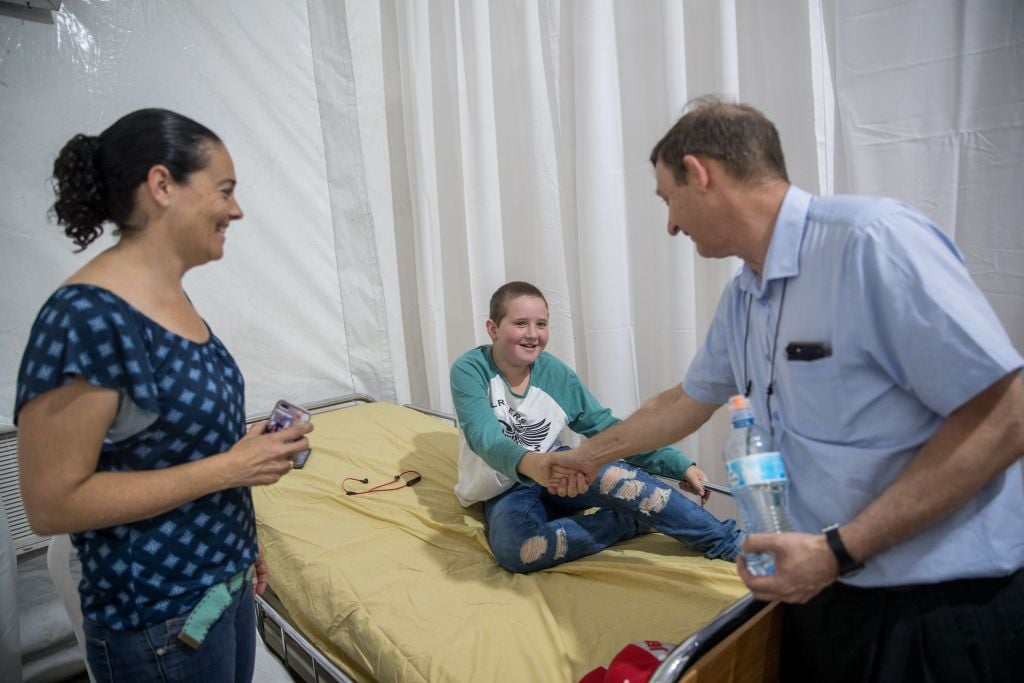
Parents of sick children, most of whom have supported the doctors from the outset, set up a protest tent in a Jerusalem park several weeks ago, complete with beds for their sick children.
They have petitioned the High Court of Justice demanding the court approve the opening of a new department at Shaare Zedek, fire Zeev Rotstein, and open legal proceedings against Rotstein and Health Minister Yaakov Litzman.
The state responded on Sunday to the court petition saying that it would not channel public funds into opening another cancer department in Jerusalem because the infrastructure already exists at Hadassah. The state further said that the solution was to immediately hold negotiations between the two sides, during which the doctors who resigned would resume work at Hadassah.
The crisis was set off by a management plan that emerged last fall to take a child bone marrow transplant expert, Dr. Paulina Stefansky, from the unit without consulting Prof. Weintraub, and to put her in charge of an adult transplant unit in another building.
The idea was to use available beds in the adult unit to treat non-Israeli child “medical tourists” from the West Bank and East Jerusalem (Palestinians) and countries of the former Soviet Union — who would pay high fees for transplants that would help replenish Hadassah’s depleted coffers — and have the existing team from the children’s unit — already overstretched — care for them, along with the Israeli patients in the children’s department.
Until the doctors’ resignation, the children’s department had six doctors and three interns caring for 160 new child cancer cases a year – the same size team that was caring for 120 children four years ago. The figures, according to a Channel 10 investigation, compared with 13 doctors and four trainees for 170 new cases annually in the child cancer department at Sheba Hospital, outside Tel Aviv, and 15 doctors and 5 interns for 160 new cases a year at the Schneider Children’s Hospital in Petah Tikva.
Most of the children who were being treated at the unit before the crisis erupted have moved to other hospitals in other cities at the recommendation of the doctors who resigned.