Laying out legislative plans, Eisenkot implies UTJ no longer in Netanyahu’s pocket
Yashar chair vows to nix outgoing coalition's legislation that 'endangers democracy,' reportedly referring to judicial and media overhaul laws; says Netanyahu only commands 46 seats
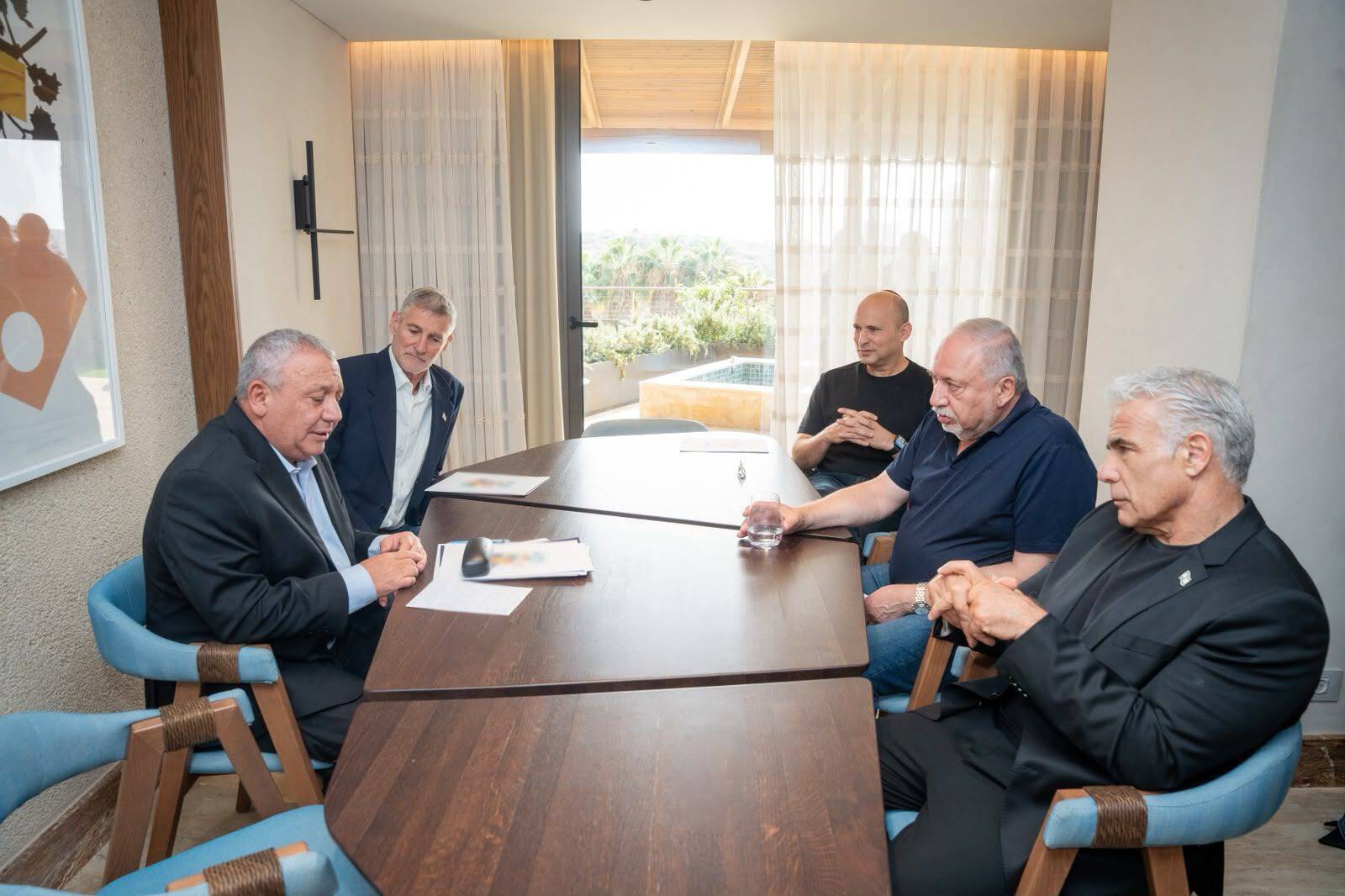
Yashar leader Gadi Eisenkot on Tuesday laid out immediate legislative plans and implied that a party often counted as part of the Prime Minister Benjamin Netanyahu-led bloc is no longer aligned with him, following a meeting with the heads of parties in his own bloc.
Calling the meeting with Naftali Bennett, Avigdor Liberman and Yair Golan “good and important,” Eisenkot said in a video statement that the bloc leaders are “coordinated and prepared for the coming days.”
Repeating his pledge to form an “emergency national government” based on his stated principles, Eisenkot said the parties will soon start working on more detailed plans and carrying out a raft of steps in the Knesset, including replacing the parliament speaker, passing unspecified “important” legislation, and “canceling laws that endanger democracy,” reportedly including the judicial and media overhaul laws passed by the outgoing government.
“We will act as quickly as possible to prevent the dragging of Israel to another election and the continuation of Netanyahu’s clinging to power,” Eisenkot added.
He said that starting Tuesday, Netanyahu is “a transitional prime minister, backed only by 46 Knesset members.”
The remark implied that the seven-member United Torah Judaism party, which was part of the outgoing government until last year and is usually counted as part of the pro-Netanyahu bloc, could cooperate with efforts to install a government without Netanyahu. Some members of Eisenkot’s bloc staunchly oppose collaborating with the Haredi parties, however, having vocally campaigned for universal conscription in the election.
UTJ has fumed over the lack of progress toward a Haredi draft exemption law by the outgoing coalition.
The change bloc could also command a majority with the help of the two Arab parties, which won a combined 19 seats, but all but one of Eisenkot’s partners — The Democrats, led by Yair Golan — publicly oppose such a move.
Eisenkot said on Tuesday that the next few days will be “full of spins and ugly and false [press] briefings,” adding that he and his allies are determined and won’t be deterred.
According to Channel 12 news, the four key, controversial laws passed by the previous government that the change bloc will repeal are: a law giving the justice minister control over the Department for Internal Police Investigations, a law greatly increasing political power and influence over the judicial appointments process in Israel, a law expanding government control over Israel’s broadcast media and news sector by overhauling media regulation, and a law significantly weakening the powers of the attorney general.
The report said that the bloc is seeking to move its legislative agenda along quickly, and has chosen to start off with the simpler route of canceling the outgoing coalition’s controversial laws, rather than the more complicated process of advancing a brand new constitutional agenda.
Having lost his parliamentary majority in last week’s election, Netanyahu has no apparent path to forming a government of his own, and his efforts appear aimed at preventing the opposition from assembling a government, potentially forcing another election.
He and his party have pointed to allegations of foreign election interference — which the Central Election Committee has said are not widespread and will not impact the results — to cast doubt on the election results.