Satellite photos show ‘significant’ renewed activity at Iranian nuclear site bombed by IDF — report
Minzadehei, an underground facility near Tehran, hosted much of nuclear program after 2025 war, IDF says; Qatar says US-Iran peace talks 'ongoing' despite apparent deadlock
New satellite images show “significant renewed activity” at the underground Minzadehei nuclear facility near Tehran, which the IDF bombed during the war with Iran this year, according to a report published Tuesday by the Institute for Science and International Security.
“Recent satellite imagery indicates a return to regular vehicle activity around the site post extensive cleanup operation that included the clearing of rubble and debris and repair of damage on the hillside,” the Washington-based think tank said.
“Significant vehicle presence can be seen throughout the site between early September and early October 2026,” the think tank added. “Cars are parked outside the security perimeter in the parking lot, and many passenger vehicles and trucks can be seen inside the perimeter.”
The Institute for Science and International Security has published multiple studies in recent months, based on satellite imagery, which show that Iran is making efforts to rebuild its bombed nuclear infrastructure.
“Given what is known about this compound, this activity may be indicative of an effort by Iran to reestablish a nuclear weapons development capability and to reconstitute what was lost in the attack on the compound,” the institute said in its Tuesday report.
The Israel Defense Forces had announced in early March that it destroyed the secret site at Minzadehei, where the military said that Iranian nuclear scientists were working to help develop nuclear weapons.
According to the IDF, Minzadehei was where Iran had moved much of its nuclear program after the 12-day Israel-Iran war in June 2025, during which the US also bombed key Iranian nuclear sites.
NEW Report: Significant Activity Identified at Minzadayi, an Iranian Nuclear Weapons Development Site
High resolution @vantortech satellite imagery from September and October 2026 shows significant renewed activity at Minzadayi, a nuclear weapons development compound northeast… pic.twitter.com/tBz1SUy86e
— Inst for Science (@TheGoodISIS) October 6, 2026
Brig. Gen. Effie Defrin, the IDF spokesman, said after the March strike that a group of nuclear scientists had “worked secretly” at Minzadehei to develop capabilities required for nuclear weapons.
The IDF tracked the scientists to “their new place of operation,” enabling the strike on the compound, Defrin said at the time.
While Iran, whose leaders are sworn to Israel’s destruction, denies seeking nuclear arms, it has enriched uranium to levels that have no peaceful application, obstructed international inspectors from checking its nuclear facilities and expanded its ballistic missile capabilities.
The US and Israel launched the war on Iran on February 28 in a bid to destroy the Islamic Republic’s nuclear and ballistic missile programs and destabilize the regime. Iran responded with deadly strikes on Israel and on Arab states that host US bases, as well as by obstructing the Strait of Hormuz, which carried about a fifth of the world’s oil and natural gas shipments before the conflict. The US responded with a blockade of Iranian ports.
The fighting entered a shaky truce in April, when armed conflict between Israel and Iran largely stopped. But since then, US-Iran peace talks mediated by Qatar and Pakistan have appeared to stall as Iran refuses US demands to dismantle the nuclear program and fully open the strait.

Despite the apparent deadlock, Qatari Foreign Ministry official Ibrahim Al-Hashmi told a regular press briefing on Tuesday that he “can confirm that the talks are continuing and the exchange of messages between different parties is continuing via Qatar and its regional partners.”
The indirect negotiations take account of “the concerns of the various parties,” Al-Hashmi said.
“As you know, the scale of this conflict and the magnitude of the price that the whole world is paying require us to put our best efforts to end this immediately through a negotiable solution on the negotiation table,” he said.
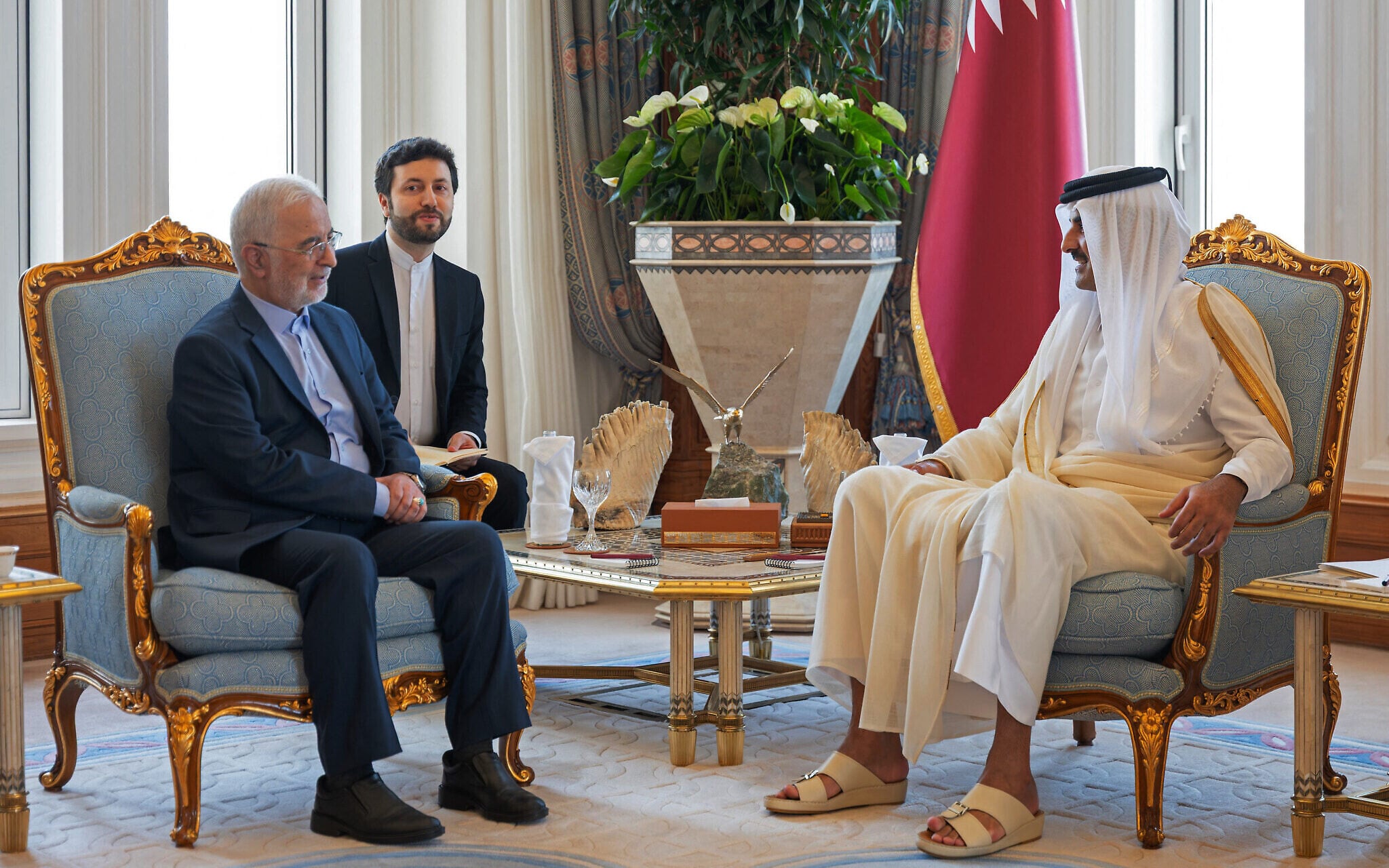
Meanwhile, Qatar’s Emir Sheikh Tamim bin Hamad Al Thani met Tuesday with Iran’s Interior Minister Eskandar Momeni in Doha, according to a statement from the Qatari royal palace.
Before threatening Iran over its nuclear program, US President Donald Trump had in January, less than two months before the war began, threatened to attack Iran over its brutal suppression of anti-regime protesters, thousands of whom were killed by regime forces.
In an apparent jab at international criticism of that crackdown, Tehran on Tuesday summoned French Ambassador to Iran Pierre Cochard over Paris’s treatment of protesters demanding better conditions in schools, who have clashed for days with police, Iranian state media reported.
Iran accused France of “violent treatment” of the protesters and “extensive and flagrant human rights violations” during the demonstrations, which began late last month and have been accompanied by unrest. While hundreds of people have reportedly been injured in the protests, no one has been killed.
Relations between France and Iran have been strained for months, with the two expelling each other’s diplomats in August.
Times of Israel staff contributed to this report.