To Indiana’s Jews, Pence is ‘not a mensch’
Arch-conservative positions of governor and GOP vice presidential hopeful are well-known and little-liked by Indianapolis Jewish community
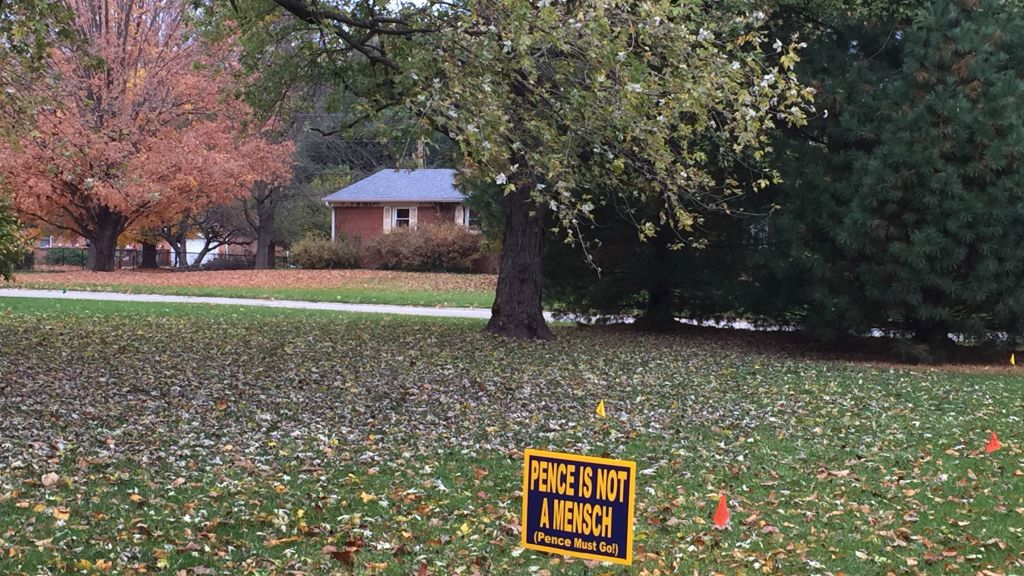
INDIANAPOLIS — Flanked by technicolor trees displaying their autumn collection, Indiana’s residential roads are strangely unadorned by political lawn signs this Election Day. But when driving up to the capital’s Jewish Community Campus, spotted among the opposite lawn’s littered dry leaves is a small but eye-catching yellow and blue sign proclaiming — “Pence is not a mensch.”
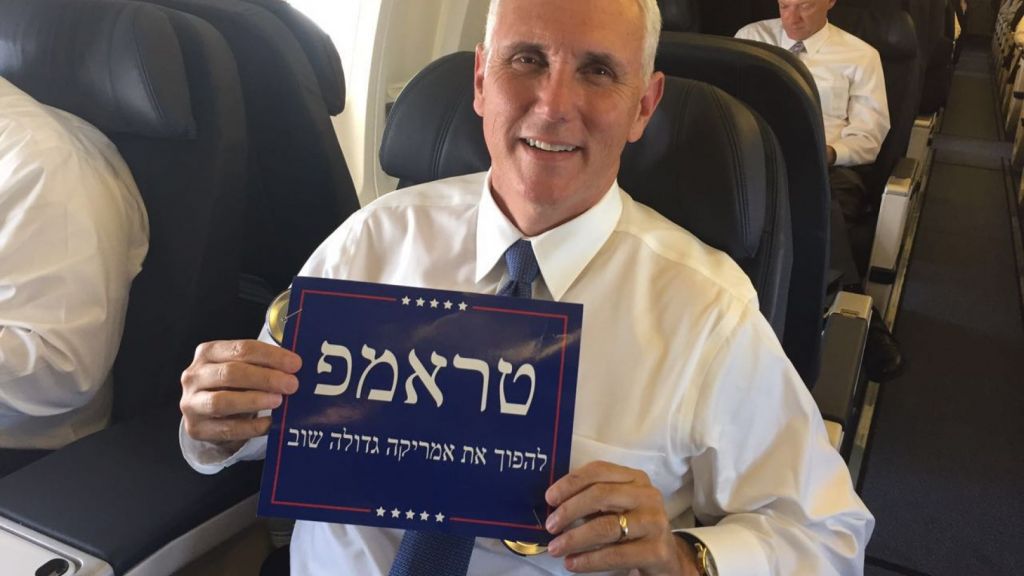
The arch-conservative positions of Indiana Governor Mike Pence, the vice-presidential running mate for Republican candidate Donald Trump, are well-known and little-liked by the Indianapolis Jewish community.
There are reportedly some 17,500 Jews currently living in the state and voting skews liberal and largely Democratic — much along the lines of national Jewish voting tendencies. Most of the community lives in Indianapolis and, increasingly, its surrounding bedroom communities. Together they support half a dozen synagogues.
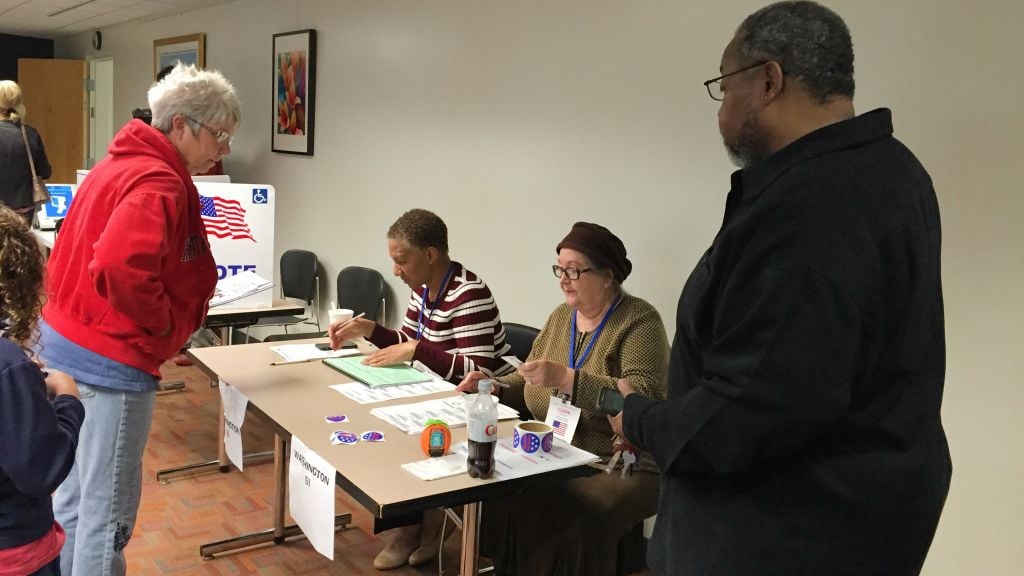
At the JCC’s two polling stations, a few retired members of the city’s Jewish community volunteer their time to serve a district that is no longer a Jewish stronghold. As one zaftig Orthodox volunteer said with a wink, “It’s mostly schvartzes [African Americans] who vote here.”
So the Pence-mensch half-rhyme is likely lost on the largely non-Jewish 2,000-odd registered voters who are eligible to cast their ballots here. But in many ways, it is a broad-strokes reader’s guide to the tenor on this election day, as many vote against a certain candidate, rather than in support of another.
The contentious campaign comes to a close Tuesday, but as one Indianapolis resident put it, she’s relying on her faith in God and “voting with the taste of vomit in my mouth.”
Indiana: an election day wild card
At the JCC polling station, a quick glance at a 2016 paper ballot shows a three-party system emerging in the state, with a Libertarian candidate listed for almost every political position. (Anecdotally, the greatest number of lawn signs on display throughout Indianapolis were either against the two mainstream candidates, or in support of Libertarian candidate Gary Johnson.)
Indiana has a population of 6.6 million, of which 80-86 percent is white. Less than half a percent of Indiana residents are Jewish and only one percent is Muslim, according to the Public Religion Research Institute (PRRI).
According to PRRI, it is a state of voters — over 75% of residents are registered to vote. As a state which allows early voting, by late Sunday Indiana has already seen over more than 711,000 early ballots out of 4.7 million eligible voters.
Interestingly, the majority of voters, some 39%, consider themselves independent. Another 24% identify as Republican and 28% as Democrat. However, regardless of party affiliation, 36%-40% of Indiana voters identify as “conservative.”
According to the PRRI, Indiana residents are largely socially liberal regarding gay rights. Some 52% support same-sex marriage, 70% favor LGBT non-discrimination laws, and 58% oppose religiously based refusals to serve gays.
And so, while a traditionally politically conservative state, Indiana’s social liberalism makes it somewhat of a wild card on election day.
In the past 100 years, the Indiana electoral college has only voted for three Democrats for president. One of those times was recently in 2008 ahead of President Barack Obama’s first term. He carried the state by less than one percent.
During this summer’s primaries, the Hoosier vote was likewise unconventional. The Democrats chose counter-culture politician Senator Bernie Sanders by 52.5% (335,256 votes) and the Republicans turned to maverick newcomer Donald Trump by 53.3% (590,460 votes).
According to Sean Trende, senior election analyst for Real Clear Politics, as one of the first six states where polls close on Tuesday, Indiana is a state to watch. “Mitt Romney won by 11 points in 2012, so if Donald Trump is over that, if he’s up around 15-16%, maybe even approaching George W. Bush’s 20% win from 2004, then we’ll know that we have a race on our hands,” Trende told PBS NewsHour.
Hoosiers are also deciding two other close races for senate and governor today.
Interestingly, many long-term governors have been Democrats, including Evan Bayh, who served from 1989 to 1997 and later was a senator from 1999 to 2011. Once thought a shoo-in for his old senate seat, today, surrounding accusations of making millions as a lobbyist since leaving the senate, Bayh is in a heated battle against Republican Congressman Todd Young.
The Democrats lack five seats to take control of the Senate. According to analyst Trende, a Bayh tie or loss in the senate, would indicate “real problems for senate prospects,” he told PBS.
A Democratic win was made all the more difficult last week when, in a pre-election day goof-up blamed on mismatched data bases, the Indiana Democratic Party sent thousands of voters texts directing them to incorrect poll locations.
The Indianapolis Star reports that the party claims it sent more than 400,000 text messages to likely Democratic voters, using telephone numbers received through voter registration file information. While the IDP acknowledges texting wrong polling locations to about 2,000 voters, several high-level Republicans also claim to have received the text.
A rigged vote?
Sitting in a large plastic stroller built for six, a JCC preschooler was clearly not having any fun. “What’s the matter, buddy?” asked a male caretaker. “Are you feeling a little Trumpy?”
According to a November 8 Fox News report, Republican presidential candidate Trump has sued a Nevada voter registrar over a Las Vegas polling station that remained open late last week to accommodate a long line.
Indiana saw its own allegations of voter fraud on Monday when a local TV news station reported some 56 Indiana counties are under suspicion of voter registration fraud.
According to Call 6 Investigations, in October the Indiana State Police received a report of misconduct by the Indiana Voter Registration Project. The project, run by the liberal-leaning Patriot Majority USA Super PAC, bussed canvassers into “historically underrepresented” neighborhoods, an IVRP employee told investigators, and paid them $50 for five-hour shifts.
After county clerks allegedly received “very sloppy” forms, dozens of voter registrations in Indiana counties were found to have missing or incorrect voter information. Other forms had signatures that didn’t match those on record, according to the news report.
According to a Jewish Community Center poll volunteer, voter fraud is relatively easy to accomplish. “There are people on the books here who haven’t lived here for 15 years, or who are maybe ‘nifter‘ [dead],” he said, sporting a grey beard and black yarmulke.
He assured The Times of Israel that Indiana polls are carefully safeguarded against fraud, but adds that the registrar books were out of date. He said, hypothetically, a voter could be registered in multiple locations.
Echoing Trump, the poll worker said a deceased registered voter’s identity could be assumed by — he suggested — illegal immigrants for instance, in a way to swing the vote more liberal.