WZO closes election fraud case without penalties for suspected cheaters
Reform movement receives most seats, followed by Am Yisrael Chai and Eretz Hakodesh, two of the six slates revealed to be involved in the alleged voting fraud
In a final decision regarding the contentious US elections for the World Zionist Congress, judges have ruled that six parties suspected of voter fraud will not be penalized with the loss of seats.
The decision by the Zionist Supreme Court, which is the top judicial authority for national Zionist institutions such as the World Zionist Organization, provides seeming closure to a drama that has gripped the US Jewish community since early April. The vote helps determine how a global annual budget of more than $1 billion is spent on Jewish and Israeli causes each of the next five years.
The ruling also revealed for the first time that the six suspected slates were Am Yisrael Chai, Eretz Hakodesh, ZOA, Shas, Herut and Achdut Israel.
The American Zionist Movement (AZM), the organization that administered the vote in the United States, on Wednesday published the certified final election results, three months after the ballots were first tallied.
A record 224,969 valid votes were recorded in the online election, which took place from March 10 to May 4, 2025. The final allocation of the 155 seats that US slates were competing for was released Wednesday.
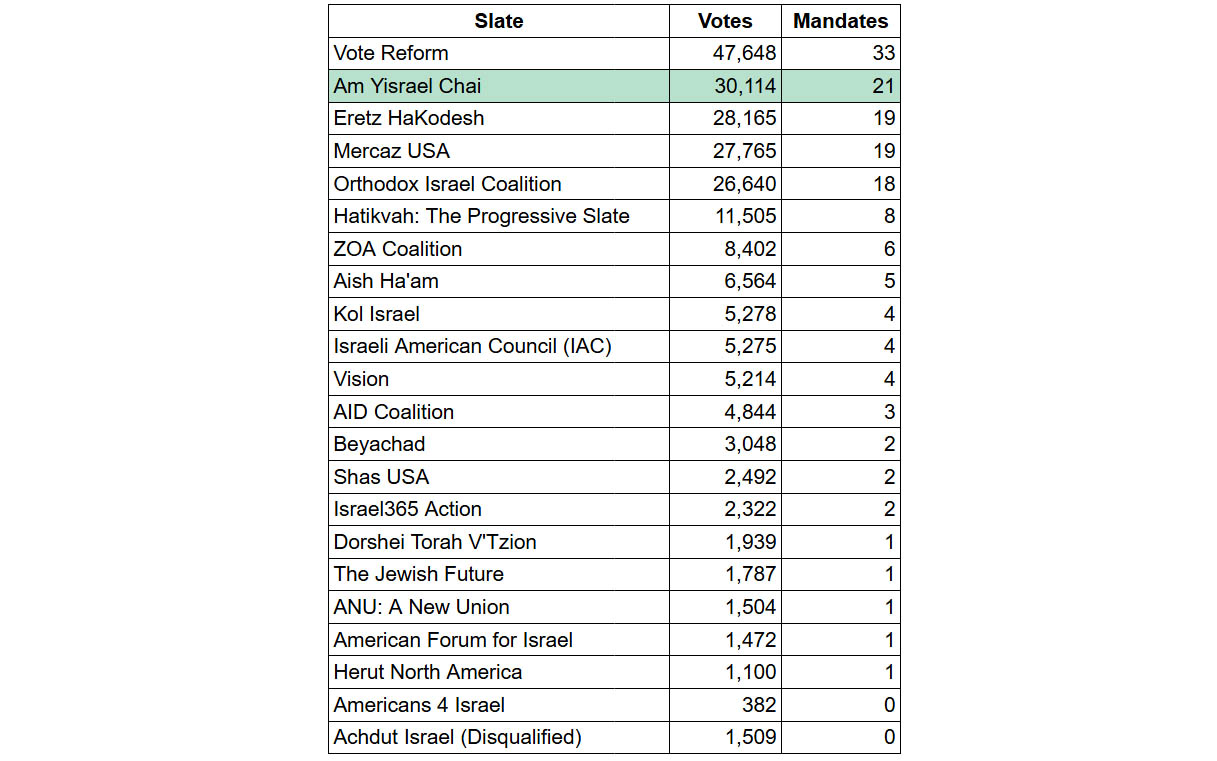
In line with the original vote count, Vote Reform, which represents the Reform movement, received 33 seats, the largest number of delegates. Am Yisrael Chai, a new slate representing Jewish college students and young professionals focused on pro-Israel advocacy and “love of Torah and Judaism,” came in second with 21. Eretz Hakodesh, associated with Israel’s Haredi United Torah Judaism party, and Mercaz USA, representing Conservative/Masorti Judaism, each received 19, while the Orthodox Israel Coalition, representing mainstream Orthodox institutions, received 18.
“Based on the final election results that have been certified today, we can say without question that the Zionist movement in the United States is stronger than ever,” said AZM executive director Herbert Block. “American Jews’ record-breaking turnout means that the overall US delegation to the 39th World Zionist Congress is positioned to have a greater backing and prominence than ever in advancing a multitude of high-priority Jewish and Zionist causes.”
Navigating fraud
The final vote count doesn’t include 18,948 votes that were disqualified, many of which were linked to suspicious credit cards or phony contact details. These represented 8.2% of the total votes cast.
Six slates, of the 22 that competed in the election, were suspected of various forms of voter fraud, and AZM officials engaged in extensive debates about how they should be penalized. Their challenge was to find an approach that would maintain the integrity of the ballots that were validly cast while setting a precedent to strongly discourage future voting fraud.
In an internal document obtained in June by The Times of Israel, the Area Election Committee (AEC), which oversaw the election, recommended a multi-tiered penalty system that took the severity of each breach into account. According to its suggestions, Shas USA, which won only 1% of the vote and had the most egregious case against it, would have its votes completely disqualified, be barred from running in the 2030 election, and be fined $5 per disqualified vote.
For the other five offending slates, the AEC recommended penalties that included monetary fines and annulling portions of their valid votes, in proportion to their levels of culpability.
However, the Zionist Supreme Court chose to disregard the AEC’s recommendations, ruling that annulling valid votes was an unacceptable way to solve the problem.
“Annulment of valid votes contradicts the fundamental principles of democracy, constitutes a disproportionate violation of the right to vote and to be elected, and even changes the election rules retroactively,” the court said in its decision.
Thus, Shas USA comes away with two seats, along with a fine of $13,530, or $5 for each disqualified vote. Fines were also levied against Eretz Hakodesh and ZOA, without any reduction in their valid vote count. Am Yisrael Chai did not receive any sanctions.
A tribunal previously ruled that Ronn Torossian, the head of the militant pro-Israel group Betar USA, will be permitted to attend this fall’s World Zionist Congress as a delegate for ZOA.
The tiny Achdut Israel slate, which might have otherwise qualified for a seat, was disqualified from the congress. The list did not meet the original eligibility conditions to run in the first place, and its percentage of annulled votes was extraordinarily high, the Zionist Supreme Court said. The Herut party, also accused of fraud, was not penalized, and came away with one seat.
The court formally admonished all slates to do a better job of adhering to the rules in the next election. It also called on the AEC to prevent the possibility of future irregularities. An investigation by The Times of Israel in April revealed that the online voting platform used to manage the election had insufficient security features to prevent the flood of fraudulent entries.
The court also gave credit to “an on-the-ball AZM member” who first identified the irregular voting patterns.

Fierce competition
Competition between parties was particularly intense throughout the 2025 election, due in part to the entry of several new Orthodox and ultra-Orthodox slates that threatened the long-standing hegemony of liberal left-wing slates.
While Haredi constituencies have traditionally stayed out of the Congress due to their ideological opposition to Zionism, this changed in the last election, with the Haredi Eretz Hakodesh slate winning an astonishing 25 out of the 152 US seats. That pushed the Congress’s liberal parties, who have traditionally held the majority of seats, into the minority for the first time.
That inspired a slew of other parties to join this year’s race, including many Orthodox slates, bringing the number of parties running to 22, compared to 14 in 2020.
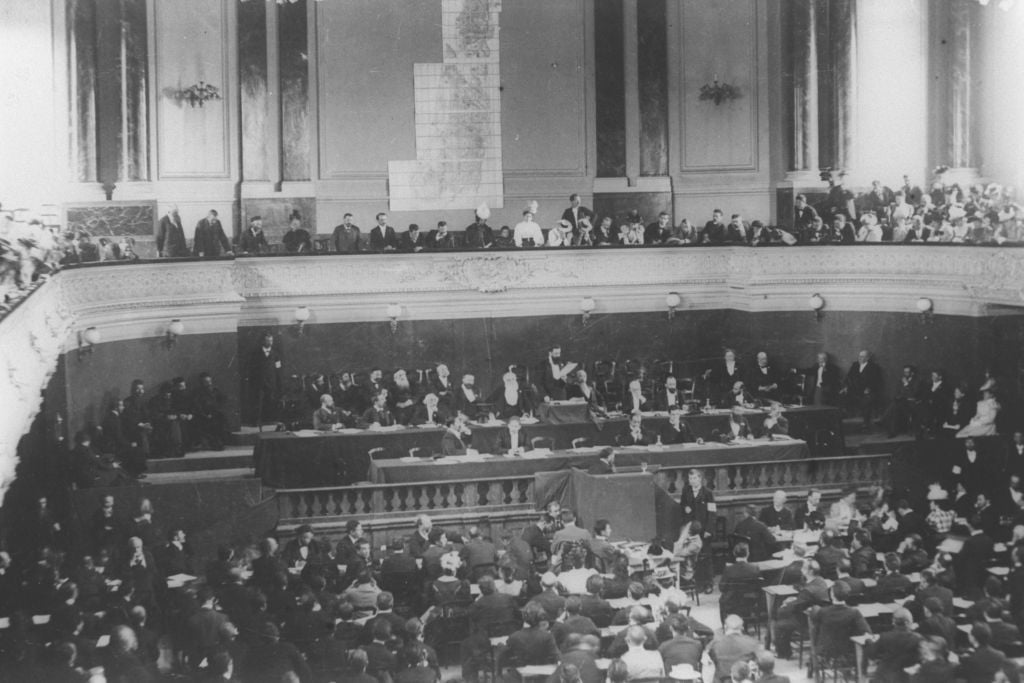
The World Zionist Congress, established by Theodor Herzl in 1897, decides how to allocate $1 billion to Jewish causes every year and oversees Israel’s so-called national institutions, including the World Zionist Organization, which carries out the Congress’s vision; the Jewish Agency, which plays a central role in Jewish immigration to Israel; and the Keren Kayemeth LeIsrael-Jewish National Fund.
The World Zionist Congress comprises 525 seats, with representation from three different geographic areas. Israel has 200 seats, automatically allocated according to political party representation in the Knesset. Another 152 seats represent the United States, divided according to the WZC election results. The final 173 seats are chosen by other countries, either through a public vote or, in smaller communities, by local Jewish leaders.
The World Zionist Congress will convene in Jerusalem this year on October 28-30.