

Greater expectations
Peace talks are underway but the press is split between caution and optimism over the propitious start
 Add ToI as a Preferred Source on Google
Ilan Ben Zion is an AFP reporter and a former news editor at The Times of Israel.
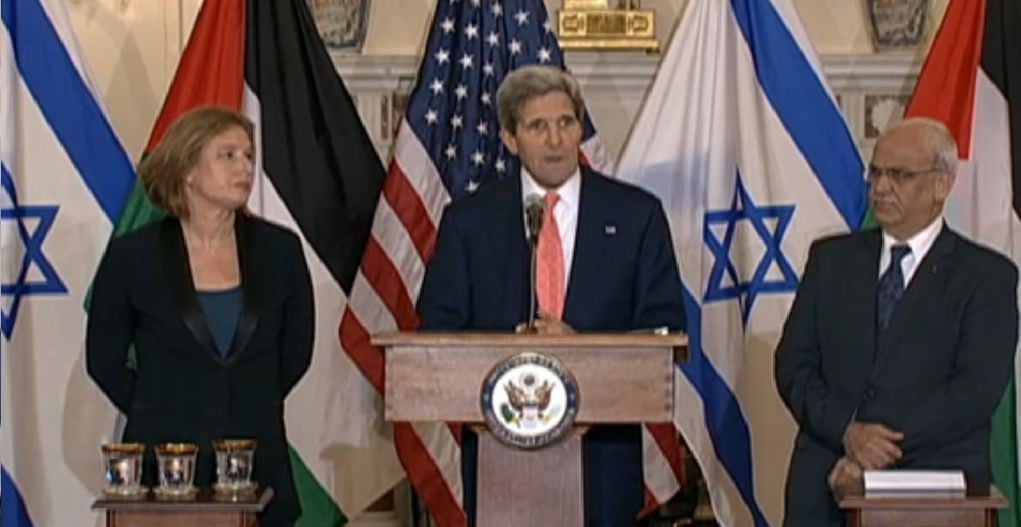
What but the renewed peace talks could possibly take top billing in the news on Wednesday after their propitious commencement the day before? Grinning visages of US Secretary of State John Kerry, Justice Minister Tzipi Livni and Palestinian top negotiator Saeb Erekat grace the pages of Israel’s newspapers.
“Everything’s on the table,” reads Israel Hayom‘s headline; “Optimistic start,” runs Yedioth Ahronoth‘s front page banner. The other two dailies quote Kerry’s optimistic statement that the talks seek a final resolution within nine months. Maariv‘s writers, with more skepticism than the hope broadcasted by Livni, Erekat and Kerry, call it a “high target.”
Haaretz reports that the US handed letters to the Israeli and Palestinian delegates outlining the American stances on the negotiations, its objectives and guidelines. It noted that the letters’ content likely focused on the issues of refugees and borders. The paper goes on to speculate that the letter to the Palestinians in all likelihood stated that “the US’s stance is that negotiations will be conducted on the basis of the 1967 lines with land swaps.” To the Israelis, Haaretz conjectures, Washington said that “the future border will not resemble the ’67 lines, rather it will include changes in accordance with the reality created in the territories.”
Concerning the negotiations’ guidelines, Maariv reports that the two sides have already agreed that “unlike in previous rounds of talks, this time an American official will not be present in the room for the lion’s share of the talks.” It also notes that whereas the Palestinians preferred an American presence, Israel insisted on face-to-face chats. A foreign diplomat the paper quotes said that “Israel is certain that this way will allow better bridging of the gaps in trust between the two sides, and greater openness in speaking.”
Yedioth Ahronoth focuses on the presidential element, that Barack Obama graced the two sides with a chat in Washington to inject the talks with greater enthusiasm. The paper writes that the presidential presence was bestowed on the talks “only after the two sides arrived at an agreement in the morning on two principles important to the Americans.
“The first was the announcement that the talks will deal with all the core issues concerning a final agreement, including ’67 borders, and the second was Israel’s preparedness to announce a lightening of conditions for residents of the West Bank and Gaza in the coming days — meaning removing impediments for construction and in the future perhaps opening crossings to Gaza,” it reports.
Israel Hayom reports that the Prime Minister’s Office was content that the terms “’67 lines” or “Jewish State” weren’t mentioned at any stage during the opening phase of the negotiations — “as it was clear that the Palestinian side would also have to perform painful concessions.”
“A senior political source in Jerusalem said that the declaration of the end of the conflict and preconditions by other side is a demand that Israel has raised several times in recent years and is a key to the seriousness of the talks,” the paper writes.
Haaretz reporter Barak Ravid writes that the mood of the press conference at which Kerry laid out the nine-month plan was “official, not celebratory” and the speeches from Livni and Erekat “minimalistic.” Despite this, and “after the government had done everything it could in recent weeks to reduce expectations… the secretary of state announced that the objective was to arrive at a final agreement within nine months.”
“Kerry really and truly believes that this is possible and plans to do everything in order for it to happen,” Ravid writes. “At the same time, it’s not certain that the way he presented things was wise.”
Picking Prime Minister Benjamin Netanyahu’s brain, Avraham Tirosh asks in Maariv whether the PM has really had a change of heart and is willing to make painful concessions for a two-state solution. He recalls a prime ministerial predecessor, Menachem Begin, who, despite vocal Likud support for keeping part of the Sinai Peninsula, conceded the entirety of the territory in exchange for peace with Egypt.
“True, the West Bank is not Sinai, and Begin even thought (and erred) that in giving up all of the Sinai he rescued Judea and Samaria; but Israel’s precarious political situation today, without an agreement with the Palestinians — and what is expected should that continue — doesn’t compare to the situation with Egypt and the rest of the world in 1979,” he says.
“Netanyahu, be Begin,” he emphasizes.
Shlomo Cezena writes in Israel Hayom regarding the talks that “it’s clear to everyone that specifically they [Kerry, Livni, Erekat, Martin Indyk and the Israeli and Palestinian No. 2s] are on the front lines because of the level of expectations.”
“Livni clarified [on Tuesday] that she wouldn’t conduct the negotiations from the point from which [former prime minister Ehud] Olmert left off. It’s also not clear precisely what degree of freedom was given to her, or the question of all questions: will maps be opened and ‘difficult decisions’ be made, and when?” he writes.
Yedioth also cites a Israel National News report about travelers in northern Israel who stumbled upon a group of ultra-Orthodox visitors bathing in a reflecting pool belonging to a memorial to 73 IDF soldiers killed in a helicopter crash in 1997.
A woman told the news outlet that she protested the disrespectful treatment of the site by the half-naked and bathing suit-clad families, and that they responded, “Water doesn’t memorialize a soul. If we want to memorialize a soul we light candles and recite psalms. This pool is not a holy thing. We pay taxes like everyone else in the country, therefore we can do what we want.”
Speaking of taxes, Haaretz reports that part of the reason the Defense Ministry’s expenditures went up was because “the number of career soldiers in the army has ballooned by 12 percent over the past six years.” The increase in manpower raised the IDF’s salary expenses by an estimated NIS 500 million to 1 billion per year, the paper reports.







The Times of Israel Community.