Israel is primed for unrest around election day. Is there a way out?
There’s already violence in the streets, candidates are receiving death threats and a specter of war looms over the country. And that’s before any ballots have been counted
Around halfway through Tuesday night’s edition of “The Patriots,” the vociferous nightly talk show on the pro-government Channel 14, Yotam Zimri accused Naftali Bennett of “treason.”
A short while later, co-panelist Erel Segal said that Bennett, a former prime minister, and opposition frontrunner Gadi Eisenkot, a former IDF chief, were “ignoramuses” and “scoundrels.” Earlier in the show, host Yinon Magal warned that the opposition would have joined in a coalition with Yahya Sinwar and Hassan Nasrallah, the slain heads, respectively, of Hamas and Hezbollah, in order to avoid partnering with Prime Minister Benjamin Netanyahu.
The epithets didn’t come out of nowhere. In that same segment, the show had played a clip of a Haaretz podcast in which someone called Netanyahu “the worst Jew in Jewish history.”
The accusation that Bennett was a traitor came in response to Bennett, an opponent of Netanyahu, using the same term for Jonatan Urich, who is suspected of doing public relations work for Qatar, including after the October 7, 2023, Hamas invasion and massacre, while serving as a key adviser to the premier.
The show’s panelists weren’t pulling any punches, and it wasn’t the first round of the fight. Israeli political rhetoric has been at a fever pitch for months. There’s unrest in the streets and candidates are receiving death threats, and all the while the specter of war is looming over the country. The president has pleaded, over and over, for his polarized country to eschew violent discourse.
And that’s before a single ballot has been counted in the October 27 election that both sides say will decide the future of the country. Each camp claims only its candidates can ensure Israel’s future. Each claims the other will bring the country to ruin.
Polls are inconclusive at best, misleading at worst, with pro-Netanyahu outlets like Channel 14 predicting a vastly better result for the prime minister than surveys by the rest of Israeli media, priming the right to charge that the election was stolen if their favored network’s polls end up being wrong. So many parties have made so many promises not to partner with each other that when one of those vows is almost inevitably broken, a segment of voters is liable to erupt in indignation.
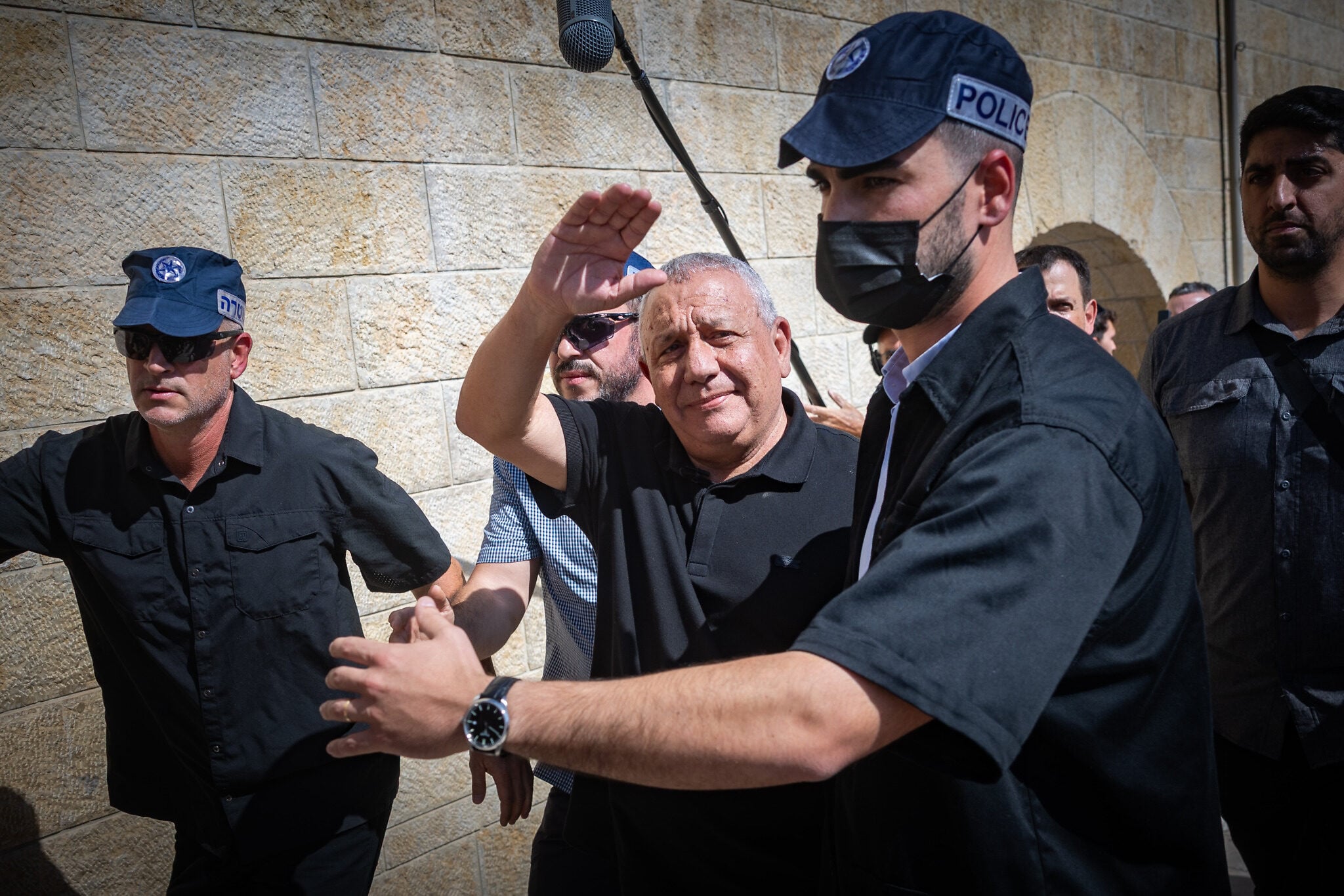
So as Israelis approach election day next week, the question isn’t only who will win. It’s whether there’s any scenario in which the entire electorate accepts the results without street protests, riots — or even physical clashes.
“Part of the populace will feel disenfranchised no matter what happens,” Gilad Hirschberger, a professor of political and social psychology at Reichman University, told The Times of Israel. He added, “There’s a lot of trauma, a lot of grief here. Nerves are frayed. The Israeli public isn’t in the same place as it was four years ago, and that obviously makes the situation more explosive.”
The violence is already here
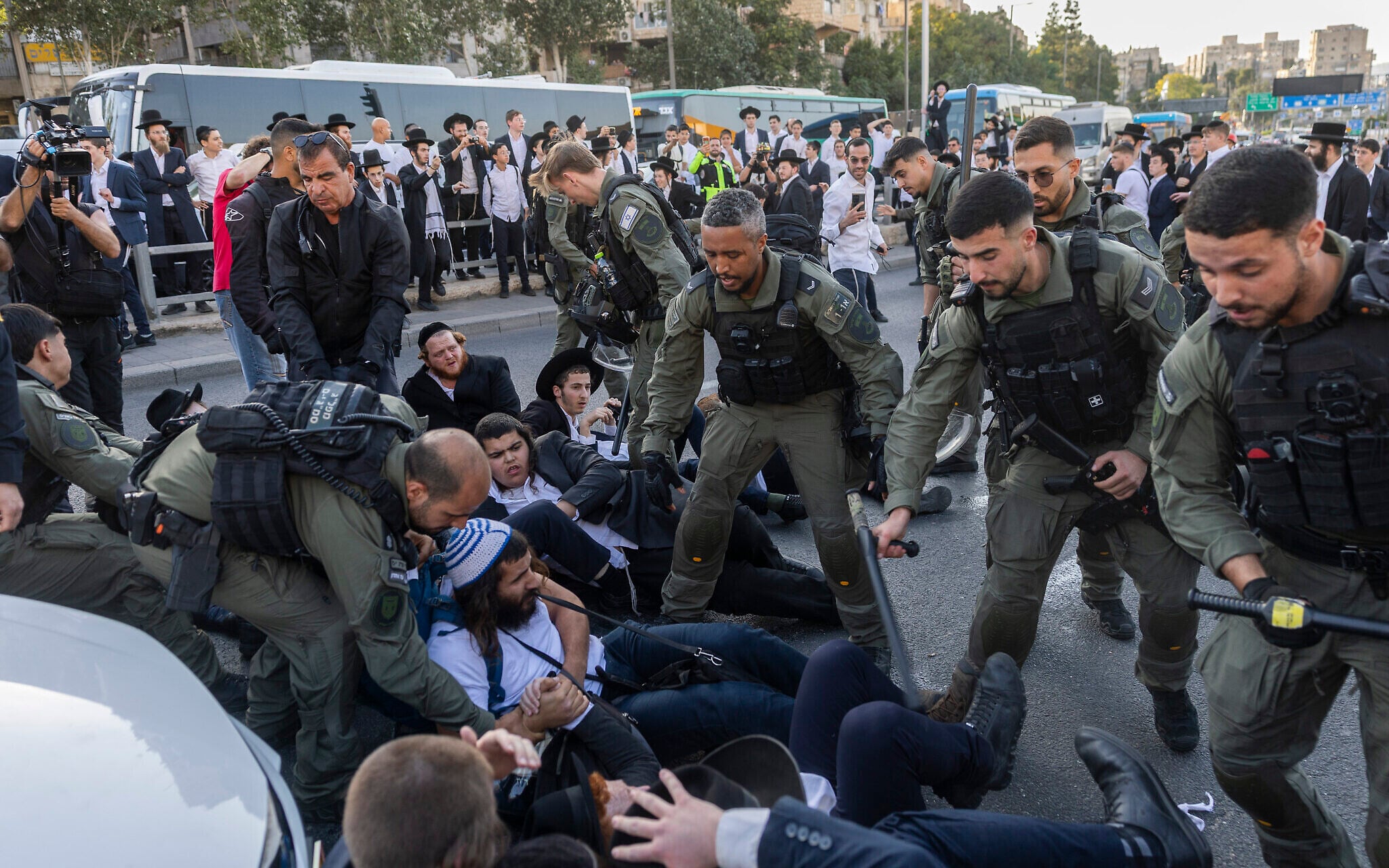
The situation, of course, is already explosive. Haredi anti-draft demonstrators regularly block roads, including earlier this week in the central city of Kfar Saba. One night, some of them threw rocks at police, injuring an officer.
Violence has also spiked in the West Bank. On Friday, Palestinian gunmen killed two soldiers in a West Bank shooting attack; the IDF said it believed the gunmen were planning to carry out a larger attack against Israeli civilians. Several days earlier, Palestinian rock throwers attacked a delegation including a candidate for the Knesset, smashing a car window.
Settler violence is also surging. Last weekend, Jewish extremists brutally attacked a Washington Post photographer, who required hospitalization. Another group threw rocks at a group of European diplomats, smashing their car window.
None of this is directly related to the campaign. All of it has been happening, in some form, for years. But it creates a volatile atmosphere ahead of an especially tense moment with peak potential for social strife. And it is conditioning parts of Israel to view each other with deep suspicion, to distrust democracy, and to condone violence as a legitimate political tool.
Recent clashes are conditioning parts of Israel to view each other with deep suspicion, to distrust democracy, and to condone violence as a legitimate political tool.
A poll from earlier this year, cited by Hirschberger and his Reichman University colleague, Sivan Hirsch-Hoefler, in a Zman Yisrael essay, found that only 68 percent of Israeli Jews would accept a democratically elected government whose policies they oppose. By contrast, more than a third of Israeli Jews say the state’s Jewish character, or its control over the West Bank and Gaza. should supersede its democratic character. A third also said that settler violence against Palestinians can be justified.
Likewise, 68% of Israeli Jews are worried about Arab Israelis committing violent acts against their fellow Jewish citizens. An Israel Democracy Index poll from this summer found that nearly a third of Israeli Jews think, or are certain, that Arab Israelis shouldn’t have the right to vote.
What does that portend for election day? Last week, Netanyahu’s Likud, as well as the far-right Religious Zionism party, said they would station nearly 2,000 activists at polling stations in Arab towns and neighborhoods to police unsubstantiated claims of voter fraud. The Arab-led Joint List called the plan racist, and left-wing activist groups are sure to show up in opposition.
While Hirschberger doesn’t expect the poll watchers to meaningfully depress Arab voter turnout — there are, after all, some 2 million Arab citizens across Israel — he did worry that the right-wing activists’ presence will create friction and provoke fighting.
“There’s a lot of explosive potential here for clashes between forces that want to disrupt proper elections in the Arab sector, and those who want to stop the disruption,” he said. “The chance that it will meaningfully lower Arab turnout is not high… It can create chaos. It can send a message to Israel’s Arab citizens that they’re seen as an enemy, that people don’t want them to vote.”
Betrayed by the polls
When it comes to the post-election period, another episode of “The Patriots” is instructive. Last week, Netanyahu came on set for a nearly hour-long interview, which he kicked off by telling the audience not to believe the polls — positive or negative.
“The real numbers,” he told the crowd full of his ardent supporters, “are not what those channels put out, and they aren’t the very optimistic ones that are published here. The real position is on the bubble.”
Netanyahu was referring to the substantial discrepancy between the polls put out by a range of outlets — Channels 11, 12, 13 and 16, and The Times of Israel — and those that air on Channel 14. To take a recent example, The Times of Israel’s most recent poll showed Likud in second with 21 seats, and the pro-Netanyahu bloc overall with 51 seats, far short of a majority of 61 in the Knesset. Polls this week from Channel 14, by contrast, had Likud blowing everyone else out of the water with 30 seats, and the pro-Netanyahu bloc eking out a majority of 62.
The gap, said Hirschberger, is “astronomical.” And it could lead to grievance and, possibly, unrest in the election’s immediate aftermath. If Channel 14 is right, and everyone else is wrong, half of Israel’s voters will be demoralized, and the vast majority of the country’s media establishment, or at least its polling operations, will be discredited. Predictions of a mass brain drain from the country, as liberal voters flee, may come to fruition.

The opposite, more plausible scenario could be more combustible. If everyone else is right and Channel 14 is wrong, and the prime minister falls far short of a majority, who will Netanyahu’s fans believe — the government employees who report the election results, or the outspoken TV station that has shaped their reality for months or years, posing itself as the sole arbiter of truth in a sea of left-wing perfidy?
“That’s a gap you can’t explain through statistical error or anything like that,” Hirschberger said of the poll differential. “So supporters of the right can say, ‘Look, there’s a gap between the polls and the result, and it looks like they stole the election from us.’”
“Supporters of the right can say, ‘Look, there’s a gap between the polls and the result, and it looks like they stole the election from us.’
Netanyahu’s rhetoric the last time he was unseated, in 2021, didn’t exactly encourage his voters to trust the disappointing election results. He said the opposition was scheming to set up a “dark dictatorship” comparable to North Korea or Iran. He said the incoming government was born of “the greatest electoral fraud in the history of the country.” Throughout that government’s short tenure, he called it the “fraud government.”
The American example of the pro-Trump riot at the US Capitol on January 6, 2021, shows that widespread claims of fraud, amplified through megaphones, can lead to turmoil in the streets, or worse. Already, nearly 60% of Israelis are worried about election interference, according to a Channel 13 poll.
Nor has Channel 14 taken heed of Netanyahu’s ostensible advice to lowball its own polling. Anxious about the potential for wasted votes on the right, Magal warned that the pro-Netanyahu bloc could drop to 59, “and that means we lose” — implying that it is currently at 61 or 62, far above the other polls’ predictions.
The path forward
The sense of betrayal in the pro-Netanyahu camp may deepen further if the opposition, despite various campaign pledges, forms a government that relies, in some form, on Arab-led parties.
Warning of such a scenario has been the centerpiece of Netanyahu’s campaign, which claims that frontrunner Gadi Eisenkot “has no government” without the support of Arab parties. The goal is to delegitimize the idea of partnering with those parties, which are projected to collectively hold about 13 to 15 seats in the Knesset.
“The current government is fueling this,” Hirschberger said. “When the whole campaign is, ‘Eisenkot will form a government with terror supporters,’ the government isn’t doing anything to calm matters. Rather, it’s feeding the flames.”
The left-wing Democrats Party has said that its chair, Yair Golan, a vocal proponent of forming a government with Arab support, has received death threats. The party has pleaded with the government to provide a security detail for him.
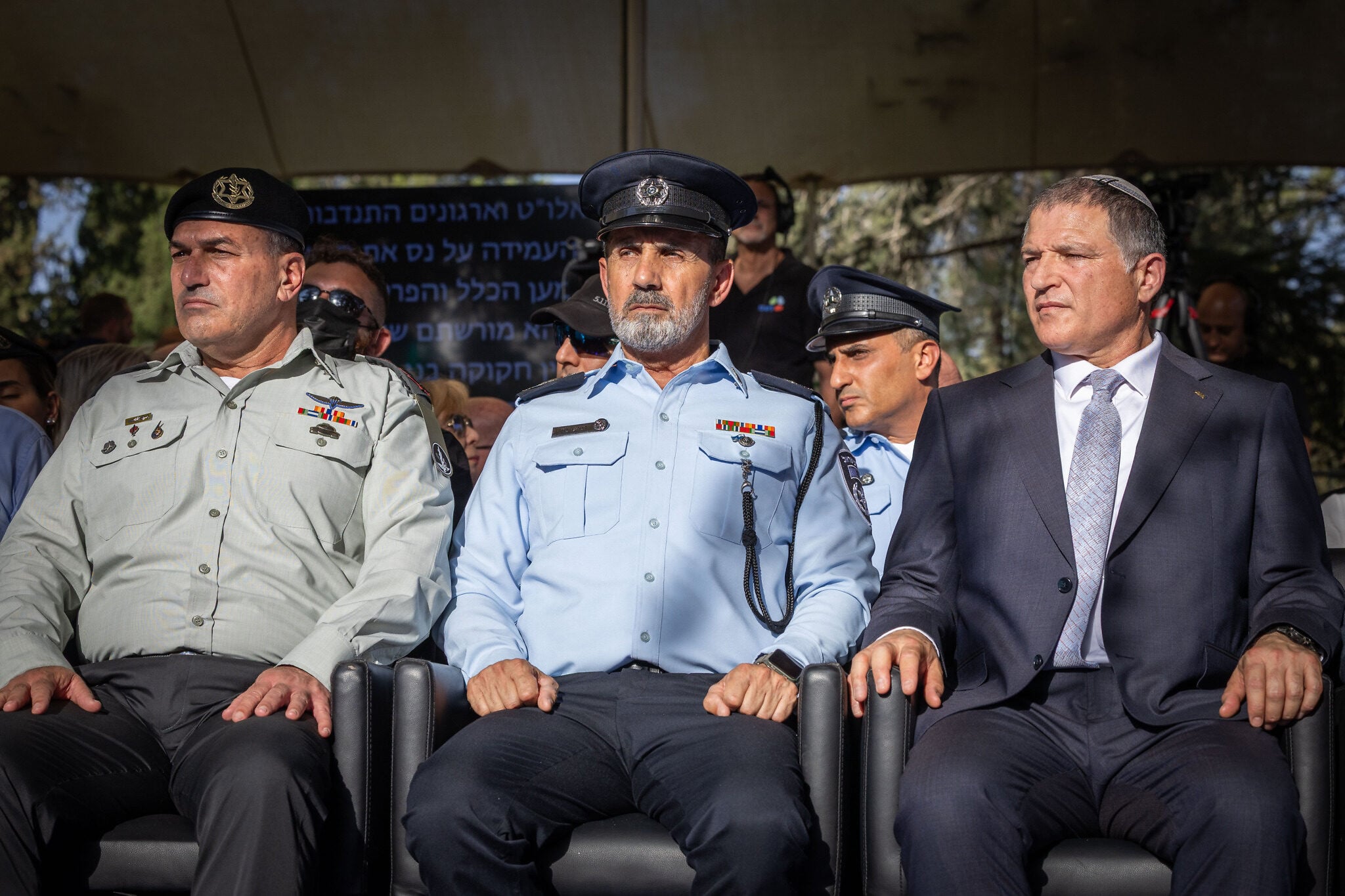
On Thursday, at a memorial for Yitzhak Rabin, the prime minister whose assassination in 1995 was the quintessential nightmare of Israeli political violence, President Isaac Herzog issued one more desperate appeal for civility.
“I stand here and say: Words kill,” Herzog said. “Therefore, candidates, leaders, pundits and commentators should all speak with care.”
Much of the anger and anxiety of the past few years stems from the Hamas-led October 7, 2023, onslaught and the multi-front war that followed. But the legacy of October 7 could also contribute to a cooling of passions, Hirschberger said.
It’s true that the attack and the war that followed have exhausted the country and traumatized large swaths of it. But he said that the attack also showed Israel why it needs a baseline level of internal solidarity, despite the chasmic disagreements that divide its populace.
“We all still have the trauma of October 7, which happened against the backdrop of a deep rift in the nation, and most of the populace doesn’t want to get to that situation again,” he said. “More extreme forces can obviously drag the state into violence, but most of the populace doesn’t want to go there.”
Can Israel get to a place where everyone accepts the election results with serenity? Likely not. But Hirschberger said the powers that be must strive to ensure that, even if half the country or more feels depressed and aggrieved on October 28, those emotions don’t cascade into bloodshed.
“There’s a lot of frustration and there’s a lot of anger and there’s a lot of misunderstanding between us; all of those things certainly exist,” he said. “But to go from there to the place we were at on the eve of October 7, or to get to a worse place of violence — I think a lot of Israelis are worried about that, a lot of Israelis on both sides.”