Israel’s election yielded a stalemate. Which means Netanyahu has won
The anti-Netanyahu parties won a Knesset majority, but they do not have the means to translate that into even a minority government. The failure is staggering, and may echo long into Israel's future
There seems to be some confusion about the result of Israel’s election, specifically as regards who won.
That’s somewhat understandable. Neither of the two rival sides has secured a Knesset majority.
But it’s also incorrect. The election, and the stalemate, show one clear winner: Benjamin Netanyahu.
How so? Simply because he does not have to do anything in order to retain power — not to concede anything, not to compromise on anything.
And that’s because the political forces arrayed against him have no realistic means of ousting him.
They do have the votes, in principle. With the count near-complete, the anti-Netanyahu parties — Gadi Eisenkot’s Yashar, Naftali Bennett’s B’Yachad, Yair Golan’s Democrats and Avigdor Liberman’s Yisrael Beytenu, plus the two Arab parties, the Joint List and Ra’am — have won a clear Knesset majority over the pro-Netanyahu bloc: 67 seats to 53.
But they do not have the means to translate that Knesset majority into a majority government, or even a minority government. And that’s because 19 of those 67 anti-Netanyahu seats are held by the two Arab parties.
Whatever you, me, President Isaac Herzog, Netanyahu, Eisenkot, or anybody else has to say about the right of duly elected Arab Knesset members to serve in an Israeli government, or of Eisenkot to swear in a minority government reliant on the votes or even abstentions of those Arab MKs, the fact is that Liberman, whose party members would not defy him even if they wanted to, will not consent to any such process. Neither will some members of Eisenkot’s party. Bennett, too, has stated that “the Arab parties are not Zionist and we will not rely on them,” though he was more equivocal in a recent Times of Israel interview.
Eisenkot himself, in our interview in early October, left a little bit of wiggle room. Here’s the relevant exchange:
Gadi Eisenkot: … If [Netanyahu] does not win an outright majority… he hopes the other side will be unable to form a coalition and that he will simply remain caretaker prime minister indefinitely. I will not allow that to happen. I will convince my colleagues to replace him.
The Times of Israel: In other words, you will try to form a minority government, with outside support from the Arab parties?
Gadi Eisenkot: I do not want the support of the Arab parties, and I am not calling on them to support me. If we reach a situation where I do not have a 61-seat majority, I will bring my government to a vote and call on Likud as well, and on all the Zionist parties, to support me. I believe it cannot be ruled out that at least one Haredi party will stay out of the vote and strategically abstain.
But Eisenkot’s Zionist opposition bloc has won a mere 48 seats, nowhere near a majority, and with no prospect even of swearing in a minority government. Nobody in Netanyahu’s bloc is going to “strategically abstain,” and that wouldn’t help him much anyway; Liberman will not cooperate; his own Yashar party cannot be fully relied upon; he’d need the active support, rather than mere abstentions, not only of the newly unpalatable Ra’am party (which did sit in the 2021-22 Bennett-Lapid coalition), but also of the Joint List, whose positions are intermittently empathetic toward terrorist organizations, and whose Balad component is avowedly anti-Zionist… The cumulative list of insurmountable obstacles goes on and on.
Wherever it winds up, the investigation announced by the Central Elections Committee on Thursday morning into alleged foreign interference in the election, with Likud predictably asserting that Ra’am “stole the elections,” is not going to make the Arab parties more acceptable in the eyes of those who already discount them. Similarly, it is impossible to take seriously Thursday’s anonymously sourced reports that the seven-strong United Torah Judaism party is considering abandoning Netanyahu’s bloc to support a minority Eisenkot-led coalition from the outside. What would it gain? Eisenkot, who lost his son and two nephews fighting in Gaza, is not going to concede to UTJ’s core demand for the ongoing mass exemption from the draft of the ultra-Orthodox community.
Various commentators have been positing truly ridiculous scenarios by which Eisenkot might somehow become prime minister:
- US President Donald Trump calls him up and tells him he needs a general at or near the helm in Israel as he prepares to try again to defeat the Iranian regime; Netanyahu goes along with the idea.
- Netanyahu does a deal with Herzog under which he partners Eisenkot in a unity government, takes first turn as prime minister but, in an ironclad agreement, pledges to honor that arrangement in exchange for a presidential pardon in his corruption trial, and then puts himself forward as candidate for president when Herzog’s term ends in July 2028.
I could go on. I won’t waste your time.
The best opportunity
Netanyahu’s victory, and the Zionist opposition’s failure, are remarkable. There could hardly have been a more dismal, and therefore helpful, reality in which to unseat the prime minister and his coalition:
- Netanyahu and his allies held office when Hamas invaded on October 7, 2023; he refused to accept prime ministerial responsibility, much less resign; he prevented the establishment of a state commission of inquiry, the single most effective means of understanding and learning from the failures surrounding that blackest of days and thus of preventing a recurrence.
- He defied the will of a huge majority of the people in refusing to draft ultra-Orthodox males to national service.
- Hamas has reasserted control over most of Gaza’s populace; the Iranian regime remains in situ, bent on Israel’s destruction, with Netanyahu himself warning days before the election that Israel consequently faces the threat of a “second Holocaust.”
- He has indulged and minimized rampant violence by settler extremists against Palestinians in the West Bank, violence not only condemned abroad but opposed by most Israelis.
- His closest aide, who ran his election campaign, is under investigation for allegedly working for Qatar from inside the Prime Minister’s Office before and after October 7.
- Israel’s economy is facing global sanctions related to settlement expansion that, Netanyahu suggested last week, could be so damaging as to require the startup nation to become an outlaw, sanctions-busting nation, resorting to cryptocurrency to try to circumvent them.
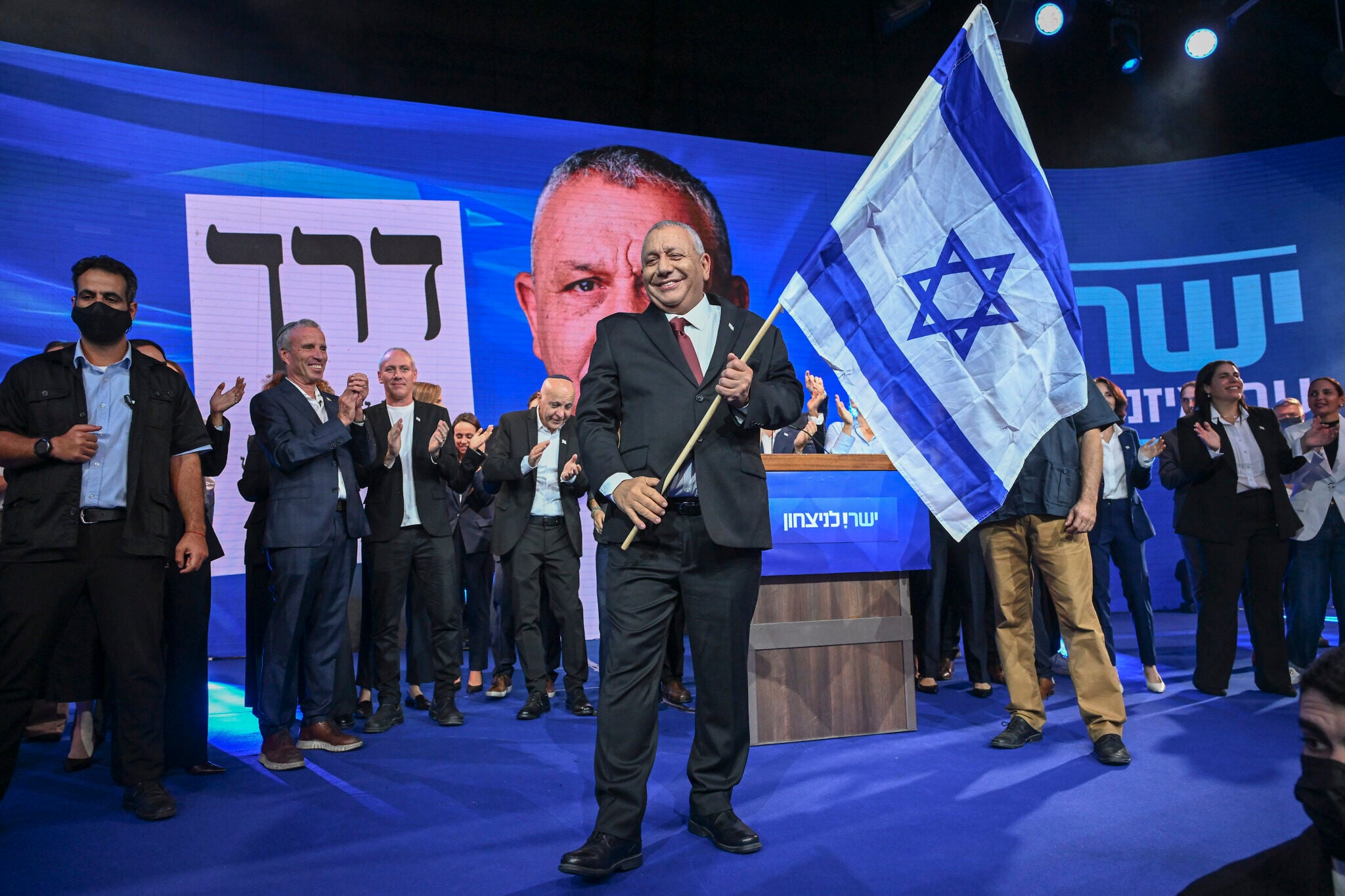
And the Zionist opposition parties, a fractious alliance of the left, center and right, with a lackluster campaign, got nowhere near majority support to defeat him.
Take it or leave it
Netanyahu has been assuring his outgoing coalition partners that he intends to stick with them. He may not actually want to stick with all of them, and perhaps least of all with the far-right thug Itamar Ben Gvir and his Otzma Yehudit party. Nonetheless, in his elated speech in the early hours of Wednesday, he promised to establish a “strong, national, right-wing” government, as opposed to any kind of unity government — potentially limiting his own capacity to muster a majority coalition of his own.
From Netanyahu’s point of view, that’s no disaster. He would prefer a widened coalition, including some of those who currently oppose him. As things stand, that Knesset majority for the anti-Netanyahu parties is significant and highly problematic for him. It dooms his judicial overhaul agenda, for a start.
But, crucially, the bottom line is that he will retain power for the next few months anyway, while Herzog goes through the process of consulting with the representatives of the incoming Knesset parties, and potentially charging Eisenkot and Netanyahu with the task of building a coalition.
Eisenkot, who may well get the first opportunity, will not succeed. Netanyahu, when his turn comes, will set out his terms — making clear, among other core positions, that he will continue to block a state commission of inquiry. And if, as is likely, none of the Zionist opposition parties are prepared to accept those terms, Israel will head to new elections.
If so, next time, there’ll be no comparable mass fly-in of anti-Netanyahu voters, no comparably sky-high Arab turnout, and a likely even more disunited opposition. The brain drain and wider emigration of Israelis opposed to Netanyahu will have continued, and likely accelerated. There’ll be relatively more ultra-Orthodox voters. And the incumbent prime minister, having survived an election in the least propitious possible circumstances, will be justifiably confident of faring better still.
Millions of Israelis are committed to maintaining a democratic state with a Jewish majority, to a non-supremacist Judaism, to aspiring to peace with those nations in the region who genuinely seek it while protecting itself from enemies bent on its destruction, to greater unity within. Leaders come and go. New, charismatic, inspirational figures emerge. Stances change, alliances shift. Realities impose themselves on political leaders, and on the electorate.
But October 27 was not only the best opportunity the anti-Netanyahu political forces had to unseat him. It may also echo long into Israel’s future, in the struggle to return the State of Israel to its foundational democratic and liberal Jewish principles.
This was arguably the most consequential election in Israeli history. And Netanyahu won.
—
This is an updated version of the Editor’s Note sent out earlier on Thursday in ToI’s weekly update email to members of the Times of Israel Community. To receive these Editor’s Notes as they’re released, join the ToI Community here.