


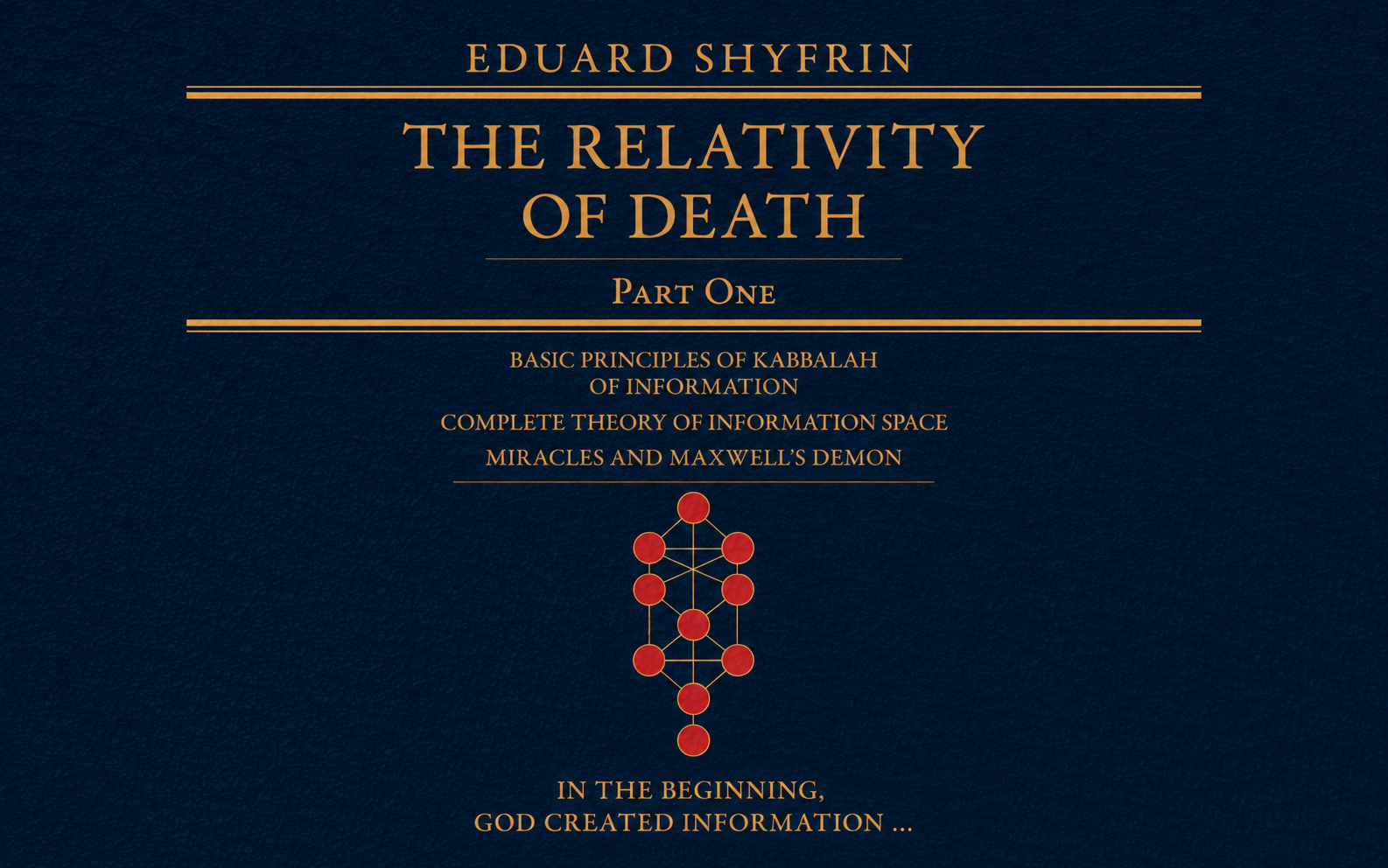
Religion and science are not at odds, according to a new book recently published by Doctor of Physical Chemistry, Eduard Shyfrin.
The book, titled The Relativity of Death, explores a new theory that synthesizes Kabbalah and physics in a revolutionary new thought experiment.
“When I started reading the works of kabbalists, I realised that Kabbalah is deeply ‘scientific’, that it is a theory of Creation of which our Universe is just a part,” writes Shyfrin in the book’s introduction.
Historically, he notes, Kabbalists were not scientifically educated and treated science suspiciously, which is why this connection has never before been created. However, paradoxically, the Kabbalist theory is “deeply scientific.”
The Relativity of Death uses Jewish mystical sources as well as scientific publications to present the theory of Kabbalah of Information. The book then provides the basic theories of Kabbalah and physics, and then connects the two. The connected theory, Kabbalah of Information, considers Creation as an Information Space.
The book continues to explain evil in the information space as a positive-negative charge and how miracles are a simple way of processing information. One of the more complex points of the book is how souls walk through the information space, thereby giving the title about the relativity of death.
Shyfrin notes that Kabbalistic texts are often full of allegories, parables, and hints, and therefore difficult to read and comprehend. Conversely, Shyfrin’s book is a straightforward, although complex and dense with facts and evidence, explanation that is accessible to contemporary readers who are interested in studying Kabbalah and physics in a scholarly manner.
Who better than a man of science to bridge this connection? Born in 1960 in the Ukraine to two metallurgists, Shyfrin was raised with reverence for science and books. He studied advanced physics and was the Ukrainian Olympics of Physics champion for two consecutive years. He wanted to study at the Moscow Institute of Physics and Technology, but despite scoring 24 out of 25 on the entrance exams, was denied entry because he was Jewish.
Shyfrin, however, knew nothing about Judaism and did not practice his religion, as Jewish religious observance was forbidden in the Soviet Union at that time.
His entrance exams allowed him admittance to the National University of Science and Technology in Moscow, where he studied steelmaking and metallurgy and later began a career as a shift foreman of an electric arc furnace. In the meantime, he completed his PhD in physical chemistry.
His journey in Judaism began when he first met a rabbi in 1996 in Kyiv, Rabbi Bleich, the Chief Rabbi of Ukraine. With him, Shyfrin donated funds to rebuild the oldest synagogue in Kyiv and support other charitable organizations. Although, he still did not feel much connection to his Judaism.
That came in 2002, after Shyfrin experienced a health crisis. The crisis brought up existential questions that Shyfrin couldn’t answer despite his years of studying science. Why are we here? What is our mission? Why are we destined to die?
He turned to Rabbi Bleich, who advised him to “Return to G-d,” which is what Shyfrin did. He read the Torah and other books, but the contradictions bothered him.
“If it seems that there are contradictions between the Torah and science, that means our knowledge is either wrong or incomplete,” writes Shyfrin. Determined to find the answers, Shyfrin began his deep dive into Kabbalah and its connection with physics and information theory.
His research led him to publish his first book, From Infinity to Man: the Fundamental Ideas of Kabbalah Within the Framework of Information Theory and Quantum Physics in 2018. The thesis of the book is that in the beginning, G-d created information and nothing else. The book was well-received by others in the scientific community who also struggled with the dissonance between their studies and beliefs.
Shyfrin then realized that many others sought the answers he did, and over the course of publishing more than 50 articles in the Jerusalem Post, Shyfrin organized his ideas into three more books, including The Relativity of Death.
“The book is addressed to the perplexed like myself,” said Shyfrin in an interview with the Times of Israel. “When people ask what is more important, faith or knowledge, they are asking the wrong question, that is like asking what is better, left or right? Faith and knowledge are inseparable.”
Shyfin is a modern-day Renaissance man. When he isn’t working on his books, he is composing music. Shyfrin learned to play piano and guitar as a child, but he never enjoyed it until recently. During the pandemic, he created the Shyfrin Alliance, a project to compose and record albums infused with Kabbalistic principles.
Based in London, Shyfrin is now busy working on a new music composition as well as his third book which will build on The Relativity of Death and explore quantum physics. The fourth book in the series will unravel the mysteries in the Torah.
“My book is not a universal truth,” Shyfin said in the interview. “I ask readers to consider it food for thought. I think, therefore, I am. But the reverse isn’t always true.”