

Amid sabotage complaints, some irregular ballots to be counted
Central Elections Committee issue new guidelines after receiving numerous reports of vandalized voting slips
 Add ToI as a Preferred Source on Google
The Central Elections Committee reported that it received numerous complaints during Tuesday’s Knesset elections about ballot slips that were vandalized or whose format differs from the committee-approved version.
In order to preserve the integrity of the elections, committee chairman Supreme Court Justice Hanan Melcer instructed polling station committees to retain any ballot slip that has a small hole in it or that has been scribbled on with the clear intent to render it invalid, or whose format is different from the official one.
If by the end of the vote count, the polling station finds just one of either kind of irregular ballot slip, that slip will be regarded as invalid. But if there are two or more examples, they should be regarded as valid. In all events, all irregularities are to be noted in the protocols.
The ruling comes after multiple parties, from far-left to far-right, claimed ballots were damaged, hidden or missing at some of the 10,000 polling stations around the country.
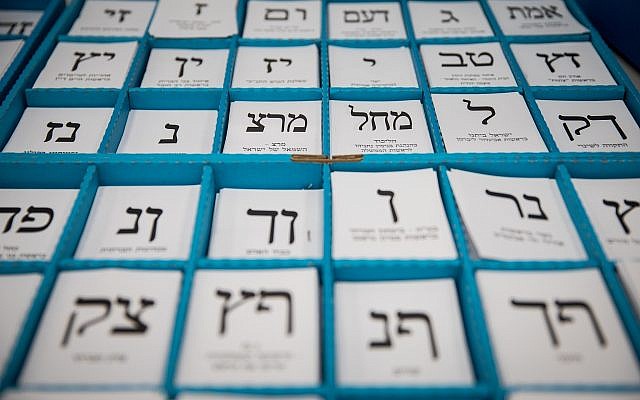
Earlier, police said they were investigating what some Blue and White officials claimed amounted to a “systematic” campaign to vandalize — and thus disqualify — Blue and White ballots around the country.
Blue and White, which is led by Benny Gantz and is the main challenger to Prime Minister Benjamin Netanyahu’s Likud party, provided examples to the committee of vandalized ballots with small markings on them that would disqualify the vote.
Melcer said that if police find evidence of widespread vandalism meant to disqualify Blue and White votes, he would instruct polling stations to count damaged or marked ballots for the party as valid.
Following the Blue and White complaint, Netanyahu accused activists from the party of invalidating Likud voting slips. Unlike Blue and White, the prime minister did not offer proof.
Separately, activists and election observers, primarily from the Likud party, placed at least 1,200 hidden cameras in polling stations in Arab towns Tuesday morning, prompting a police investigation. Some of the cameras were hidden on the bodies of activists and observers from the party, and some were said to have been installed in the polling stations. The effort included devices planted in Arab towns throughout the Galilee and Negev, and in Arab-majority areas in Haifa, Nazareth, and elsewhere.
Activists deployed the cameras in areas where they suspected there could be “problematic” levels of election fraud, according to the Ynet website.

Melcer, of the Central Elections Committee, said filming inside polling stations was a breach of election law and issued a directive prohibiting filming voters inside polling stations, “except in the case of a special incident.”
In the wake of the revelation of the hidden cameras, prominent pollsters said turnout among Arab voters was dramatically lower than past elections.
The Arab-majority party Hadash-Ta’al submitted a complaint about the hidden cameras to the Central Elections Committee, alleging that the “illegal” action by the “extremist right” was a bid to intimidate Arabs from exercising their right to vote.
Less than an hour before polls closed at 10 p.m., Hadash-Ta’al said turnout in Arab towns and villages stood at 46 percent and was rising “following Likud’s efforts to sabotage the vote in Arab communities.”
Hadash-Ta’al, along with the left-wing Meretz party, filed an appeal with the Central Elections Committee to keep polling stations in Arab towns open for another hour, until 11 p.m., saying the cameras had deterred voters.
“The Arab public is afraid to arrive at the polls due to the use of hidden cameras,” Meretz said.








The Times of Israel Community.