

Après moi, la mêlée: 9 things to know for March 28
With more Gaza violence on the horizon, the sides are scrambling to reach some sort of deal to at least stave off fighting until April 10. What happens after is anyone’s guess
 Add ToI as a Preferred Source on Google
Joshua Davidovich is The Times of Israel's Deputy Editor
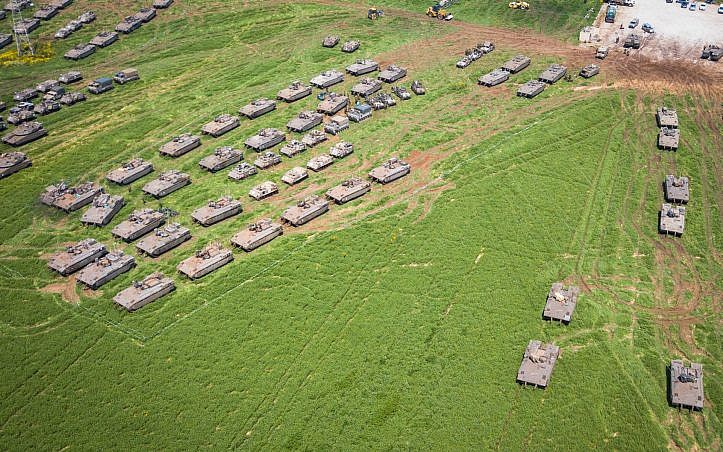
1. Girding for another round: With the last round of fighting barely over, the Israeli press is looking forward to the next expected round of violence over the weekend, with potentially tens of thousands of Palestinians massing at the border fence for an anniversary protest.
- Fears are sky high that the protests, marking Land Day and a year since the start of the March of Return demonstrations, will be a repeat of last year, when 15 Palestinians were killed and there were various attacks on troops on the border.
- “From the army’s view, the round of fighting has ended, but can pick up again in the wake of whatever happens on Saturday … especially if there are deaths,” Yedioth’s Yossi Yehoshua predicts.
- Israel has massed troops along the border, both as a threat of a ground operation if things get bad, and as reinforcements for the expected riots on Saturday.
- During a visit to troops along the border Wednesday, IDF chief Aviv Kohavi ordered troops to be prepared for whatever, especially the infantry, armored and artillery reinforcements that were recently sent to the region, ToI’s Judah Ari Gross reports.
- On Wednesday, Hamas leader Ismail Haniyeh emerged from hiding, said Israel had “gotten the message,” and called for “Palestinian people in Gaza, the occupied West Bank, and abroad to participate in Land Day (March 30) and take part in the million-man march.”
2. Trying to avert disaster: Despite the bluster, there are reports of intensive efforts by Egypt to broker a calm ahead of the protests, at least until Israelis can head to the polls.
- “Egyptians are trying to draw up a ‘limited arrangement,’ unofficial understandings that would allow Hamas to receive some concessions regarding movement through the checkpoints, fishing waters and a few other items in return for keeping a lid on the violence until Election Day, April 9, and perhaps somewhat beyond that,” Haaretz’s Amos Harel reports.
- But London-based Arabic newspaper Asharq al-Awsat reports that Hamas conditioned an end to all violence on a wider and more comprehensive agreement to lift the blockade of the Strip, which Israel says is in place to prevent arms reaching the terror group.
- Israel Hayom claims that the chances of the sides reaching a deal are “slim” and nobody is putting much stock in them.
- And even if there is a deal, who knows what April 10 shall bring. As Army Radio’s Tzahi Dabush points out on Twitter, 2018 saw a massive uptick in rockets fired, with 1,146, compared to 35 the year before.
כדי להבין סדרי גודל של השנה האחרונה בעזה, הנה סיכום השיגורים לישראל בשנים האחרונות לפי השב״כ:
2018 – 1,146 שיגורים
2017 – 35 שיגורים
2016 – 15 שיגורים
2015 – 23 שיגורים— צחי דבוש (@TsahiDaboush) March 28, 2019
3. Deal with the devil: ToI’s Avi Issacharoff writes that while Prime Minister Benjamin Netanyahu and his minister won’t admit it, “the alternative to Hamas’s regime in Gaza would be far more chaotic and dangerous, which is why the prime minister would rather reach an agreement with Hamas, of whatever kind, than start a war that will lead nowhere.”
- In Israel Hayom, Yaov Limor writes that both sides are trying to keep things calm and work “from the head and not the gut.”
4. Getting out of Dodge: Many Israelis living in the Gaza area have decided to decamp for the weekend, fearing the uptick in violence and what may come with it, Yedioth Ahronoth reports.
- Some communities are even planning organized retreats to get out of Dodge.
- “We want our kids to be as far from the events as possible,” the resident of one Eshkol-region community that is making a mass exodus tells the paper. “In the last year Fridays have been really tough, with all the explosions and noise from the protests. This time we decided, because of the expectation that it will be very tense, to simply leave and get some air together as a community and return when the battles end. It’s safest for us, allows the army to do what it needs and mostly gives us some peace of mind after very tense days.”
- Residents are feeling pretty abandoned, with the country responding forcefully to rockets on the Tel Aviv area but not the south.
- “It’s like we live in another country,” Kerem Shalom resident Guy Teitelbaum tells Israel Hayom. “This country has left us behind and I have to believe we’ve been abandoned for political reasons.”
- An interview given by Likud minister Miri Regev to Ynet in which she remarks, “Who cares if they shoot at Ashkelon, we shoot back … and we decide when,” does little to address those feelings.
5. But is it good for Netanyahu? A partial survey put out by the Israel Democracy Institute shows that most Israeli Jews think the US recognition of the Golan Heights will help Netanyahu in the election, especially those on the right.
- However, while the same amount on the right (74%) think the move is helpful to Israel, those numbers dip to 42 percent and 40 percent among centrists and left-winger respectively. (The full survey will likely be released Sunday, a spokesperson says.)
- In Commentary magazine, former Israeli ambassador to Canada Vivian Bercovici writes that talk of the Golan recognition being gifted to Netanyahu by US President Donald Trump, and it torpedoing chances of a Palestinian peace deal, is just “diversionary noise” since the move is completely legal.
- “There are consequences to military attacks, particularly when the attacker loses. International law is silent on this point, and for good reason. Because it was, on a logical basis, incomprehensible,” she writes. “People may hate president Trump and PM Netanyahu. They may be contemptuous of the timing of America’s recognition of Israeli sovereignty over the Golan Heights. But it is not contrary to international law. And it does not impact the outcome of the Palestinian-Israeli conflict one iota.”
6. Abu Dhabi on the line: While many had predicted the Golan recognition would push Arab states further away from ties with Israel, the UAE’s minister of state for foreign affairs Anwar Gargash tells The National that Abu Dhabi should be more open to ties with Israel.
- “Many, many years ago, when there was an Arab decision not to have contact with Israel, that was a very, very wrong decision, looking back,” he says. “Because clearly, you have to really dissect and divide between having a political issue and keeping your lines of communication open.”
- Gargash also seems to discount the possibility of a two-state solution, telling the paper that “a two-state solution will no longer be feasible because a sort of reduced rump state will no longer be practical.”
- “I think 10 to 15 years, the discussion will be what is the nature of the Israeli state, what are the rights of the Palestinians within that Israeli state, should they be equal citizens, is it sustainable that they are not equal citizens?”
- Reuters calls the remarks “unusually candid.”
- Gargash is the same minister who came out strongly against Netanyahu earlier this year over his comments about Israel not being a state of all its citizens.
Not only are PM Netanyahu’s comments that “Israel is not a state for all its citizens” repugnant, but they provide vindication sought by extremists. The road to peace is further undermined by this shameful approach.
— د. أنور قرقاش (@AnwarGargash) March 12, 2019
7. West Bank for immunity: There is widespread speculation about whether Netanyahu will parlay the Golan recognition to sue for control of parts of the West Bank.
- ToI’s David Horovitz writes that according to American and Israeli sources, there is “a post-election scenario in which Netanyahu would indeed seek to annex at least the major settlement blocs — such as the Etzion Bloc, Ma’aleh Adumim and Ariel — and to do so, ideally, with some degree of American backing.”
- “Netanyahu could explicitly or implicitly encourage MKs who want to see partial annexation of the West Bank to support legislation that would protect him from prosecution while in office,” he adds.
- However, in Haaretz, Mordechai Kremnitzer points out that “it requires imagination to view the occupation of the West Bank as the result of a defensive war.”
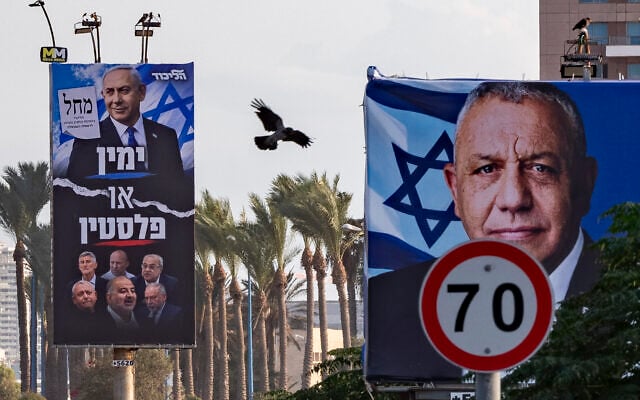
8. He’s corrupt too! Netanyahu-backing Israel Hayom is playing up a state comptroller report that found that the Israel Police negotiated a contract with a cybersecurity company headed at the time by current prime ministerial candidate Benny Gantz without issuing a tender, in violation of acquisition regulations.
- While the case gets press elsewhere as well, most of the suspicions focus on the conduct of the police, and nobody is quite as excited as Israel Hayom, which sees it as a chance to take some heat off Netanyahu.
- The tabloid places the story prominently on its front page, even above Gaza tensions, pointing fingers at Gantz, former police chief Roni Alsheich (who led the investigations of Netanyahu), and others in Blue and White with ties to Gantz’s defunct Fifth Dimension firm.
- Even before the report was released, Netanyahu backers were trying to drum up excitement in recent days by hinting at a “fatal report” that would be coming out against Gantz.
- “This is suspicion of a deal in which there are hints of something more. Gantz and Alsheich had an intimate relationship. Two peas in a pod, If the police chief is suspected of doing deal with his friends in the security establishment, maybe those ties led elsewhere too,” Israel Hayom’s Amnon Lord speculates. “This is exactly the cancerous relationship of the good ol’ boys in the defense world. Israel needs defense, not a defense complex that goes around with the Israeli public like a bull in a china shop from crisis to crisis.”
9. And him! One person making the rounds pointing fingers at Netanyahu over his corruption cases is former prime minister Ehud Olmert.
- Olmert, who served jail time for his own graft convictions, is a strange choice for someone who should be offered a spot on TV to give his self-righteous commentary about his successor’s wrongdoings, writes Uzi Benziman in the Seventh Eye, who calls it “almost comic, if not outrageous.”
- “As I see it, his behavior disqualifies him off the bat since it gives legitimacy to someone who misappropriated the public trust given him,” he writes. “He may be an expert on the subject, but he’s certainly not on the viewer’s side.”





The Times of Israel Community.