

Berlin fears AfD win will undo efforts against far right
Many in Germany’s left-leaning capital are terrified by likely strong showing for the populist party in Sunday elections
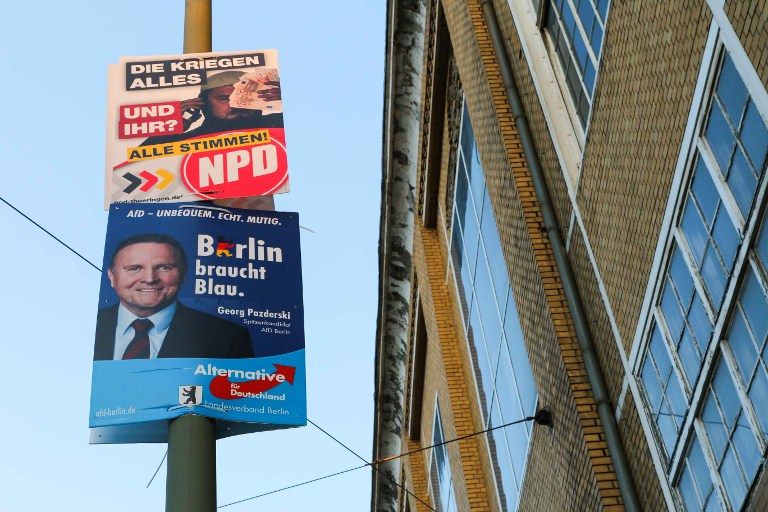
BERLIN (AFP) — Berlin prides itself on being hip, multicultural and tough on the racist far-right — but that image could take a beating as an anti-migrant party eyes election gains Sunday.
Many in Germany’s left-leaning party capital are terrified by the likely strong showing for the right-wing populist Alternative for Germany (AfD), which is polling at up to 14 percent.
They worry that a win for the Islamophobic AfD — which is especially popular in poor areas of the city’s former communist east — will undo Berlin’s long struggle against neo-Nazi groups such as the NPD party.
“Careful, Berlin!” Mayor Michael Mueller of the centre-left Social Democrats wrote on Facebook Thursday, warning of the rise of “Nazis” who “stoke hate and violence.”
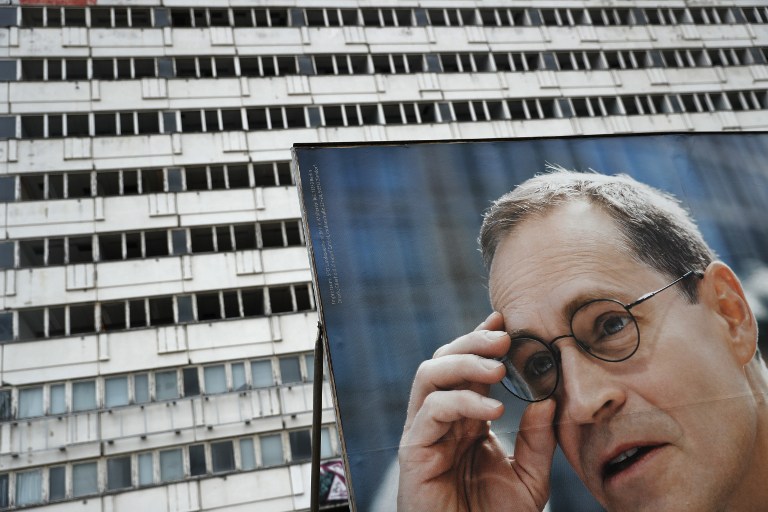
He said laid-back Berlin — a city known for its IT start-ups and all-night techno raves — could not just “shrug off” a 10-14 percent AfD win that would be “seen throughout the world as a sign of the resurgence of the right and of Nazis in Germany.”
“Berlin is not just any city,” he wrote. “Berlin is the city that has evolved from the capital of Hitler and of Nazi Germany to a shining beacon of freedom, tolerance, diversity and social cohesion.”
The AfD’s top candidate for Berlin, Georg Pazderski, fired back, charging that Mueller was branding “hundreds of thousands of voters” as Nazis with rhetoric that could incite violence against AfD members.
Berlin authorities, in their effort to promote a diverse and tolerant city, point to the success story of Schoeneweide, a former neo-Nazi stronghold in the southeast that has been transformed into a more diverse and artistic student district.
Once skinheads waxed nostalgic about the Third Reich at the notorious local bar “Zum Henker” (“The Hangman’s”), which operated from 2009-11.
Today the space hosts the pizzeria “Anima e Cuore” (“Heart and Soul”), managed by Hanan al-Kassem and her Lebanese-born father, while the racist graffiti outside has vanished under a coat of white paint.
In the same street — Brueckenstrasse, once dubbed “Brown Street”, after the Nazis’ khaki uniforms — the Berlin leader of the NPD party, Sebastian Schmidtke, was forced in 2014 to close his military accessories store — ironically, making way for a shisha shop.
Key to chasing them out was a regulation in the city-state that allowed for the termination of leases if tenants engaged in extreme right-wing activities, but also neighbourhood initiatives such as festivals “for democracy and tolerance”.
As a result, “Schoeneweide today is no longer a Nazi stronghold”, said Berlin government spokesman Oliver Fey, who called the city-state “a national frontrunner” for such initiatives.
All major parties in the capital have agreed a “Berlin consensus” against the extreme right and for an “open city with cultural diversity”.
Berlin’s budget for programs against the extreme right, racism and anti-Semitism rose from 2.5 million euros ($2.8 million) in 2015 to 3.2 million this year.
Berlin’s past progress, many fear, could now vanish as the influx of one million refugees and migrants to Germany last year has reignited xenophobic sentiment.
“The political discourse has shifted to the right,” said Bianca Klose of the anti-fascist advocacy group MBR.
The AfD, she said, “benefits from the fact that people with racist ideas have dared to emerge from the shadows and become visible in the streets.”
Mueller has warned that the AfD could gain control of “one or two district administrations,” the local government units in the city of 3.5 million.
“The AfD would end up with executive responsibility … affecting millions of actions and hundreds of employees.”
Even the ultranationalist NPD — which is currently fighting a government case in Germany’s highest court to ban it — hopes to win some local district seats on Sunday.
Its Berlin leader, Schmidtke, predicted that, even if the neo-Nazis’ bars and shops in Schoeneweide are gone, the party will still make ballot box gains, thanks to its silent supporters.
On election day, he said, “we will see that nothing has changed. After all, the people are still there, and so are their ideas.”




The Times of Israel Community.