

Bill of fights
A proposal that could protect the prime minister from prosecution engenders some impassioned opposition, some political wrangling, and some willful ignorance
 Add ToI as a Preferred Source on Google
Joshua Davidovich is The Times of Israel's Deputy Editor
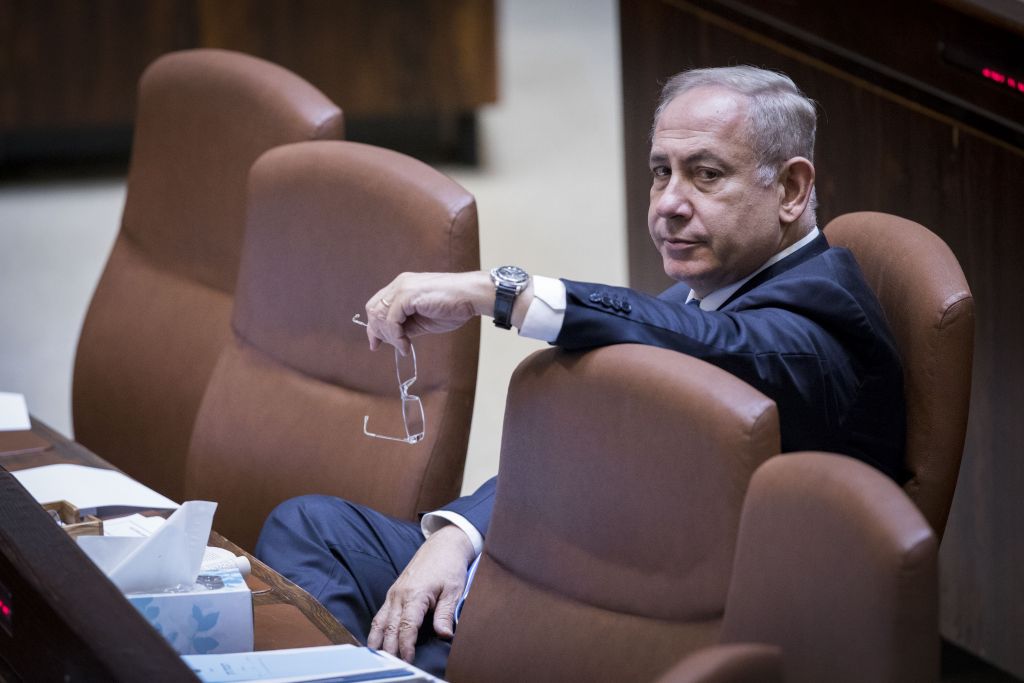
The start of the Knesset season of legislative wrangling gets off to a bang in Monday morning’s papers before a single MK even takes his or her seat in the august halls of the parliament, thanks to a bill being fought over which could potentially grant Prime Minister Benjamin Netanyahu immunity from prosecution.
That bang is most acutely felt on the front page of Yedioth Ahronoth, which makes its hatred for the bill fully known with a main headline screaming out “They have lost all shame.”
The headline is for a column by renowned Bibi-basher Sima Kadmon, whose vitriol targets bill author David Amsalem, Likud attack dog David Bitan and Netanyahu himself, surmising that even if the proposal’s backers say it won’t help the current prime minister, it surely will in fact help him in some way, maybe in future investigations into criminal things we don’t even know about yet.
Yet she still holds out hope it can be stopped.
“This is the hour of truth for ministers in Netanyahu’s government. These are the hours, days, maybe weeks in which they will be judged for their honesty, morality and leadership. If we don’t see them standing as a united front against this in the coming weeks … we can just shut the whole thing down,” she writes. “One should hope that the police chief and his force will not fold, that the state prosecutor and attorney general will seek justice based on the evidence and that the public will realize that Netanyahu is acting like a guilty person and trying to freeze a personal investigation, and that the coalition will not lend their hands and Likud will not commit collective suicide in battling all the state’s enforcement mechanisms, just for Netanyahu. It also depends on the Israeli public. How much longer will they be willing to let him spit in their faces and call it rain? When will they open their eyes and see what is happened under their noses? Until when will they be willing to aid and abet criminal behavior?”
The paper’s main news story, while not as impassioned, isn’t exactly neutral either, dubbing the bill the “Bibi law” in its headline and rounding up the coalition opposition to the bill already shaping up.
“This bill will harm the rule of law and place the prime minister above the law,” the paper quotes Kulanu MK Rachel Azaria saying, amid a dense tangle of political infighting, even within Likud, over the measure.
Haaretz doesn’t place the story on its front page, but its lead editorial gives rare backing to Justice Minister Ayelet Shaked for refusing to push the bill forward before a proper discussion can be had on it (even as a front-page story slams her for placing too heavy a finger on the state’s dealings with the High Court.)
“Such legislation would smash the basic principle of a democracy, of equality before the law. This principle mandates that in a criminal matter, no one is above the law,” the editorial reads. “The public message that passage of this law would send is that personal and systemic corruption among the country’s political leadership is a permitted norm. The public would conclude that if the person at the top can take bribes, engage in nepotism, misuse public funds and harm the public interest – then this same behavior must be okay at all levels of government, on the national and municipal level.”
If one were looking for signs that Netanyahu and his allies may be backing off their offensive over the bill, they might take heart by looking at Israel Hayom, which buries nearly all mention of the tiff. Instead, the Netanyahu-backing tabloid exhibits high hopes that the coalition will be able to get together on something possibly a bit more benign, the 2019 budget, getting started on it before 2018 is even a thought in anyone’s mind.
“If it works out, this will be a dramatic advancement over the regular legislative calendar for the yearly budget,” the paper reports dryly.
Netanyahu could be backing off, or the paper may just be expert at ignoring things that could cast the prime minister in a poor light. For instance, a story previewing President Reuven Rivlin’s speech to the Knesset’s opening session Monday notes that he will speak out against politicians who attack the police or other law enforcement officials. Yet the paper manages to glaringly leave out the politician who has been in the spotlight recently for doing just that… you guessed it, Netanyahu.
“Rivlin will emphasize that unjust criticism against the police, attorney general, state prosecutor and state comptroller could hurt their standing and public service, the paper reports,” its blinder force-field on full blast.
Turning a blind eye to wrongdoing seems to be something of an Israeli pastime, given Haaretz’s lead story, which reports that Jerusalem was selling advanced arms to Myanmar while the Southeast Asian nation was in the midst of an ethnic cleansing campaign against the Rohingya minority.
“Israeli weapons are being sold to Myanmar despite the restrictions on weapons sales to that country. Only last month Israel refused to announce that it would stop selling weapons to Myanmar despite the UN declaration about ethnic cleansing. The Rohingya minority is now considered the most persecuted people in the world,” the paper reports. “Israel is careful not to officially confirm that it is granting permits to Israeli weapons firms to sell weapons to Myanmar. But the visit two years ago by Myanmar’s chief of the armed forces, Gen. Min Aung Hlaing, who met with Israel’s entire top military brass, was an indication of the cooperation between the two armies.”
Apparently doing business with rogue regimes is not that difficult, thank to some loopholes, but Israel Hayom reports that efforts are being made to close those up, with North Korea specifically in mind.
The paper reports that a bill is beng worked on to update a law which prohibits Israeli cooperation in the sale or production of weapons of mass destruction, to bring it in line with international standards, after the Financial Actions Task Force which oversees international sanctions found Israel’s legislation to be lacking.
“The draft of the bill’s abstract — the fruit of discussions that began in 2013 — obtained by Israel Hayom shows that its purpose is to boost Israel’s ability to take part in the international fight against the spread and funding of weapons of mass destruction, including via immediate financial sanctions against those selling or funding these weapons, or those aiding them,” the paper reports. “The new abstract blocks existing loopholes that allowed for the forging of business ties with North Korea and even Iran.”









The Times of Israel Community.