

Breaking ground without digging: In first, archaeologists ‘X-ray’ Jerusalem’s hidden layers
Israeli researchers use muon detectors, which detect elementary particles akin to heavy electrons, to reveal subterranean cavities; hope method will be deployed across the world
 Add ToI as a Preferred Source on Google
Rossella Tercatin is The Times of Israel's archaeology and religions reporter.
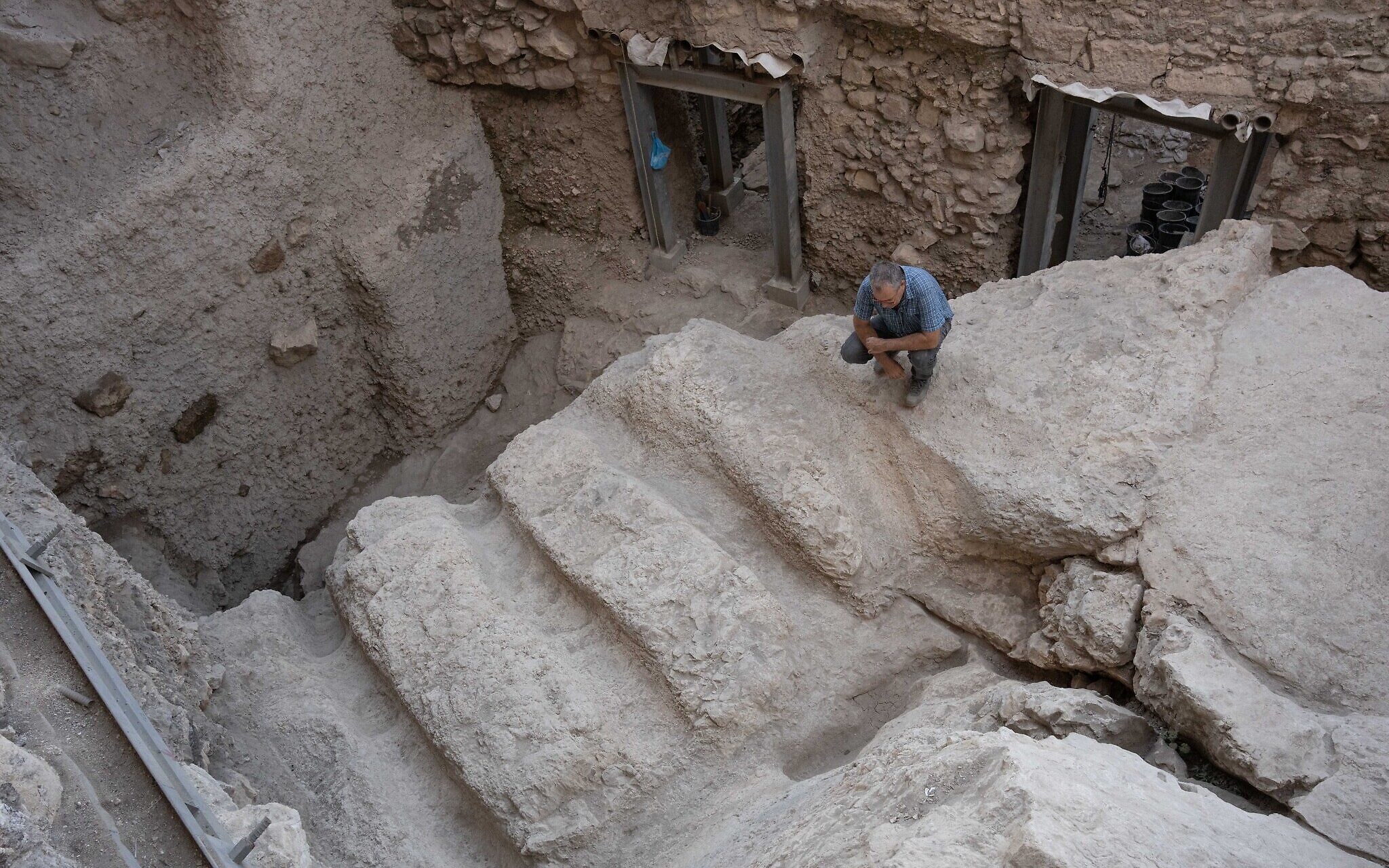
In a groundbreaking achievement that requires no actual breaking of ground, Israeli researchers have demonstrated the archaeological utility of a technology that acts like an “X-ray” for the Earth, revealing hidden spaces beneath an ancient site in Jerusalem, Tel Aviv University announced Monday.
Combining physics and archaeology, the scientists deployed a detection system based on muons — elementary particles akin to heavy electrons — to scan for underground hollows and cavities in the City of David site, just outside of Jerusalem’s Old City walls in the predominantly Palestinian neighborhood of Silwan.
Their findings, published in the Journal of Applied Physics, could give archaeologists worldwide a powerful new tool to map subterranean spaces before they lift a single shovel.
“All archaeological sites are like Swiss cheese,” Prof. Oded Lipschits of TAU’s Department of Archaeology and Ancient Near Eastern Cultures told The Times of Israel in a phone interview.
“From the pyramids of Egypt to the Maya cities of South America, and of course here in Israel, ancient inhabitants carved out underground spaces for water systems, agricultural storage, and more,” he said. “In archaeology, we have no reliable method to detect such cavities — only chance. I might be excavating deep into the bedrock and suddenly stumble upon an opening, the entrance to a hidden reservoir. I can dig it once I find it, but until that moment, I have no way of knowing it’s there.”
According to Lipschits, subterranean structures are particularly common in Israel because vast areas contain a layer of hard limestone, known as nari, beneath which lies a softer chalk. Over the millennia, inhabitants who managed to pierce the upper layer could easily create chambers for storage, water installations, or even living spaces.

“With this research, we set out to develop a simple, low-cost method to produce a 3D map of what lies beneath the bedrock — using artificial intelligence as well — so that archaeologists can arrive at a site already knowing the underground layout and decide where to dig accordingly,” Lipschits said.
Muons are particles carrying an electrical charge similar to electrons or protons. They are primarily created by the interaction of cosmic rays (particles roaming across the universe) with the Earth’s atmosphere.
“Muons hit the ground at a constant, known rate,” Prof. Erez Etzion of TAU’s School of Physics and Astronomy said in a university statement. “Unlike electrons, which stop after only a few centimeters of soil, muons lose energy slowly and some penetrate deep into the Earth – some even reaching depths of up to 100 meters [328 feet]. If we place muon detectors underground and measure the surrounding environment, we can identify empty spaces where energy loss is negligible.”
Etzion compared the method to a medical X-ray, which reveals hidden structures inside the human body.
“You send an X-ray beam through a body and place a camera on the other side to image bones and joints, which block the beam more than, for instance, fat or flesh,” Etzion explained. “Here, the muons are the X-ray beam, our detector is the camera, and the underground systems are the human body.”
According to Etzion, archaeologists already used more primitive muon detectors to scan pyramids starting as early as the 1960s.

The Israeli team produced the proof of concept for their method at the City of David, where, according to Lipschits, the detectors not only confirmed underground cavities already known to archaeologists but also revealed previously undiscovered ones.
The City of David preserves layers of Jerusalem’s past, from the First Temple period or Iron Age (1200–586 BCE) through the Roman era and into the Early Islamic period.
“It was very interesting, a clear indication that the system works,” Lipschits said. “Now we can move forward and refine the technique.”
Part of the novelty of the project was showing the possibility of setting up muon detectors in an underground site with limited accessibility. To get the detectors into place, the research team had to rappel into the cavern, using ropes and pulleys to bring in the scientific equipment.
“It was an extremely challenging task,” Etzion told The Times of Israel in 2024. “In the lab, we are in a sterile environment; here, we rebuilt a detector in a few crazy days, under the ground where it’s dark and humid, far away from a clean laboratory with ideal conditions.”
One of the team’s key goals now, Lipschits said, is to create portable, affordable muon detectors and software so that excavations anywhere in the world can employ the technology.
“We’re already working on developing them,” he said.

Meanwhile, the team is preparing to scan more archaeological sites across Israel.
“We are planning a case study at Tel Azekah,” Liphshitz said, “because we know there is a large water reservoir there, and we want to see what the cosmic ray detectors can reveal. Afterwards, we will excavate the site and compare the findings.”
First settled around 3500 BCE, Tel Azekah remained a significant center throughout biblical times (1000–586 BCE) and continued to thrive during the Hellenistic, Roman, and Byzantine periods, lasting until the sixth century CE.
Co-authors of the paper also include researchers from the Israel Antiquities Authority and Rafael Advanced Defense Systems, underscoring the potential of muon detectors for use not only in archaeology but also in other fields, including the defense industry, for identifying underground cavities.










The Times of Israel Community.