

Construction worker falls to his death in Beit Shemesh
Eyewitnesses say man fell from several stories up; death is 40th construction-related fatality in 2019
 Add ToI as a Preferred Source on Google
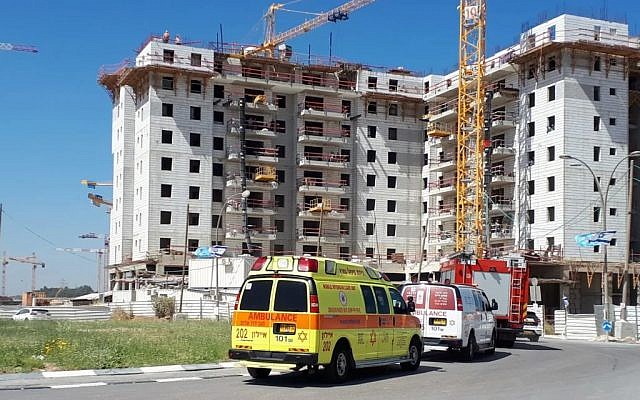
A construction worker was killed Monday at a work site in Beit Shemesh, a city west of Jerusalem.
The Magen David Adom ambulance service said the 50-year-old man sustained serious head injuries after falling from a building. MDA said paramedics declared him dead at the scene.
Eyewitnesses said the man fell from several stories high.
Police were investigating the death, which according to Hebrew media outlets was the 40th construction-related fatality and 76th death in a work accident overall since the start of 2019.
Deaths of construction workers in Israel are a near-weekly occurrence, largely because of poorly enforced safety codes.
Last week, one construction worker was killed and two were injured in various building accidents throughout the country.
In June, figures released under Freedom of Information laws showed that police have opened criminal investigations in only 25 percent of job site accidents that led to deaths or severe injuries of workers in 2016-2018.
In response to the huge spike in work site accidents, police established a special unit called Peles at the end of 2018, under the aegis of its serious crimes unit Lahav 433, which specializes in accident investigation. However, the Haaretz daily reported in June, the unit had only opened investigations into three of the 38 deadly work accidents that occurred in the first five months of 2019.
Police have said the unit was not meant to investigate every accident, but only those “with unique attributes, like complex accidents involving infrastructure collapse, or the sort that require expertise and resources,” according to a statement.










The Times of Israel Community.