Flight escorted by IAF into Ben Gurion after ‘security incident’; concerns unfounded
Air force scrambles fighter jets after ‘threatening message’ reported aboard Wizz Air flight from London to Israel; after landing, authorities determine ‘no real incident’
Illustrative: A Wizz Air flight takes off from Ben Gurion International Airport, July 22, 2019. (Moshe Shai/Flash90)
The Israeli Air Force scrambled fighter jets to escort a Wizz Air flight into Ben Gurion Airport Sunday afternoon, following a suspected “security incident,” a military source told The Times of Israel.
The suspicions occurred aboard the low-cost Hungarian carrier’s flight W95301 from London’s Luton Airport, and came after one of the passengers purportedly received a “threatening message” on their phone, according to a security source.
An Israel Airports Authority spokesperson told The Times of Israel that “due to suspicious conduct on the aircraft, security forces acted in accordance with the procedures for such a case.”
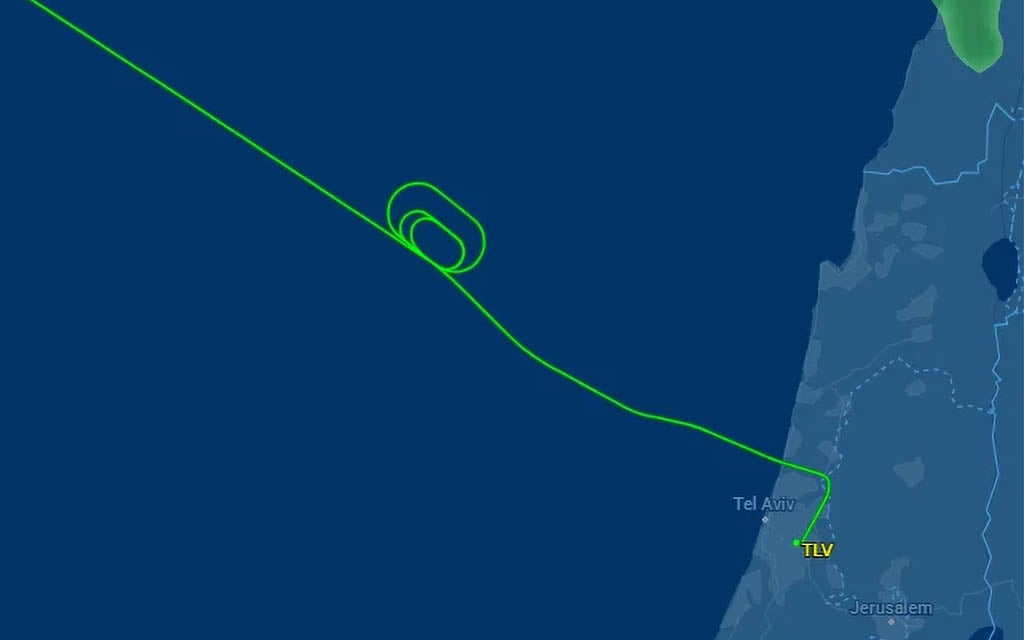
The air force scrambled several fighter jets, which escorted the plane back to the airport.
“The aircraft landed, and it was found that there was no real incident,” the spokesperson said.
Get The Times of Israel's Daily Editionby email and never miss our top stories
According to reports in Hebrew media, the “threatening message” first appeared on the phone of a ultra-Orthodox couple, though Channel 12 said that the “message” was the name of a Wi-Fi hotspot that had been changed by their son to the Arabic word for “terrorist,” sparking fears of a possible attack.
A flight tracker map of the Wizz Air flight W95301, which was escorted by IAF jets into Ben Gurion Airport following suspicions of a “security incident,” February 8, 2026. (Screenshot: flightaware.com)
Once on the tarmac, passengers and their belongings were checked by bomb-sniffing dogs, Channel 12 added, and nothing suspicious was found.
Air traffic returned to normal after incoming and outgoing flights were briefly paused due to the incident.
Advertisement
Help us report truthfully on social media
As a multimedia journalist, my job is to take the quality, fact-based journalism produced by The Times of Israel newsroom and make it accessible across every platform — from Instagram posts to podcasts to short-form videos.
This is how many, especially young people, consume news these days. But misinformation is rampant on social media. Our team at ToI produces accurate, responsible short-form reporting on Israel and the Jewish world.
If you believe in the importance of factual social media journalism, please consider joining our reader support group, The Times of Israel Community. Your financial support is essential to sustain responsible multimedia reporting.
We’re really pleased that you’ve read X Times of Israel articles in the past month.
That’s why we started the Times of Israel - to provide discerning readers like you with must-read coverage of Israel and the Jewish world.
So now we have a request. Unlike other news outlets, we haven’t put up a paywall. But as the journalism we do is costly, we invite readers for whom The Times of Israel has become important to help support our work by joining The Times of Israel Community.
For as little as $6 a month you can help support our quality journalism while enjoying The Times of Israel AD-FREE, as well as accessing exclusive content available only to Times of Israel Community members.
Thank you, David Horovitz, Founding Editor of The Times of Israel


 Add ToI as a Preferred Source on Google