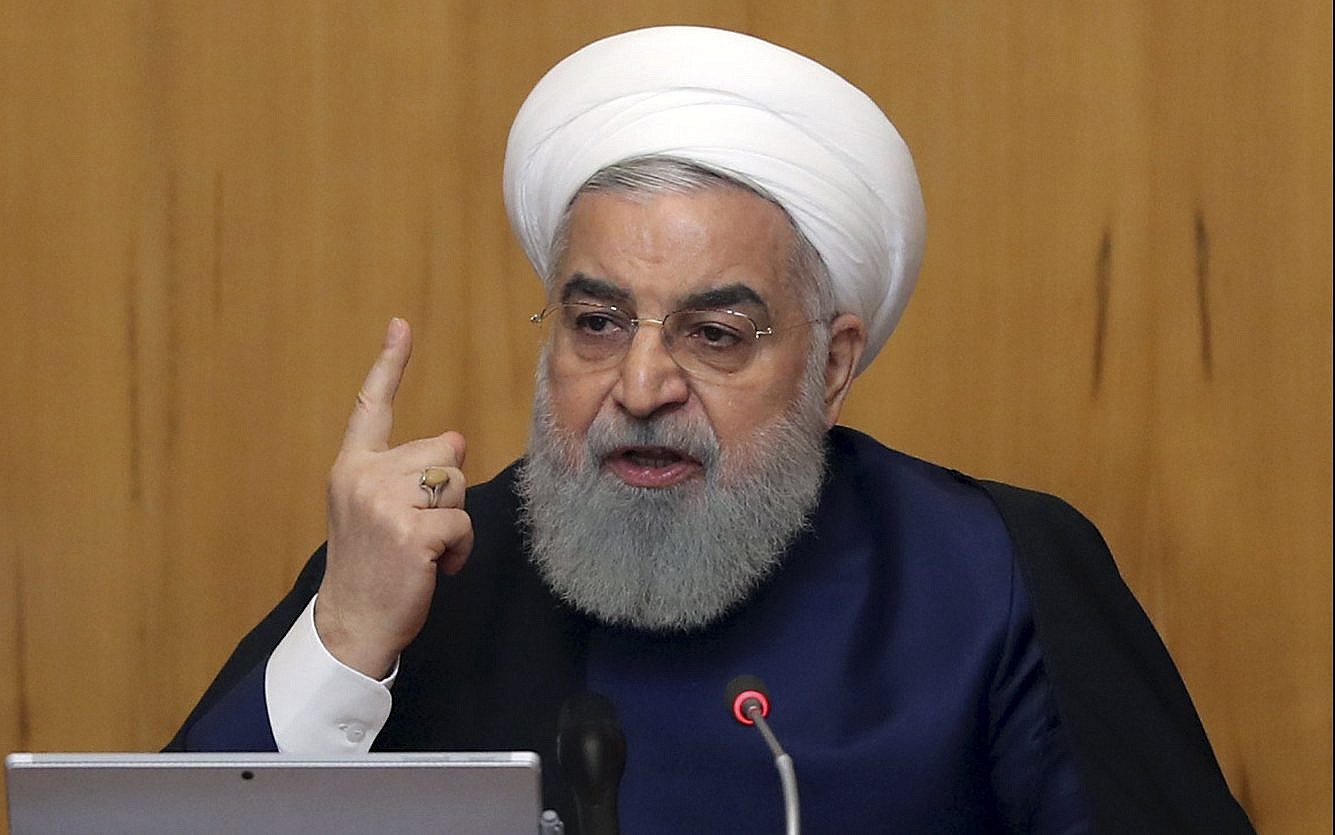
In this photo released by the official website of the office of the Iranian Presidency, Iran's President Hassan Rouhani speaks in a cabinet meeting in Tehran, Iran, May 8, 2019. (Iranian Presidency Office via AP)
TEHRAN — Iran’s president on Monday ruled out negotiations with Washington until it acts “normal,” after Secretary of State Mike Pompeo said the US is ready to talk to Tehran without preconditions.
“The party that has left the negotiating table, the party that has trampled the pact must return to a normal” behavior, Hassan Rouhani said in a televised speech.
“If the enemy truly realizes that the path it took was wrong, that will be the day to sit at the negotiation table and fix any issue,” the president added.
Tensions have spiked in recent weeks between Tehran and Washington, which last year pulled out of a landmark Iran nuclear accord and imposed tough sanctions on the Islamic Republic.
United States Secretary of State Mike Pompeo attends a news conference with German Foreign Minister Heiko Maas at the foreign ministry’s guest house Villa Borsig in Berlin, Germany, Friday, May 31, 2019. (AP Photo/Markus Schreiber)
But Washington’s top diplomat appeared to soften the US stance on Sunday, saying “we are prepared to engage in a conversation with no preconditions.”
Get The Times of Israel's Daily Editionby email and never miss our top stories
Washington is “certainly prepared to have [a] conversation when the Iranians will prove they are behaving as a normal nation,” Pompeo said in Switzerland, which represents Washington’s interests in Iran in the absence of bilateral relations.
Pompeo however gave no indication that lifting sanctions would be on the table.
On Saturday, Rouhani insisted that Iran would not be “bullied” into talks with the United States, saying “total respect” was needed for negotiations to take place.
Advertisement
Help us report truthfully on social media
As a multimedia journalist, my job is to take the quality, fact-based journalism produced by The Times of Israel newsroom and make it accessible across every platform — from Instagram posts to podcasts to short-form videos.
This is how many, especially young people, consume news these days. But misinformation is rampant on social media. Our team at ToI produces accurate, responsible short-form reporting on Israel and the Jewish world.
If you believe in the importance of factual social media journalism, please consider joining our reader support group, The Times of Israel Community. Your financial support is essential to sustain responsible multimedia reporting.
We’re really pleased that you’ve read X Times of Israel articles in the past month.
That’s why we started the Times of Israel - to provide discerning readers like you with must-read coverage of Israel and the Jewish world.
So now we have a request. Unlike other news outlets, we haven’t put up a paywall. But as the journalism we do is costly, we invite readers for whom The Times of Israel has become important to help support our work by joining The Times of Israel Community.
For as little as $6 a month you can help support our quality journalism while enjoying The Times of Israel AD-FREE, as well as accessing exclusive content available only to Times of Israel Community members.
Thank you, David Horovitz, Founding Editor of The Times of Israel


 Add ToI as a Preferred Source on Google