

Iran says EU not doing enough to save nuclear deal
Zarif calls on Europe to increase investment in country to preserve pact, as adviser to Khamenei blasts Europeans for ‘dubious contradictions’
 Add ToI as a Preferred Source on Google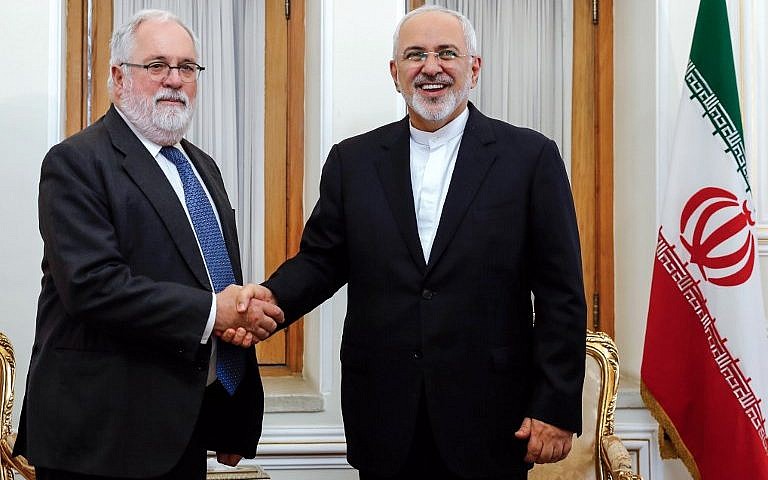
The Iranian foreign minister on Sunday said the European Union’s support for preserving 2015 nuclear deal was not enough to save the accord, calling on the bloc to strengthen economic ties with Iran.
“With the US exiting the [Joint Comprehensive Plan of Action], public opinion’s expectations from the European Union have increased to save the JCPOA’s achievements,” state-owned Press TV quoted Mohammad Javad Zarif as saying, using the official name of the deal meant to curb Iran’s nuclear program.
“The [European] Union must take more practical steps to continue its economic cooperation with Iran and boost its investment in Iran,” he added.
Zarif made the remarks during a meeting in Tehran with Miguel Arias Canete, the EU’s commissioner for energy and climate action.
“We have to preserve this agreement so we don’t have to negotiate a new agreement,” Reuters reported Arias Canete as telling journalists after meeting with Iranian officials.
“Our message is very clear. This is a nuclear agreement that works.”
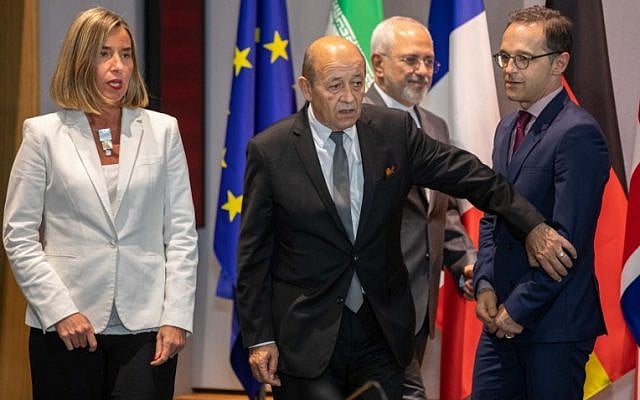
The so-called EU3 — Britain, France and Germany — have expressed their continued support for the nuclear deal since President Donald Trump said the US would leave the accord and reinstate sanctions, as have fellow signatories Russia and China.
Zarif has been on a diplomatic blitz since Trump’s May 8 announcement, traveling to Beijing, Moscow and Brussels in a bid to salvage the accord.
Despite the EU’s expressed commitment to preserving the deal, a top adviser to Iran’s Supreme Leader Ayatollah Ali Khamenei said Sunday that Europe is giving conflicting signals.
“They run with the hare and hunt with the hounds,” said Ali Akbar Velayati, according to the official IRNA news agency.
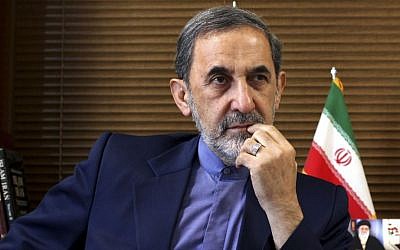
“Some of the EU members say they will remain committed to the Iran deal; others say they will enhance their economic relations with Iran,” he said. “Yet, there are some European officials arguing that they are not going to stand against the United States and provide [Iran with] guarantees.”
“The contradictions in what they say are dubious,” Velayati added.
Velayati’s comments came after a report said representatives of European powers will meet with Russian and Chinese officials in Vienna this week to discuss a new accord with Iran, in an effort to preserve the nuclear deal.
World powers plan to offer Tehran financial incentives in return for the Islamic Republic limiting its ballistic missiles program and expansionism in the Middle East — thus placating the US and avoiding the resumption of American sanctions, Reuters reported Sunday, quoting German newspaper Welt Am Sonntag.
EU officials later denied to Reuters that such a deal will be offered.
“The Vienna meeting next Friday will address the implementation issues and details of the JCPOA,” an EU source was quoted as saying. “The meeting will not cover any other issues.”
Iran has put the onus on Europe to save the accord and has threatened to resume industrial uranium enrichment “without limit” unless its interests are preserved by the remaining parties to the deal, which also include China and Russia.
After leaving the nuclear deal, Washington wants to move forward by offering to build a “coalition” to counter the multiple “threats” posed by the Tehran regime — but Europeans intent on saving the 2015 accord may thwart that effort.
US Secretary of State Mike Pompeo on Monday will unveil a new “diplomatic roadmap” for Iran — how America plans to “address the totality of Iran’s threats,” according to the State Department’s director of policy planning, Brian Hook.
Washington is looking to draft a “new security architecture and a better security framework, a better deal,” Hook told reporters ahead of the speech, the first major policy address by Pompeo since he became America’s top diplomat.
“The US will be working hard to put together a coalition,” State Department spokeswoman Heather Nauert said, flagging Washington’s bid for a multilateral approach after its unilateral withdrawal from the accord.

Trump has long trashed the deal with Iran — concluded under his predecessor Barack Obama, together with Britain, China, France, Germany, and Russia — saying it did not do enough to curtail Tehran’s nuclear ambitions.
The Republican leader also said it did not go far enough in restricting Iran’s ballistic missile program, or its intervention in regional conflicts from Yemen to Iraq and Syria.
“We need a new — a framework that’s going to address the totality of Iran’s threats,” Hook said.
So far, the guidelines of this new strategy are unclear.
The big unknown is whether European leaders, who were bitterly disappointed by Trump’s decision to ditch the deal, would be willing to return to talks with his administration any time soon.
The re-establishment of the US sanctions that were lifted after the Iran nuclear deal was signed will force European companies to choose between investing in Iran or trading with the United States.
The Europeans have tried to squeeze a little flexibility out of Washington to help out their firms, but to no avail.
By reimposing the sanctions, Washington aims to “bring economic pressure to bear on Iran,” Hook said.
“It was economic pressure that brought the Iranians to the table a few years ago.”
Agencies contributed to this report.



The Times of Israel Community.